
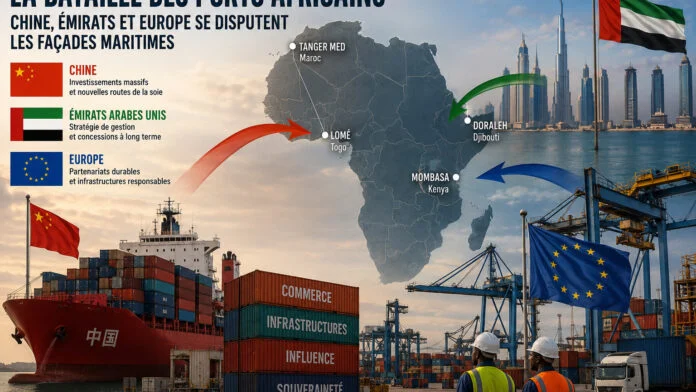
In twenty years, Beijing has built a global port network by combining loans, construction sites, concessions and mining corridors. In Africa, its influence is measured not only by the number of docks built, but by the control of all the logistics routes that lead there.
From Djibouti to Kribi, from Lekki to Morebaya, China has not simply built ports: it has settled successively on the nerve points of world trade. On the African continent, this strategy takes a particular form, far from the clichés of the brutal takeover. Rather, it is a patient network combining financing with exploitation, with direct access to raw materials in focus.
This advance is not done by proclamation, but by cranes, dikes, terminals and free zones. In two decades, Beijing has transformed a commercial opportunity into a geopolitical strategy: controlling maritime access means controlling an essential part of the movement of goods, minerals and, now, logistical data.
The movement is global. According to the AidData research laboratory, Chinese public actors injected nearly $24 billion in port financing between 2000 and 2025, affecting 168 ports in 90 countries. On all these projects, Beijing retains a form of shareholding or operational control in 35% of cases.
A global network strategy, from Piraeus to Hambantota
This deployment accelerated from 2013, with the launch of the « New Silk Roads« . The Council on Foreign Relations (CFR) lists 129 port projects abroad involving Chinese entities, of which 115 were fully active in mid-2024. A logical priority for the world’s second largest power, which carries out about 95% of its international trade by sea.
If Piraeus (Greece), where Cosco holds 67% of the port authority, has become the symbol of this breakthrough in Europe, the port of Hambantota (Sri Lanka) remains the most cited case study. In 2017, Colombo sold the commercial operation of the infrastructure to China Merchants Port Holdings through a 99-year lease, to pay off part of its debt.
These examples have fueled the « debt trap » thesis. Reality is often more nuanced. The Chinese right of way varies according to the land: it sometimes takes the form of a construction loan, an operating concession, or a minority but strategic participation. The challenge is not necessarily to own the entire port, but to hold the key terminal, the logistics area or the corridor connecting the dock to the mining hinterland.
Africa, laboratory of the « port-corridor »
It is on the African continent that this corridor logic appears most clearly. As early as 2019, the Center for Strategic and International Studies (CSIS) had already identified 46 African ports connected to Chinese interests. More than a direct property, this map draws a diffuse presence at the entrance doors of the continent.
AidData’s data places several African infrastructures among the most funded by Beijing: Caio in Angola, Abidjan in Côte d’Ivoire, Bata in Equatorial Guinea, Lekki in Nigeria, Nouakchott in Mauritania, Doraleh in Djibouti or Tema in Ghana. The port of Kribi, Cameroon, even ranks third in the world in Chinese port investments.
The Cameroonian case illustrates the complexity of the model. In Kribi, the container terminal is operated by a consortium associating the French CMA CGM and the Chinese CHEC. The Chinese company does not act alone, but its triple cap of builder, financier and operator, makes it the pivotal player of an infrastructure designed to decongest Douala and open roads to Chad and the Central African Republic.
In Nigeria, the deep-water port of Lekki marks another milestone. Having become one of the major hubs in West Africa, it has received a $629 million loan from the China Development Bank. The China Harbour Engineering Company conducted the work there before retaining direct shares in the operating company.
Djibouti: the strategic node of the Red Sea
Djibouti remains the most sensitive point of this network, in the heart of the Bab-el-Mandeb Strait. China Merchants controls 23.5% of Port de Djibouti SA, while the polyvalent terminal of Doraleh was financed by Eximbank of China before being connected to the new railway leading to Addis Ababa.
Djiboutian specificity is based on the immediate intertwining of trade, logistics and the military. The Doraleh terminal flanks the first military base of the Chinese navy abroad, opened in 2017. If every commercial investment does not automatically become the outpost of the People’s Liberation Army, this proximity reminds us that African ports now exceed the simple economic function.
The new frontier of critical minerals
In recent years, the development axis has been reoriented towards the supply of critical raw materials through the « mine-rail-port » triptych. The Morebaya project in Guinea, linked to the exploitation of the giant iron deposit of Simandou, is the most spectacular example. In December 2025, the first ships loaded with ore left the Guinean doch for China, realizing a billion-dollar rail and maritime infrastructure project.
It is at this level that influence becomes structural. A port is only the last link in a chain that integrates both telecoms and customs tracking software, energy networks or storage areas. At each stage, Chinese state subsidiaries make themselves indispensable, making the border between commercial interests and sovereign imperatives porous.
For African states, these projects respond to a glaring need for modernization, reduction of logistics costs and decongestion of maritime facades. But the political effects are evaluated over the long term. Faced with concessions spanning several decades, the question is to understand who concretely sets rates, manages traffic data and arbitrates docking priorities. In contemporary globalization, it is at this operational level, invisible and daily, that sovereign room for maneuver is redistributed.
source : afrik.com