Underwater photographer Zafer Kızılkaya hadn’t dived in the turquoise waters of Turkey’s Gulf of Gökova for 20 years. In 2008, when he returned to his home region, he found the seabed deserted: fish, crustaceans, sponges… everything had vanished. He rescued an abandoned female seal and embarked on a long quest to understand what was happening.
Accompanying the Wild, an evening debate in Geneva
Aboard the rigid inflatable boat sailing in the Gulf of Gökova, in southeastern Turkey, Zafer Kızılkaya and Kayhan Güçeli are about to delve into the memories of a childhood friendship. Around them stretch the turquoise waters of this immense promontory of the Aegean Sea, 100 kilometers long, guarded by the small fortified city of Bodrum, the ancient Halicarnassus. The place, with its idyllic coves fringed by lush forests, seems untouched by everything – and yet.
The two men met at the diving club of the prestigious Middle East Technical University (METU) in Ankara, the Turkish equivalent of EPFL, during their engineering studies. Their paths then diverged: the South Seas and National Geographic for the former, American pharmaceuticals and Chicago for the latter. They reunited 30 years later on the major project that now dominates their lives: the rewilding of Turkey’s southwest coast.
Groupers that survived
At my request, we came to visit one of the seven « no-take zones » in the Gulf of Gökova, known as Boncuk-Karaca, because it extends over the two neighboring bays of Boncuk and Karaca.
“The eastern Mediterranean is warming twice as fast as the western part. This is one of the main causes of ecosystem collapse,” Zafer Kızılkaya, in his diving gear, explains to me. He has just brought aboard about twenty temperature sensors placed on the seabed in the area, spaced every 5 meters and down to a depth of 40 meters. “Understanding the effects of warming is fundamental to conservation and restoration strategies for these habitats.”

As we head back, Zafer Kızılkaya and Kayhan Güceli discuss the numerous white groupers they saw during their dive. “Ten years ago, we hardly saw any ,” explains Kayhan Güceli. “ In areas where fishing is prohibited, like the one we’re in, we’re seeing their population increase again. In the case of the white grouper, this is all the more important because it’s a predator. Its return is a sign of a healthy ecosystem.”
A disfigured love
Other endemic species have returned to the no-fishing zones of the Gulf, such as grey sharks, which have returned permanently to the Boncuk-Karaca area, and other species prized by fishermen, such as red mullet, striped sea bream and dentex, these carnivorous fish with small sharp canines, considered a delicacy.
Zafer Kızılkaya couldn’t resist pointing out several cliffs that jut out on the other side of the vast expanse of water. « That’s where the monk seals find refuge, returning since we managed to get trawling and purse seine fishing (a large net deployed around entire schools of fish, ed.) banned throughout the bay. »
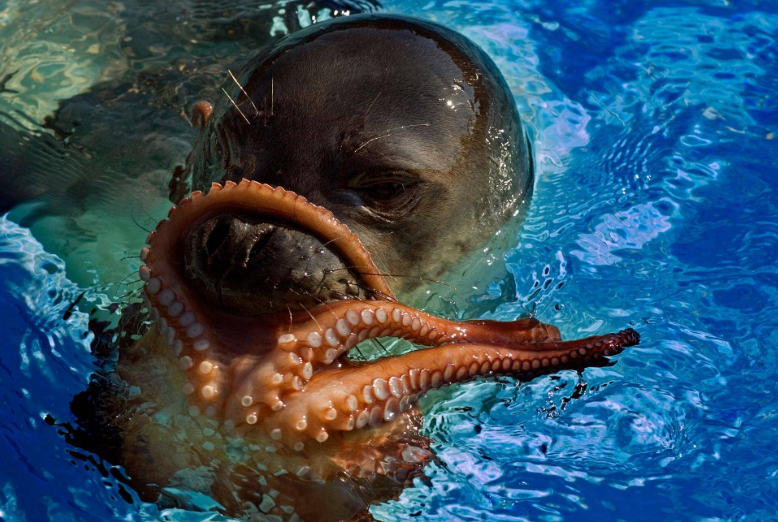
On his mobile phone, he shows me images from a camera installed in a cave where he has created a pebble ledge. They show a mother monk seal and her pup, born in 2024.
Monk seals captured by camera traps in one of the constructed caves in the Gulf of Gökova. | AKD, courtesy
Monk seals have returned to the Gulf, with the population increasing from two to eleven individuals between 2010 and today. Meanwhile, the Gulf has become the largest marine protected area in the Mediterranean: 268 square kilometers, roughly the size of Lake Garda. All of this is under the auspices of the Society for the Conservation of the Mediterranean ( Akdeniz Koruma Derneği , or AKD), founded by Zafer Kızılkaya in 2012, for whom this is a flagship project.
AKD’s story is one of awakening. At the time, the engineer returned to the region where his grandfather owned a house. It was there that he spent his entire childhood, exploring the deep blue sea with a mask and snorkel, and falling in love with it. But after spending 20 years exploring and photographing the seabed for National Geographic, from the Celebes Sea in Indonesia to the Line Islands in Polynesia, he found himself confronted with a childhood love that had been disfigured.
Badem the baby seal
“I came back in 2007 to visit friends and family in the area, and there was a monk seal stranded on the beach,” Zafer recounts after removing his drysuit. “I went to see her; she was a female, very small. She was orphaned, and we decided to take care of her.” He named the baby seal Badem, “almond” in Turkish.
A descendant on his mother’s side of the Rodos family, who owned Istanbul’s largest fleet before it was sunk by the British during World War I, Zafer is not only shrewd and empathetic, but he also understands the codes of Turkish high society. He picks up the phone and calls the wealthiest couple in the country: Mustafa Koç and his Levantine wife, Caroline, a graduate of St. George’s International School in Montreux, Switzerland. The couple immediately agrees to sponsor Badem’s protection.
Zafer then took a six-month break from National Geographic to build a rehabilitation center for the little female seal. “This allowed us to bring in experts from the Pieterburen Seal Nursery in the Netherlands. They have built up a large program with stranded grey seals, whose pups they feed. They came here so my little monster could grow up. And when the time was right, we released her into the Gulf of Gökova. It was the most pristine spot at the time, since the land area had been protected by the Turkish government in 1988.”
The special status of the Gulf of Gökova has allowed most of its coastline to avoid the type of tourist development seen further north, on the coast stretching from Bodrum, or further east, towards the major resort of Antalya. However, Turkish coastal law is limited to protecting coastal landscapes. The sea itself remains vulnerable.
Like after a nuclear winter
“I had returned to Indonesia and I didn’t realize what was happening,” Zafer Kızılkaya continued. “ And of course, our little solitary monk seal had become accustomed to humans. She constantly sought out human presence. One day, she crawled to a school to play with the children in the courtyard. There were several near-drowning incidents when she tried to approach swimmers. Mustafa Koç called me on my mobile phone and said, ‘You should come back.’”
Rocks where all the algae have been eaten by invasive rabbitfish. | Zafer Kızılkaya, courtesy
So Zafer returns. He gives up his dream job at National Geographic and, thanks to a $400,000 donation, builds a huge enclosure in a sparsely populated area of the Gulf to keep the monk seal during the summer.
“While I was taking care of her in the enclosure, I decided to go diving to see what was going on. What I saw was like after a nuclear winter. Like waking up one morning in Switzerland and there wasn’t a single tree left. There was no visible life left, and since it was underwater, nobody had noticed.”
The engineer’s speech quickened as he explained. « The fish, the sponges, the crustaceans… everything had disappeared. There wasn’t even any seaweed left on the rocks. But no seaweed? That’s impossible! If you have rocks, light, and the sea, you normally always have seaweed. »
Paper parks in the Mediterranean
Faced with this mystery, Zafer Kızılkaya picks up the thread of a thwarted vocation – as a teenager, he wanted to become a marine biologist, but his parents preferred the more secure path of a civil engineer. It must be said that his years spent in the Southern Ocean allowed him to rub shoulders with the leading researchers in marine protection and conservation.
“I called my team at National Geographic and told them that something very serious was happening in the eastern Mediterranean. They came and concluded that a thorough study was needed. We obtained funding from the Pew Foundation in the United States and conducted a large-scale study from Spain to Turkey on the state of rocky reefs in the Mediterranean.”
In the Gulf of Gökova, only the coastline was protected until the establishment of protected areas in the 2010s. | AKD, courtesy
This study will open his eyes to the true state of marine conservation in the Mediterranean. First, he will grasp the concept of protection, distinguishing between genuinely protected areas and what he calls « paper parks. » « Across the entire Mediterranean, 8.43% of the surface area is officially protected. But this covers very different realities, and many areas where no protective measures are implemented. The area actually protected represents only 0.06%! »
The Gulf of Gökova is an example of flawed legislation. “Here, the special protection zone established in 1988 aims only to preserve the beauty of the coastline. It’s very strict. New construction is prohibited, although some people get exemptions. But even to repaint your house, you need a permit. As a result, the landscape seems pristine. But that’s a false impression, because there was nothing there for the marine environment. Fishing was permitted everywhere, and illegal fishing was rampant.”
On this stretch of the Turkish coast, no-fishing zones are shown in green, and areas where trawling is prohibited are shown in hatching. | AKD, courtesy
In a region where fishing has been practiced since at least Minoan times – the southern cape of the Gulf of Gökova is the site of the ancient city of Cnidus, famous for having housed the first nude statue, the Aphrodite of Praxiteles – could modern overfishing be the cause of the nuclear desert observed by Zafer during his dives in 2008?
The answer to this question will lead him down a path that, far from pitting local fishermen against environmentalists, will become one of the keys to rewilding the Turkish coast. This will be the subject of the next episode : how to recruit local residents, instead of seeing them as obstacles.
source : heidi news