The proliferation of drones strengthens maritime surveillance capabilities while allowing malicious actors to disrupt global maritime transport, thus highlighting a critical flaw in the maritime safety architecture.
Increasing access to drones in the Western Indian Ocean (OIO) is transforming maritime safety in the coastal regions of East Africa.
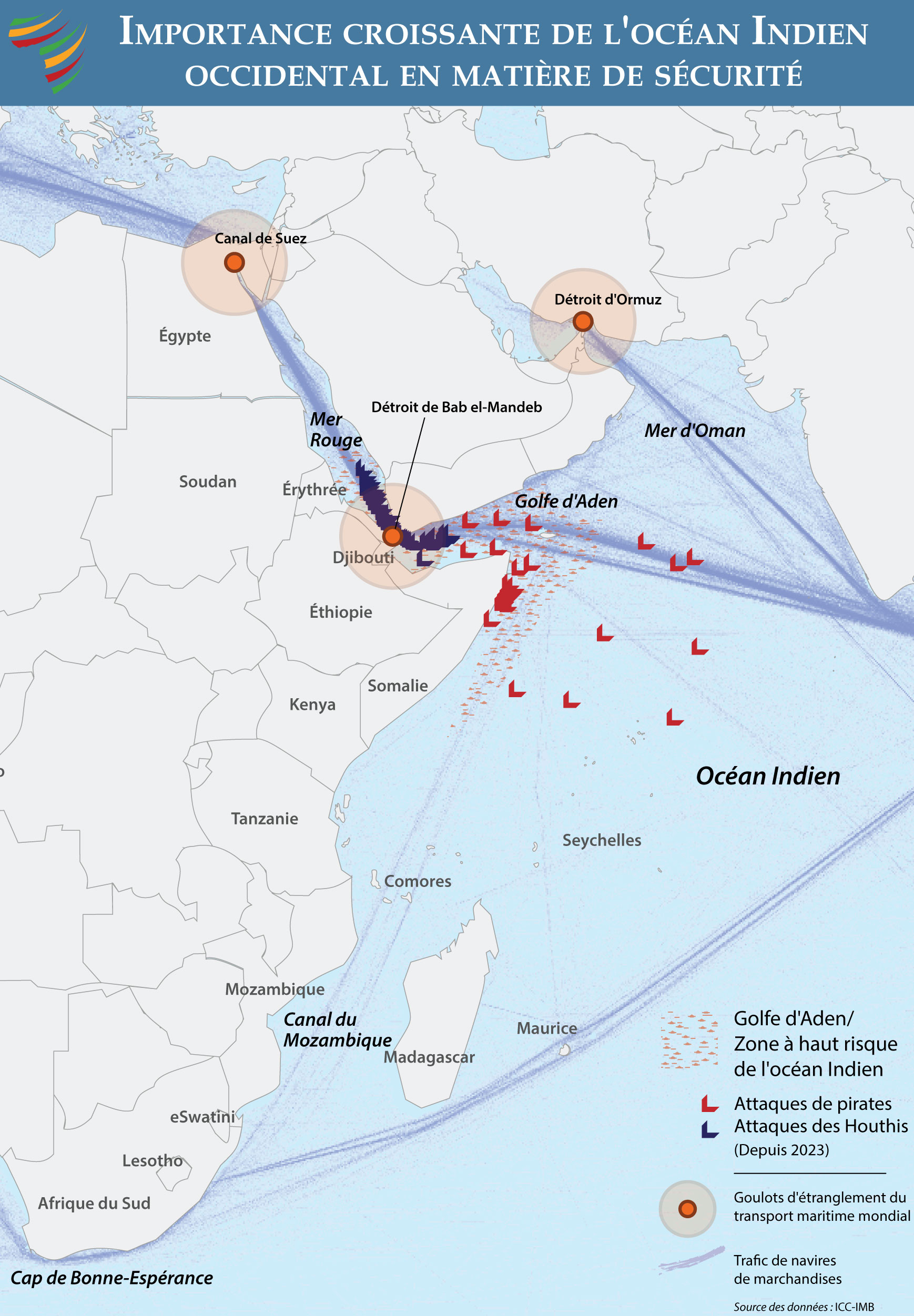
The western Indian Ocean is a strategically vital network of maritime corridors connecting world trade via bottlenecks such as the Bab al-Mandeb Strait, the Mozambique Canal and the routes bypassing the Cape of Good Hope. All of these corridors provide about a quarter of the world’s maritime traffic, making the region a hub for the global economy.
With the increasing accessibility of drones, the OIO is characterized by better visibility to counter threats, but also by limited means of control and significant legal gaps.
The IOO faces persistent maritime security challenges, including piracy, trafficking and illicit, unreported and unregulated (INN) fishing. In the Red Sea, Houthi activists based in Yemen have attacked commercial ships using naval surface missiles and drones, affecting more than 100 ships since the end of 2023. These attacks forced a diversion of maritime routes via the Cape of Good Hope, led to an increase in insurance costs and extended maritime transport deadlines. Shipping in the Gulf of Aden has also been the persistent target of attacks by Somali pirates.
These vulnerabilities are aggravated by the increasing accessibility of unmanned technologies. This proliferation redefines maritime safety in the region, transforming both operational practices and safeguarding sovereignty at sea. This transformation was clearly illustrated by global trade disruptions caused by maritime traffic restrictions in the Strait of Hormuz, where drones and other unmanned systems were used to target commercial navigation.
Drone-related maritime threats in a comparative perspective
| Region | Main actor(s) | Scale of activity | Modality | Implications for maritime safety |
|---|---|---|---|---|
| Red Sea and Gulf of Aden | Houthis Somali Pirates | Persistent and episodic climbing (more than 100 ships targeted since 2023) | Drones Anti-ship missiles Wandering ammunition | Disruption of maritime transit without territorial controlcoercive influence on international shipping routes |
| Black Sea | Russia Ukraine | Vast, in progress (more than 60 ships targeted since 2022) | Naval drones DronesSRI systems | Remote deprivation of maritime space erosion of traditional naval domination |
| Western Indian Ocean | Somali PiratesTraffikersFishing INN | Increasing (low to moderate intensity), in progress | DronesSRI systems | Progressive emergence of distributed surveillance and hybrid maritime security structures |
| Strait of Hormuz | Iran and its affiliated actors | Persistent and episodic climbing | Drone surveillanceharassment operations integration with naval means | Strategic control of bottlenecks Ability to threaten global energy flows without official closure |
Decentralized maritime operations: expansion and constraints
These developments bear witness to a change in the governance of maritime security. Maritime access is increasingly being exercised indirectly, through disruption, risk imposition and remote targeting, rather than through a permanent territorial presence. Drones play a central role in this transformation. Governments are deploying drones to improve knowledge of the maritime domain through continuous and inexpensive monitoring of vast exclusive economic zones (EEZs). This allows them to extend surveillance to large maritime areas, thus contributing to a model of decentralized maritime operations. In this evolving context, states are expanding their authority through persistent surveillance systems, integrated data and command networks, and information sharing architectures — rather than through physical deterrence. This model expands visibility and improves knowledge of the situation.
At the same time, drones strengthen the capacity of destabilizing actors to monitor, threaten and influence maritime activity without deploying conventional naval means. In other words, Somali pirates or Houthi activists do not need to maintain a naval presence in the Red Sea or in the Gulf of Aden to pose a threat. Rather, they need to pose a credible risk to maritime traffic in order to disrupt it — and thus advance their financial or political objectives.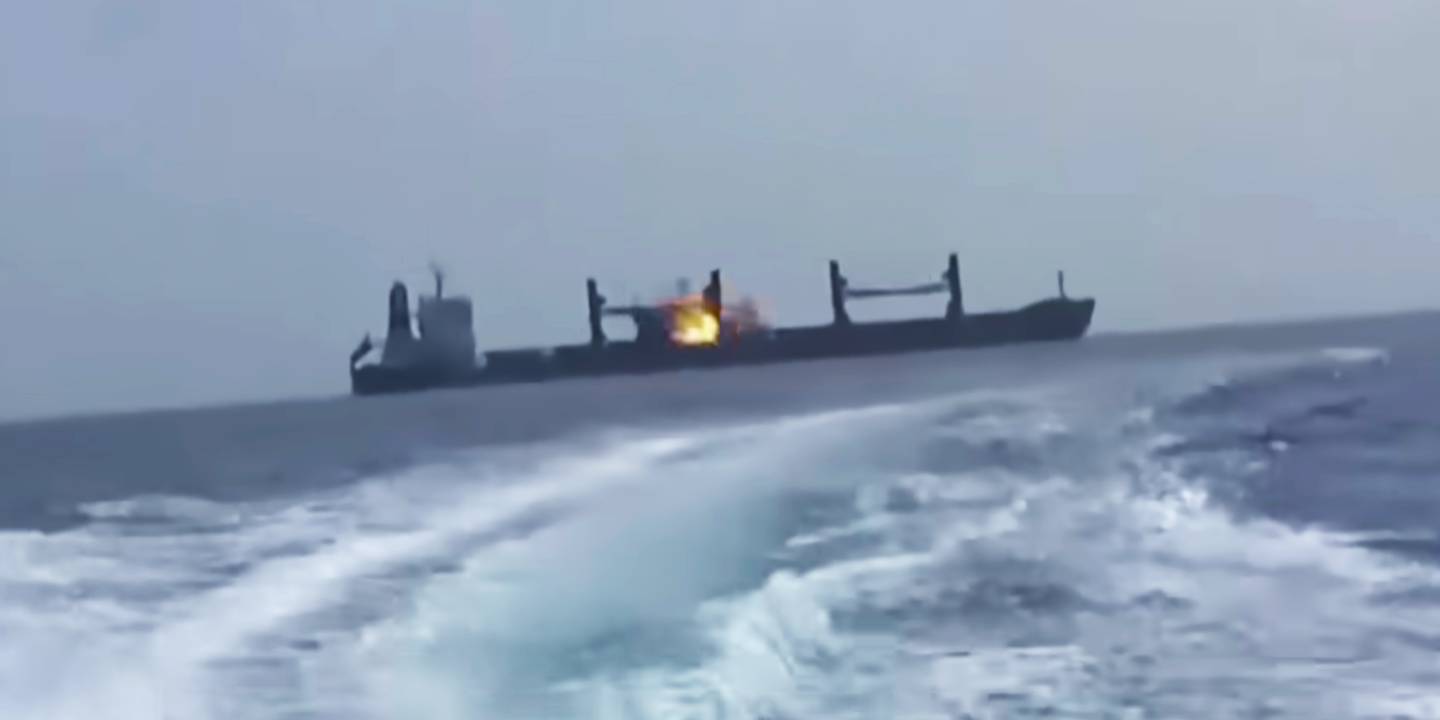
The Magic Seas cargo ship, flying the Greek flag, attacked by the Houthis in the Red Sea, July 2025. (Photo: screenshot)
The increased use of drones in the field of maritime safety is therefore a double-edged sword. While it allows governments to expand their surveillance and control capabilities, it simultaneously strengthens the ability of malicious actors to conduct reconnaissance missions, coordinate attacks and target ships directly.
If the surveillance capacity of maritime territories is extended, the application of the law remains subject to physical presence and legal remedies. Decentralized maritime operations are therefore inherently limited.
A defining feature of the deployment of drones is the structural separation between detection and law enforcement. This results in a system in which the detection exceeds the reaction capacity.
This duality reflects a broader transformation in the way in which authority over maritime space is exercised. Historically, the protection of maritime spaces depended on a physical presence — naval patrols for a visible application of the law. Drones modify this model by allowing remote authority to be exercised through distributed data, networks and detection systems.
A key feature of the deployment of drones in the Western Indian Ocean is the structural separation between detection and law enforcement. While drones allow continuous surveillance and rapid intelligence production, law enforcement remains dependent on naval and coast guard resources, limited by geography, resources and coordination.
This results in a two-speed system in which the detection capacity exceeds the reaction capacity. Disruptive actors exploit this imbalance, operating in very short time limits that limit the effectiveness of interception measures.
To fill this gap, it is necessary to integrate surveillance systems with control capabilities, legal authority, evidence frameworks and institutional coordination capable of completing the control cycle.
Legal framework and gap between law and policy in drone operations
Drone operations in the Western Indian Ocean are governed by a disparate set of international air laws, maritime law and national regulations. A key feature of this framework is the relationship between the 1944 Convention on International Civil Aviation (Chicago Convention) and the 1982 United Nations Convention on the Law of the Sea (UNCDM). The Chicago Convention establishes the principle of complete and exclusive sovereignty of the state over its national airspace. Section 2(1) of the UNCNDM states that the sovereignty of a coastal state over its territorial sea extends to the airspace that overlooks it. At the same time, the UNCTDM delimits the maritime areas as well as the rights and jurisdiction attached to them.
Read together, these instruments form an interdependent and vertically structured regime. The UNCDM defines the spatial scope of maritime jurisdiction, while the Chicago Convention — in conjunction with the general principles of air law — governs the legal regime applicable to the above-mentioned airspace.
Click here to get a printable PDF version
This interaction is particularly evident in territorial waters, where coastal states exercise their sovereignty over both maritime and airspace, which requires authorization for drone operations. In the EEZs, coastal states have sovereign rights over resources, while other states retain freedom to navigate and fly— although the scope of these freedoms, especially for drone intelligence, surveillance and reconnaissance (SRI) missions, remains contested. On the high seas, the concept of state sovereignty does not apply. Drone operations are generally authorized under the freedom of overflight, subject to respect for the rights of other States.
Overall, the drones operate within a vertically integrated jurisdictional space, defined by UNCMUD and the Chicago Convention. However, their hybrid and remote-controlled nature can create legal ambiguities and complicate the processes of award, proof and enforcement. This is part of a wider structural gap between law and politics, in particular the limited « judicial outcome« . The « judicial outcome » refers to the formal judgment of law enforcement measures, ensuring that activities detected and prohibited give rise to prosecution or administrative sanctions supported by admissible evidence. It represents the last step in the chain of law enforcement, linking criminal actions to justice.

In practice, the chain of law enforcement is often incomplete. The attacks in the Red Sea and in the Gulf of Aden highlight this gap. Attacks on ships are observed and sometimes countered, but legal responsibility remains unequal. This reflects persistent challenges in terms of jurisdiction, attribution, chain of preservation of evidence and institutional coordination between operational and judicial actors.
Drones also pose legal challenges in terms of accountability assessment. Distributed systems distribute responsibility among multiple actors. This often requires faster (and therefore less rigorous) decision-making and excessive use of technology to make these decisions, which complicates attribution and accountability.
While UNCTD and the Chicago Convention together establish a fundamental legal architecture, they do not fully address the operational realities of drone surveillance and unmanned maritime activities.
Effective maritime control therefore depends not only on legal frameworks, but also on the integration of the SRI, physical enforcement capabilities and judicial mechanisms capable of completing the enforcement chain. In this way, the legal component complements the need for a sustained naval presence and coordinated maritime governance.
Go to the end of the law enforcement cycle
Experiments conducted in the Red Sea and in the Strait of Hormuz show that drones are redefining maritime safety throughout the western Indian Ocean and its communication corridors. These technologies allow decentralized maritime operations by extending the SRI and indirect control through the disruption.
The essential task of policy makers is to ensure that maritime governance systems can complete the full cycle of law enforcement, from detection to judicial outcome.
However, this transformation remains incomplete. The central challenge is not simply technological or legal in itself, but systemic: the inability to integrate detection, law enforcement and judgment into a coherent framework. This is one of the objectives currently being examined by the 22 member states of the Djibouti Code of Conduct coalition, which aims to strengthen maritime governance and cooperation on regional security in the Western Indian Ocean.
In the context of the Western Indian Ocean, the anti-piracy prosecution frameworks developed during the Somali piracy crisis — including Kenya’s transfer and prosecution agreements — offer an instructive model of judicial outcome to address the enforcement challenges of drone-backed maritime security operations. In 2009, the Government of Kenya and the European Union established the conditions and arrangements for the transfer to Kenya of suspected piratesh held and property seized by the European Union-led naval force (EUNAVFOR) for prosecution and trial.
The Kenyan framework shows how the problem of judicial denouement can be solved by a combination of universal jurisdiction under UNCMU, bilateral transfer agreements and national legal reform. Kenya has strengthened its maritime legal regime by integrating internationally recognized definitions of piracy and by extending its competence to offences committed beyond its territorial waters. More broadly, the example of Kenya shows that maritime interceptions carried out in African waters can lead to viable prosecutions.
While such mechanisms will need to be adapted to integrate drone-specific prosecution or evidence frameworks in the Western Indian Ocean, relying on existing maritime legal architecture offers transferable legal design principles to bridge the gap between interception and prosecution.
Drones exposed in the back of a truck during a Houthi military parade in Sanaa, Yemen, on September 21, 2023. (Photo: AFP/Mohammed Huwais)
With the increasing accessibility of drone technologies, the Western Indian Ocean is characterized by increased visibility to counter persistent threats, although with limited means of application and significant gaps in judicial outliations.
Without additional improvements in physical enforcement capabilities, coordinated institutional response and effective legal follow-up, maritime security operations may be limited to disruption rather than a resolution.
The essential task for policy makers is therefore not only to use drones to expand intelligence, surveillance and reconnaissance (SRI) capabilities, but also to ensure that maritime governance systems can complete the entire cycle of law enforcement — from detection to interception, through judicial proceedings — which is essential for effective and legitimate control of the maritime domain.
source : africa center