

This is the first time creatures have been observed in the tiny caves located below the ocean floor.
Animal life also flourishes below the ocean floor, according to a study published in 2024 on deep-sea hydrothermal chimneys that suggests that these enigmatic underwater formations are home to complex ecosystems.
If previous research had highlighted the presence of microbes under the ocean floor near hydrothermal chimneys, this is the first time that larger animals, such as worms and snails, have been discovered within this underground habitat.
Hydrothermal chimneys are cracks in the seabed where tectonic plates meet and where seawater mixes with magma formed under the earth’s crust. The ocean floor is generally considered to be almost uninhabitable, but near the hydrothermal chimneys life is teeming.
Communities of shrimp, crabs, tube wors, mussels and hundreds of unique animal species have already been discovered near these chimneys, but never below. These forms of life are called « extremophiles » because they can survive extreme temperature and pressure conditions. These organisms do not survive thanks to the energy of the sun, the fuel of the trophic network everywhere else on Earth, but by absorbing nutrients produced when seawater mixes with magma.
The seabed remains for the most part a mystery to scientists. Indeed, we have only mapped 26% of them, and the present study suggests that they could be more populated than scientists thought.

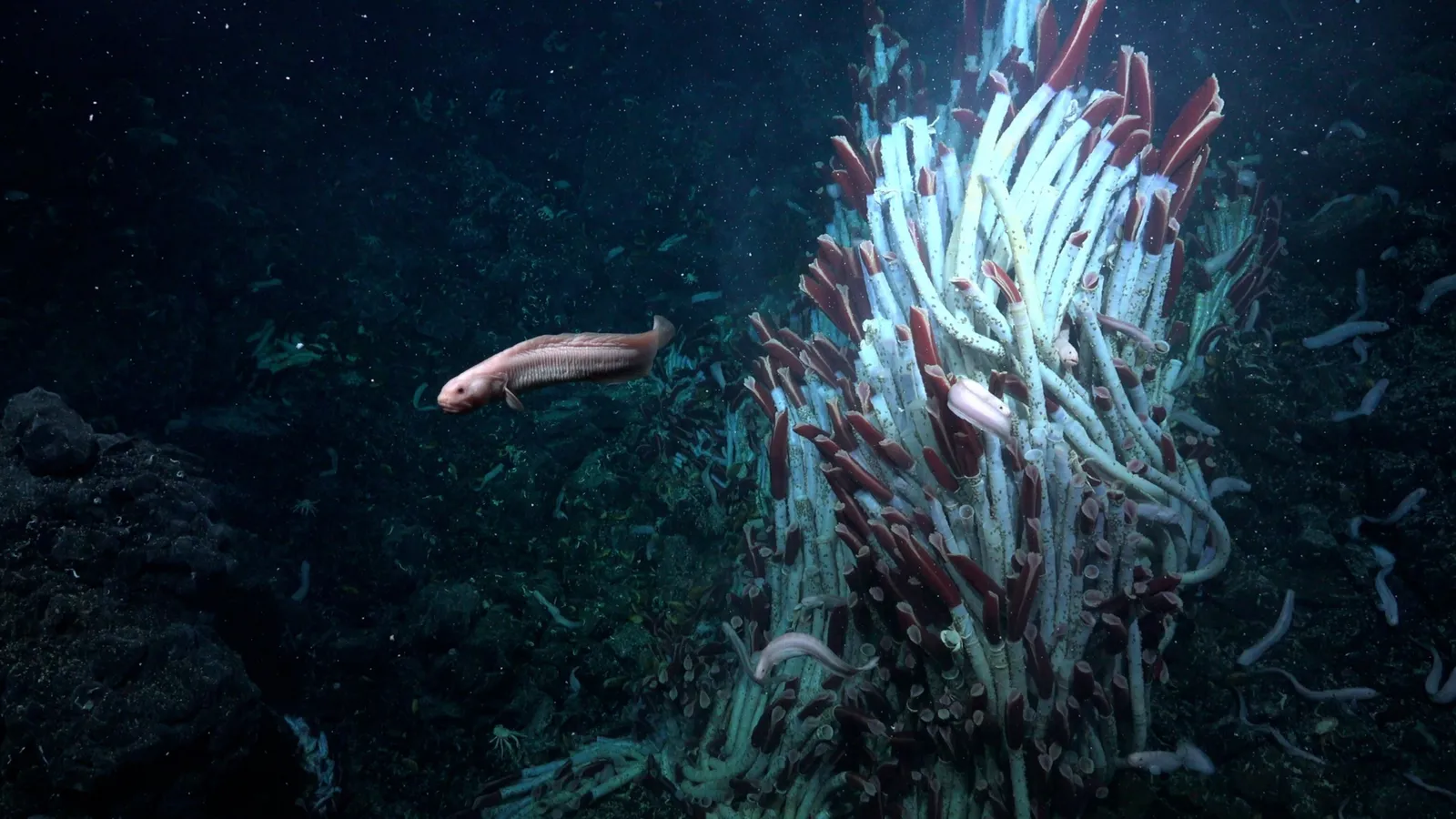
Under this sample of rocky crust were hidden specimens of tubical torms of the species Oasisia and Riftia, among other organisms. PHOTOGRAPH BY MÓNIKA NARANJO-SHEPHERD, SCHMIDT OCEAN INSTITUTE
« Each [new] study only confirms everything we still don’t know about the ocean floor, » says Rachel Lauer, a geologist at the University of Calgary who did not participate in this research.
AN UNEXPECTED DISCOVERY
Seeking to understand how tubular wors lodge in hydrothermal chimneys, marine biologist Sabine Gollner and her research team from the Royal Netherlands Marine Research Institute (NIOZ) went by boat to the East Pacific Ridge, an active volcanic ridge located on the floor of the Pacific Ocean, in July 2023. On site, during several missions, they took a remotely controlled robot down to a hydrothermal chimney located 2,515 meters below the surface.
Their goal was to collect rock samples to look for the presence of tubeworm larvae, but the rock could not be easily broken into small transportable pieces. The robot, equipped with arms and a camera, therefore had to lift sections of ocean floor to reveal what was underneath: tubel worm larvae and much more.
By turning rock sections of the ocean floor, he unearthed cavities about ten centimeters deep filled with hot fluid (water mixed with magma) and species that had until then only been discovered on the ocean floor: tubic worms, polychetes and sea snails.
The discovery of tubicle lorm larvae and adult tubical lorms living in tiny caves could greatly advance our knowledge about their life cycle. According to the researchers, tubical worm larvae could disperse in the cavities, some settling and developing in ocean floor cracks and others remaining in the cavities and developing there until adulthood; this would mean that the ocean floor and the small caves below form an interconnected ecosystem where flows of cold water and hot water meet and facilitate the growth of tubeworms.

Large clusters of tubular verms on the East Pacific ridge, at a depth of 2,500 meters. Using a robot adapted to the deep sea, researchers dug under the hydrothermal chimneys and unearthed a series of underground chambers used as tubical worm innaries as well as a conduit allowing their larvae to move between the chimneys. PHOTOGRAPH BY ROV SUBASTIAN, SCHMIDT OCEAN INSTITUTE
« The ecosystem of [hydrothermal] chimneys in this area is not limited to what we see above, it also includes the life of the basement, » explains Sabine Gollner.
According to scientists, to preserve these unique extremophiles, a larger part of the ocean floor must be legally protected. But this could be difficult, because many of these ecosystems also contain rare minerals on which new technologies can depend.
PROTECTING THE LIFE OF THE SEABED
One of the main threats to deep-sea ecosystems is their mining, a process of extracting mineral deposits on the seabed, cobalt or nickel for example, which is opposed by scientists and environmental protection organizations.
« We do not know the extent of these small connected caves, we have no idea of all the biodiversity or biomass actually present under the ground, » warns Rachel Lauer. There is a completely different stratum here, literally! «
According to her, since the ecosystems of the ocean floor are probably interconnected, large parts of them must be protected.
« We must at least understand what is there before potentially destroying these habitats, » warns Heather Olins, a biologist at Boston College who did not participate in the study.
According to Sabine Gollner, it is not known exactly how deep this underground habitat extends, nor how far it stretches horizontally, crucial information to protect the hydrothermal chimney system in its entirety beyond the only visible part of the chimney.
The study of hydrothermal chimneys and their preservation for future research can also help scientists understand living conditions elsewhere than Earth.
« If there is life outside the Earth within our solar system, it will not be sustained by solar energy, » says Heather Olins, because nowhere else in our solar system has surface conditions conducive to life as we know it.
But there are places that could be home to extremophiles, such as Europe, one of Jupiter’s moons, which is home to an ocean under its ice crust.
« We know that there is volcanic activity, and an ocean, » explains Heather Olins. There is no reason why there is no existence elsewhere in our solar system of life similar to that which develops in hydrothermal chimneys. «
source : national geographic


