
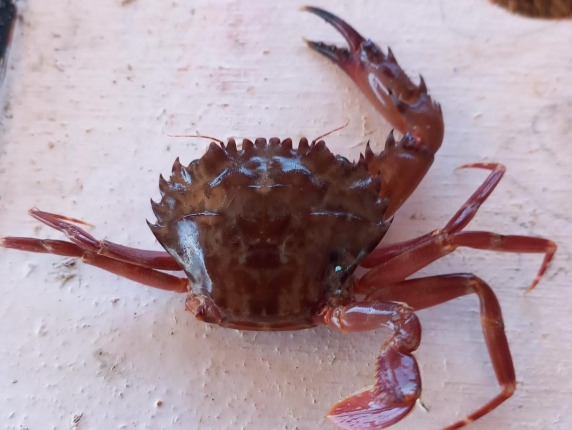
The specimen found in Portopalo is the westernmost discovery ever recorded.
The risks to native biodiversity—already threatened by the blue crab and other invasive species arriving from different seas and oceans—are increasing.
A new discovery in the heart of the southern Mediterranean further reveals how the effects of climate change are evolving, with growing risks for biodiversity. For the first time in Italian Mediterranean waters, Gonioinfradens giardi, a small crab native to the Red Sea and the Indian Ocean, has been identified. The specimen was found in Portopalo di Capo Passero, the southernmost point of Sicily (and a hotspot of biodiversity), confirming the island’s central role as a frontier zone for ecological change in the Mediterranean.
The announcement was made by the Department of Biological, Geological and Environmental Sciences at the University of Catania, where researcher Francesco Tiralongo—one of Italy’s and Europe’s leading experts on marine biological invasions—conducted the morphological analysis alongside biologist Paola Leotta. The crab specimen is a female, recovered alive in a trap placed at a depth of 10 meters. It was delivered by professional fisherman Alfonso Barone, a long-standing collaborator of the citizen-science project AlienFish, coordinated by Tiralongo himself. The project is based on a harmonious and synergistic interaction between scientists and fishermen—a practical and rational vision of science that enables citizens to contribute to scientific research, with positive social and ecological effects.
Sicily is thus confirmed as the Mediterranean’s frontline of change. This finding represents the westernmost documented occurrence of Gonioinfradens giardi in the Mare Nostrum to date. Exotic species can alter the balance of coastal ecosystems, compete with native species, and affect food webs and community dynamics. This discovery highlights the important contribution Sicily provides to international research on marine biodiversity. The University of Catania’s team, already recognized for pioneering studies on biological invasions, collaborates with networks of researchers across the Mediterranean.
The full study will be published in 2026 in the international scientific journal Mediterranean Marine Science. Gonioinfradens giardi was first observed in 2010 in Rhodes and has since spread across different areas of the eastern Mediterranean. Its presence in Italian waters indicates that the westward expansion process is now underway—and may be more advanced than currently known.
To better understand the situation, we asked Professor Francesco Tiralongo for his comments:
“Sicily is a natural platform for observing Mediterranean changes in real time. Many tropical species entering through the Suez Canal find ideal conditions to settle along our coasts. Identifying them quickly is essential.”
Tiralongo adds: “The similarity of Gonioinfradens giardi to native crabs in the Portunidae family also suggests that the species may have been present for longer, but often mistaken for similar taxa.”
But what is the ecological impact of exotic species? Tiralongo explains:
“Exotic species can alter the balance of coastal ecosystems, compete with native species, and modify food webs as well as community dynamics. It is not yet clear what role this new crab will play on Sicilian seabeds, but our experience with other introduced species—such as the recently exploding American blue crab—requires maximum attention.”
Are we witnessing a tropicalization of the Mediterranean?
“The Mediterranean is now one of the seas most vulnerable to new species arrivals, due to the opening of the Suez Canal, maritime traffic, and warming waters. Sicily, because of its geographic position and habitat diversity, is among the most exposed regions—but also among the most active in research and monitoring.”
The Sicilian scientist leaves no room for doubt:
“Our island is on the front line. Studying these transformations is not just about documenting new presences, but about understanding how the Mediterranean is evolving and how we can manage this future that has already arrived.”
We must be aware of the situation: institutions at all levels need to take note and begin rational and pragmatic planning with a multidisciplinary approach. There is a considerable wealth of scientific knowledge, and powerful collaboration between researchers and citizen fishermen. These are the starting points for developing large-scale projects to protect marine ecosystems. The issue is ecological, social, economic, and cultural.