

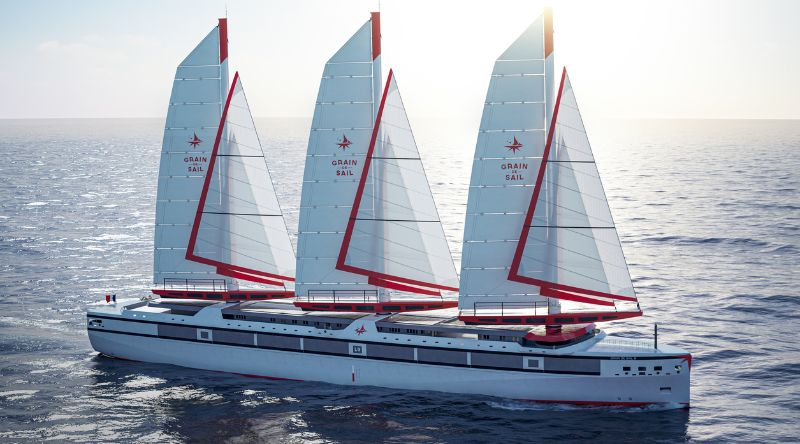
Grain de Sail has unveiled its new project: a 570 TEU sailing container ship. Before construction begins, Grain de Sail is securing its capacity for the transatlantic market.
After Grain de Sail 1 and Grain de Sail 2 , the Morlaix-based shipping company is now turning its attention to containers . « We have created a shipping company whose unit of cargo is the pallet. Our new project aims to enter the containerization market , » explains founder Olivier Barreau.
A 570 TEU capacity vessel
Thus, two years after the announcement of Grain de Sail 2, the shipping company continues its growth. The Grain de Sail 3 project aims to build a sailing container ship . It will be a 162-meter-long, 26-meter-wide vessel with a carrying capacity of 570 TEU . It will have a sail area of 7,000 m².
Rigging to withstand all weather conditions
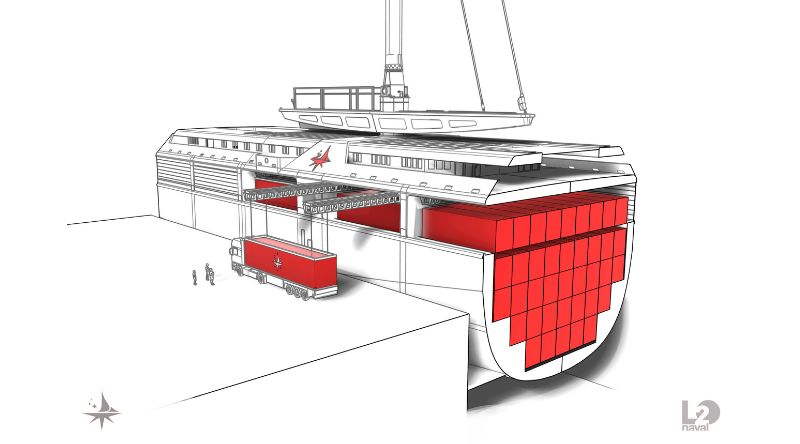
The technical aspects of this project were designed in partnership with Chantiers de l’Atlantique . They developed a research and development structure specializing in sailing vessels, Solid Sail. To support this rig, the mast bases had to be redesigned to withstand the most extreme winds. The sailing vessel boasts exceptional dimensions, with a mast height of 89 meters. « The masts are partially retractable to pass under bridges, » explains a representative from Chantiers de l’Atlantique. Loading operations are carried out using a self-unloading system. This innovation allows the vessel to operate in any port without the need for cranes or gantries .
Contractualization before the start of construction
The ship is still in the planning stages. “For the construction of Grain de Sail 1 and Grain de Sail 2 , we invested our personal fortune. Grain de Sail 3 is on a whole other scale, and we don’t have the funds to start construction,” explain the two Barreau brothers, Olivier and Jacques. So, they are now entering a “pre-commercialization” phase. The Grain de Sail teams are beginning to contract for space on board. “Once we have contracted 60% of the ship’s capacity, we will begin construction.”
Marketing is now open to commission agents
The commercial process is carried out with GDS Shipping (GDSS) and GDS Logistics (GDSL). Contract negotiation is handled by GDS Logistics on behalf of GDS Shipping. This solution offers freight forwarders the opportunity to load containers onto the vessel. GDSL’s role as freight forwarder was involved in marketing operations for the Grain de Sail 2. « Therefore, with Grain de Sail 3, freight forwarders will play a significant role, » confirms Loïc Briand, Managing Director of Grain de Sail Logistics.
An offer on the Transatlantic
The ship will be on a transatlantic route . It will operate services between Northern Europe, New York, and the hub of Guadeloupe . Grain de Sail 3 will make six round trips per year. Along with other ships, notably Grain de Sail 2, the Morlaix-based shipping company will offer one departure per month. « It’s with frequency and regularity that our service will be attractive, » says Loïc Briand.
To be different from the containerized offering
Thus, Grain de Sail is entering a competitive market. Currently, freight rates between Rotterdam and New York are around $958, according to Drewry . « The increase continues slightly, » Upply indicates in its June barometer. For Grain de Sail, this cannot be achieved in the same way. « Our rate will not be aligned with the economies of scale that ships operating on the transatlantic route can offer, » continues Olivier Barreau. The service is positioned at a different level. And the director of GDSL is looking to position his offering on unique routes. « We are analyzing the current offerings. We want to be able to offer logistics solutions between ports that do not have direct connections. »
Avoid fluctuations in oil prices
“Our solution offers decarbonized transport that avoids the fluctuations of oil prices.” To become competitive in this market, Grain de Sail managed to lower costs by building a larger-than-expected vessel. Furthermore, it has reefer plugs to transport all types of goods. “Currently, shipping operators don’t pay for the externalities of transport, such as environmental damage. The upcoming IMO regulations on decarbonizing maritime transport reinforce our approach.” Indeed, by 2030, ships must reduce their CO2 emissions by 40% compared to 2008. By 2040, this reduction must reach 70%, and by 2050, 100%. “That’s just around the corner!”
Benefit from aid and the ETS
To continue its venture, Grain de Sail is relying on its commercial relationships. However, the company has already received support from French government agencies such as ADEME and BPI. Furthermore, the law on sailing vessels, adopted on May 18th by the National Assembly, offers tax incentives. Finally, Olivier and Jacques Barreau are seeking a share of the funding from the European ETS (Emissions Trading System). « We will know how to position ourselves to promote our approach. The government is taking responsibility and understands that our sector needs a boost. »
source : Ports and corridors