

His name is not mentioned once in the document, but is on everyone’s mind: the European Union unveiled its major strategy for the Arctic on Tuesday, nine months after Donald Trump’s threats against Greenland.
In this region coveted by the United States, Russia or China, Europe must strengthen its strategic posture
, stressed European Commission President Ursula von der Leyen.
At the European Parliament in Strasbourg, the leader insisted by name on the threat of Russia, which is strengthening its military presence
in this key area.
But Europe has not forgotten Donald Trump’s desire to seize Greenland, an autonomous Danish territory shaken by the thunderous statements of the American president in early 2026. Open in full screen mode
US President Donald Trump’s intention to annex Greenland caused a strong reaction at the beginning of the year. In this photo, demonstrators protest in front of the United States consulate in February. (Archive photo)
PHOTO: GETTY IMAGES / SEAN GALLUPELSEWHERE ON NEWS: The PQ grants victory to the conservatives in Champlain
Certainly, tensions have fallen since the agreement signed in September by Denmark, the United States and Greenland, which ends the crisis, at least for the moment.
But Europeans want to prevent such an episode from happening again.
The sovereignty, territorial integrity and the rules that have guaranteed the stability of this region can no longer be taken for granted.A quote from Ursula von der Leyen, President of the European Commission
With its new strategy, the European Union (EU) therefore intends to:ADVERTISING
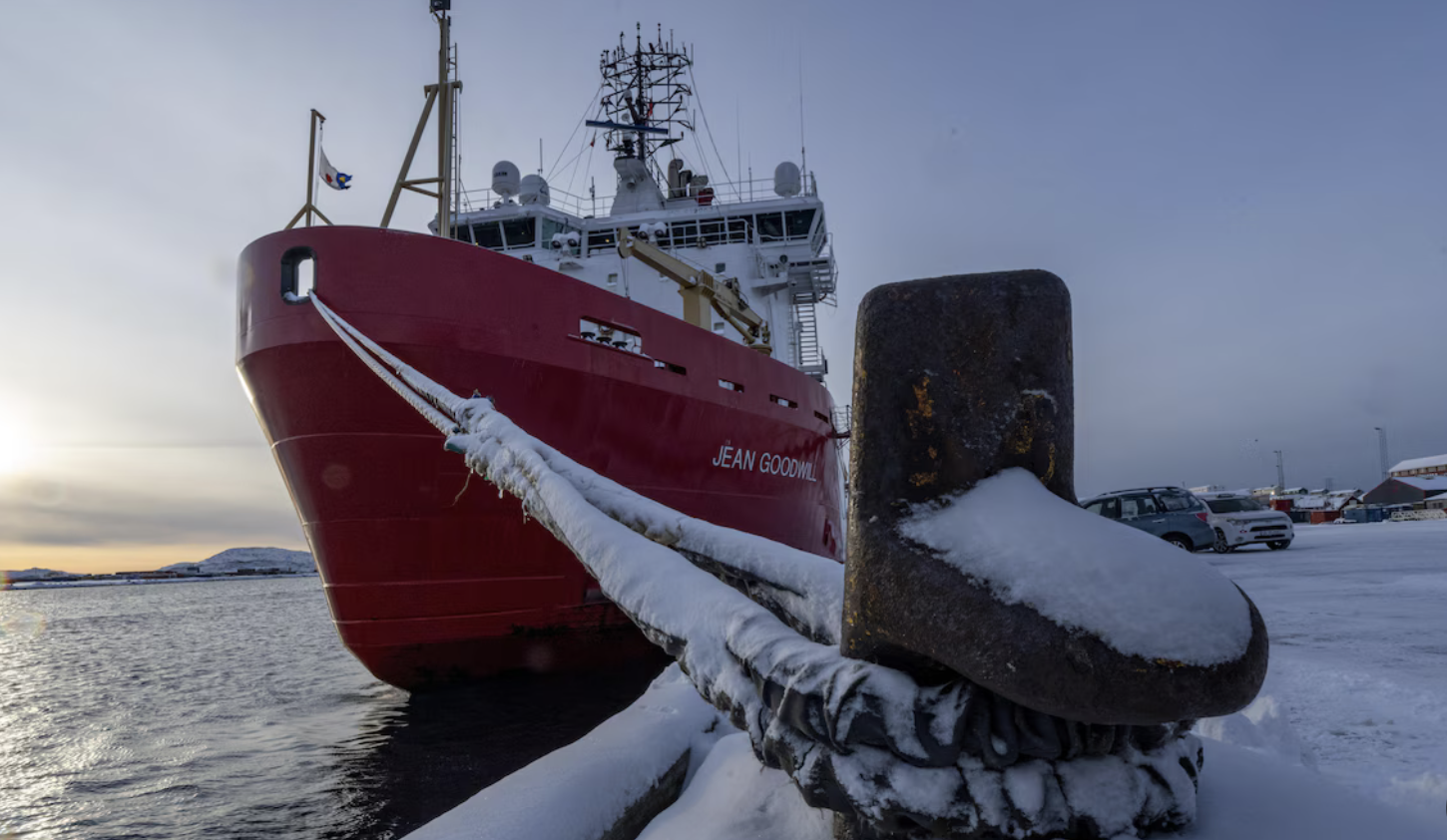
- Strengthening the European fleet of icebreakers, these essential ships for sailing on increasingly strategic roads
- Strengthen its surveillance system to better detect ghost fleet ships
- Long-term, connect Europe to Japan via a cable for submarine communications through Greenland and Canada (the United States is not mentioned)
Without additional funding
However, no additional funding is provided for in this document.
Ursula von der Leyen had already announced 200 million euros for Greenland during her visit to the Danish autonomous territory in early September.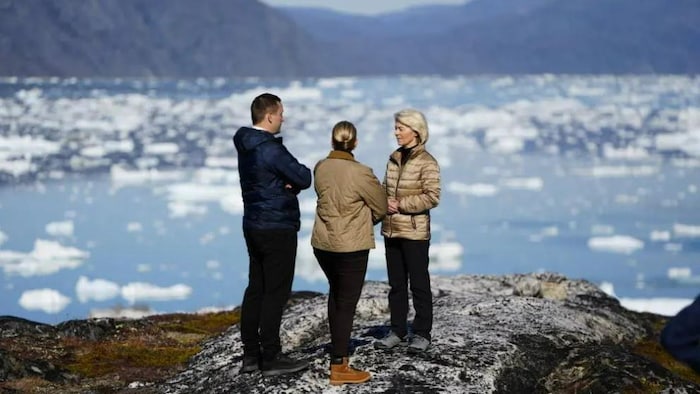 Open in full screen mode
Ursula von der Leyen (right), President of the European Commission, with Greenland’s Head of Government Jens-Frederik Nielsen and Danish Prime Minister Mette Frederiksen, in Greenland on 6 September 2026.
PHOTO: AFP / MADS CLAUS RASMUSSEN / RITZAU SCANPIX
Greenland intends to use the new European funds to participate in the development of concrete projects, such as the development of better Internet access.ADVERTISING
Brussels hopes to take the opportunity to diversify European access to critical raw materials – so far closely linked to China.
The European strategy also advocates strengthening cooperation with countries that are not members of theEUsharing the same objectives, as Canada, the United Kingdom and Norway.
Europe also proposes to organize a regular summit bringing together the partners of the northern neighbourhood
.
The United States is among the countries likely to participate.
Donald Trump’s America, long a key ally in the region, is noted by its absence in the rest of the document.
No drilling
The Arctic is also at the heart of the European Union’s environmental concerns.
According to experts, the region is warming almost four times faster than the world average under the effect of climate change, with serious consequences for ecosystems and local populations.
Brussels stresses the need to invest in renewable energy.
The position of theEUconcerning drilling in the Arctic remains unchanged and very clear: oil, coal and gas must remain in the ground.A quote from Dan Jorgensen, European Commissioner for Energy
Norway, which is not a member of theEU, campaigned for a change of foot in Brussels, in order to encourage investment in Arctic hydrocarbons.
Oslo notes, however, that the European Union does not use in its new strategy the expression of moratorium
on oil and gas exploration used in a previous text in 2021.
Russia, China and the United States have intensified their presence in this area, in particular with the aim of accessing its important natural resources and developing new sea routes.
In August, China and South Korea sent tainers along the Northern Maritime Route, which crosses Russian territorial waters, to test their viability. This route becomes navigable for longer and longer periods as the pack ice retreats.

