The Seychelles have specialized in high-end tourism, which represents nearly a third of the archipelago’s economy. Some hotels now offer their guests workshops to raise awareness about protecting coral reefs and even the opportunity to participate in their restoration. Gone are the days spent sipping cocktails on a sun lounger: tourists can now help propagate coral. But the survival of the corals will only be possible through concrete policies to combat climate change.
From our special correspondent returning from Baie Lazare,
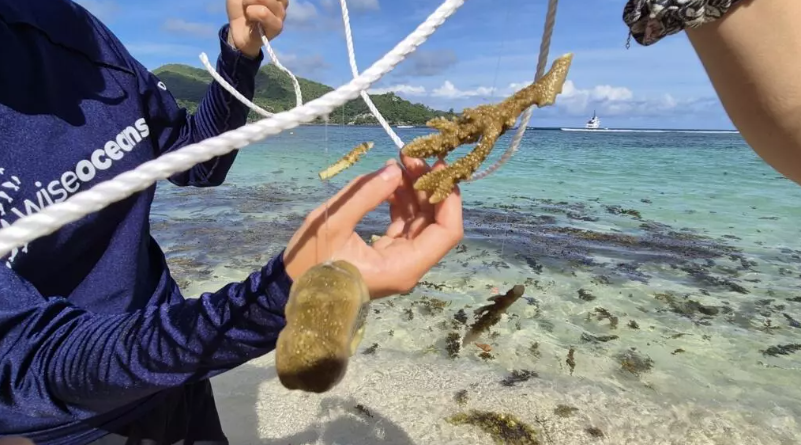
Wearing swimsuits, masks and snorkels in hand, these French tourists aren’t about to go on an excursion, but rather to restore a coral reef. Their guide: Fantine Soulat, a marine biologist with WiseOceans , an organization specializing in the conservation, restoration, and education of the marine world. Based year-round at a partner hotel, she leads awareness workshops for guests. But before the practical part, a little theory.
» So, to begin with, do you have any idea what coral is? A colony? An animal? » asks the marine biologist. « It’s an animal that lives in symbiosis with an alga and produces its skeleton from calcium carbonate. It’s a very simple animal that belongs to the same family as jellyfish. What gives coral its color is the microalga, the zooxanthellae. If you remove it from the coral, the coral turns white, and that’s what we call coral bleaching. «
The loss of more than 80% of corals
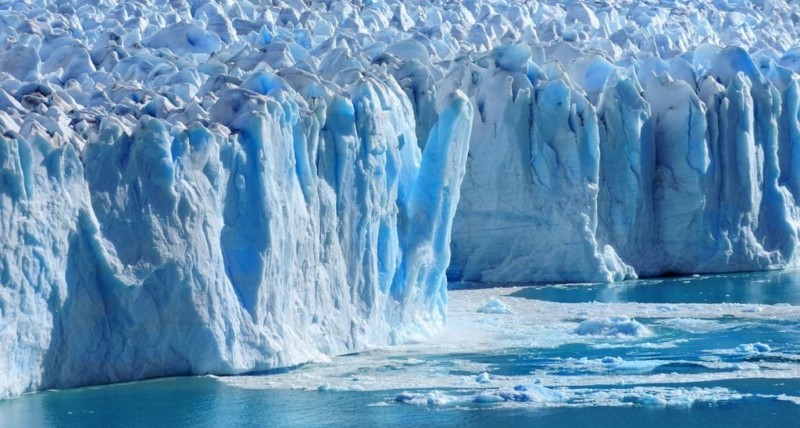
Like many tropical reefs, the Seychelles are affected by massive bleaching events linked to ocean warming. According to scientists, since 1998, some areas of the archipelago have lost more than 80% of their coral. » Because of the increase in sea temperature, the coral becomes stressed and consequently removes the algae from its tissues because it produces too many toxic substances, causing it to turn white , » explains Fantine Soulat.
Conversely, if its stress level decreases, bleached coral can recover and regain its color. This is the whole point of the workshop: to attach small fragments of coral in a protected environment – the nursery in the lagoon – to allow them to grow, and then, nine months later, to transplant them onto a reef.
These activities are enjoying increasing success in Seychelles hotels. But for the biologist, they remain primarily an awareness-raising tool. Because while these actions have the merit of drawing attention to coral, they cannot alone halt the massive decline of the reefs.
The true salvation of corals, home to a quarter of the world’s marine fauna, will only come through drastic global commitments on greenhouse gas emissions and the preservation of marine ecosystems.
source : RFI