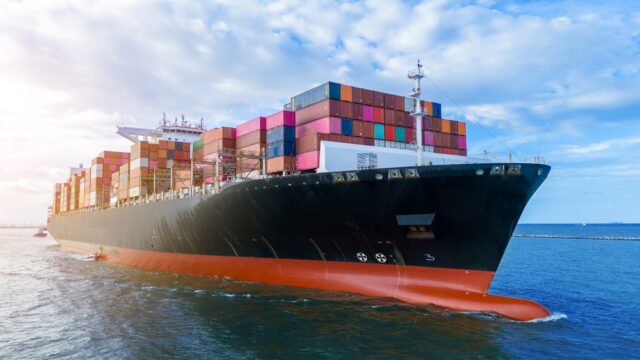
Long remained away from climate policies, maritime transport is now ordered by governments to reduce its environmental footprint. In this context, liquefied natural gas (LNG) is gradually becoming an alternative to heavy fuel oil, the historical fuel of the tankers. Presented as more « clean », it nevertheless arouses growing debate about its real climatic benefit. Between regulatory imperative and industrial constraints, its rise reveals the ambiguities of a forced ecological transition.
A sector under regulatory pressure
With about 2 to 3% of global greenhouse gas emissions, shipping has become a central issue in climate policies. The growth of international trade, driven by globalization, suggests a continuous increase in these emissions if no inflection is engaged.
Faced with growing pressure from civil society to reduce greenhouse gas emissions, regulators have tightened their position. The International Maritime Organization has set a carbon neutrality target by 2050, while imposing since 2020 a drastic reduction in the sulfur content of marine fuels (responsible for acid rain and respiratory diseases). For its part, the European Union has adopted a more restrictive approach, gradually integrating maritime transport into its carbon market and setting emission reduction targets through the FuelEU Maritime Regulation.
Beyond environmental considerations, the debate on LNG highlights a strategic opposition between the United States and China. Having become the world’s leading exporter of liquefied natural gas in a few years, the United States is actively defending its use in maritime transport. Washington advocates that LNG be recognized as a legitimate transitional fuel, in order to secure its outlets and enhance its massive investments in this sector. Conversely, Beijing is adopting a more restrictive stance and supports a tightening of international standards. China, which has made significant investments in alternative fuels such as ammonia and hydrogen, seeks to accelerate the emergence of these technologies in which it aspires to establish itself as a world leader. The world’s leading importer of LNG, it also seeks to avoid excessive dependence on this resource, largely dominated by American exports.
LNG, a solution that is becoming fast
Liquefied natural gas consists of natural gas cooled to -162 °C in order to be transported in liquid form, thus considerably reducing its volume. This technology is based in particular on complex cryogenic storage systems, an area in which the French group Gaztransport & Technigaz (GTT) has established itself as a global reference player, equipping a large part of LNG-powered ships.
His success is primarily due to his availability. Unlike other alternatives still under development, LNG is based on proven technologies and expanding infrastructure in major global ports, allowing shipowners to quickly meet new regulatory requirements without disrupting their operating models. This immediate compatibility explains its growing adoption: despite a clear slowdown in the market in 2025, marked by a drop of more than 40% in new ship orders (from 4,405 to 2,403), LNG confirms its dominant place among alternative fuels, especially in container transport. This segment recorded 547 new orders, up from 2024, and alone concentrates 68% of alternative fuel vessels. LNG represents about 58% of the tonnage, far ahead of methanol (6%), consolidating its status as a short-term solution preferred by shipowners.
On a technical level, LNG does not suffer from a performance deficit compared to heavy fuel oil. Its calorific value per ton is even higher, while so-called « dual fuel » engines, capable of operating with gas as well as traditional fuel, display good yields. But this energy advantage remains relative. LNG imposes significant storage constraints, with large cryogenic tanks that reduce the space available on board. In addition, LNG requires a higher initial investment, estimated between an additional 15% and 25% for the construction of a ship.
Ecological efficiency called into question
In terms of the environment, the benefits of LNG are real but partial. Its use makes it possible to greatly reduce sulfur emissions, almost eliminated, as well as fine particles and nitrogen oxides. Carbon dioxide emissions are also down compared to heavy fuel oil, by proportions of the order of 20%.
However, these gains are put into perspective by a major problem: methane. The main component of LNG, this gas has a much higher warming power than that of CO2 in the short term. However, fugitive emissions can occur throughout the value chain, from extraction to combustion, especially in the form of « methane slip », unburned gas that escapes from engines.
These leaks significantly reduce the climate interest of LNG, to the point that some experts believe that its overall balance could be much less favorable than announced. Therefore, the qualification of « ecological » fuel appears questionable.
A transitional fuel more than a future
Behind this apparent solution, the climate balance remains more nuanced. Methane emissions, difficult to control, put the announced gains into perspective and weaken its image as a « clean » fuel. In this context, LNG appears less as a sustainable solution than as a compromise. It allows shipowners to comply with current regulations while delaying the investments necessary for a more radical transformation such as the development of new fuels (methanol, ammonia or hydrogen).
source : revue politique