

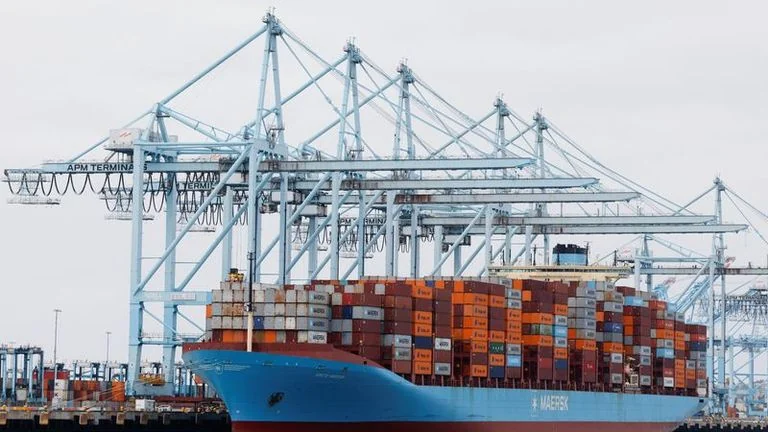
The Danish shipping group Maersk raised its profit forecast for 2026 for the third time on Thursday, as port congestion and artificial intelligence (AI)-powered demand kept containerized freight rates at high levels. However, the stock fell 11%, with analysts saying that this upward revision was expected and that the third quarter profit was disappointing.
The increase in profit forecasts comes from higher prices rather than an increase in the volumes transported, which leaves Maersk’s results dependent on congestion and disruption, some analysts of which anticipate the resorption with the return of ships to the Suez Canal and the arrival of new buildings.
The world’s second largest container shipping company, often considered an advanced indicator of world trade, now relies on an underlying earnings before interest, taxes, depreciation and depreciation (EBITDA) of between $14 billion and $14.5 billion this year, compared to a previous range of $10.5 billion to $12.5 billion.
The underlying operating profit (EBIT) is expected to be between $8 billion and $8.5 billion, compared to a previous range of $4.5 billion to $6.5 billion, the group said.
The new EBITDA forecasts were broadly in line with analysts’ expectations, which were counting on $14.02 billion for the full year, according to a survey by the London Stock Exchange Group (LSEG).
Maersk reported earnings before interest, taxes, depreciation and amortization of $4.7 billion in the third quarter, up 75%, but below the average forecast of $5.04 billion from an LSEG survey.
Analysts explained that lower-than-expected operating profit was due to lower-than-expected volumes and higher costs in the Ocean division.
A RESILIENT TRADE
« Despite the persistence of geopolitical uncertainties and disruptions, global trade has remained remarkably resilient, » CEO Vincent Clerc said in a statement.
“Demand is fueled not only by consumer spending, but increasingly by significant investments in electrification, energy and the rapid development of AI infrastructure, which generate large flows of industrial goods around the world,” he added.
The sharp increase in spending on semiconductors and data centers dedicated to AI has stimulated global trade and helped compensate for the disruptions related to the U.S.-Israi war against Iran, the World Trade Organization (WTO) said last month.
In the United States, Maersk said economic activity had remained strong, supported by consumer spending and corporate investments related to AI infrastructure development.
The volumes transported by sea remained generally stable compared to the previous year. Freight rates increased by 46% compared to the previous quarter and more than doubled in a year, with port congestion persisting while Maersk continued its gradual return to the Suez Canal, which most carriers had abandoned at the end of 2023 after the Houthi attacks in the Red Sea.
Maersk said this week that its ME1 service connecting India and Europe would resume its canal crossings.
Growth in China has been limited by weak domestic demand, as recent budget measures have provided only modest support, Maersk said. Asian exports slowed in July and August due to weather disruptions.
Maersk has greatly raised its profit prospects since the beginning of the year, when it warned that the arrival of new ships and the return to the Suez Canal would lower rates.
Maersk still expects a growth of about 4% of global container volumes this year.