

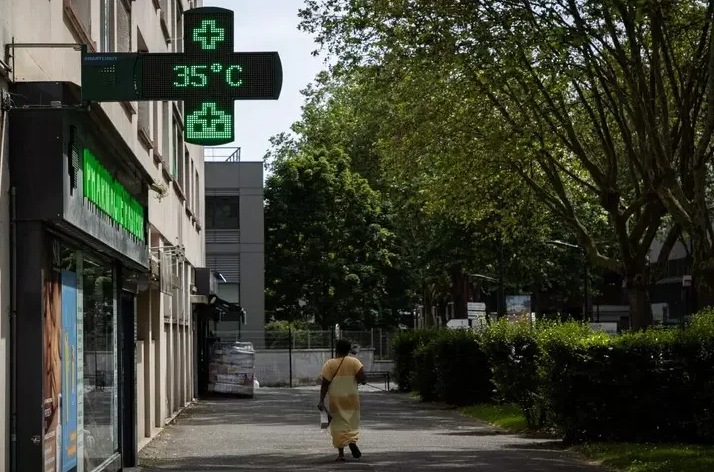
Rising marine heatwaves, melting carbon budget… These exploding indicators testify to the unprecedented pace reached by global warming, according to 73 researchers in a report published on June 11.
Climate change is worsening, this worsening is accelerating, and warming is reaching an unprecedented rate. The global temperature is rising at a rate of about 0.27°C per decade, compared to the average of 0.18°C per decade measured over fifty years. Overall, the Earth’s climate, measured on average over the last ten years, has reached +1.26°C compared to the pre-industrial era.
This is the conclusion reached by an international consortium of 73 researchers from 56 institutes in 17 countries in their annual report on the Indicators of Global Climate Change (IGCC). Published in the journal Earth System Science Data on June 11, their findings are the result of a vast analysis of more than 40 global datasets. And their alarming conclusions are unfortunately not surprising, since global greenhouse gas emissions have also continued to rise .
1.5°C of warming is now inevitable
This annual report on » key indicators of the state of the climate system » is an initiative launched in 2023 by scientists to inform policymakers’ decisions. Warming is progressing so rapidly that they felt it necessary to regularly update these indicators since the last IPCC report cycle , published in 2021 and 2022.
The first of these indicators: our carbon budget is melting away. This » budget » corresponds to the maximum amount of greenhouse gases that can still be emitted into the atmosphere while maintaining a 50% chance of limiting warming to 1.5°C. From 500 billion tons of CO2 (GtCO2) in 2020, it is only 130 GtCO2 at the beginning of 2026.
“ This carbon budget will be exhausted before 2030 at current CO2 emission levels. It is now inevitable that global warming due to human activities will reach and then exceed 1.5°C ,” the report’s authors conclude. A small sign of hope: while emissions continue to rise, the rate of increase is slowing. In other words, emissions are increasing less rapidly than in the 2000s.
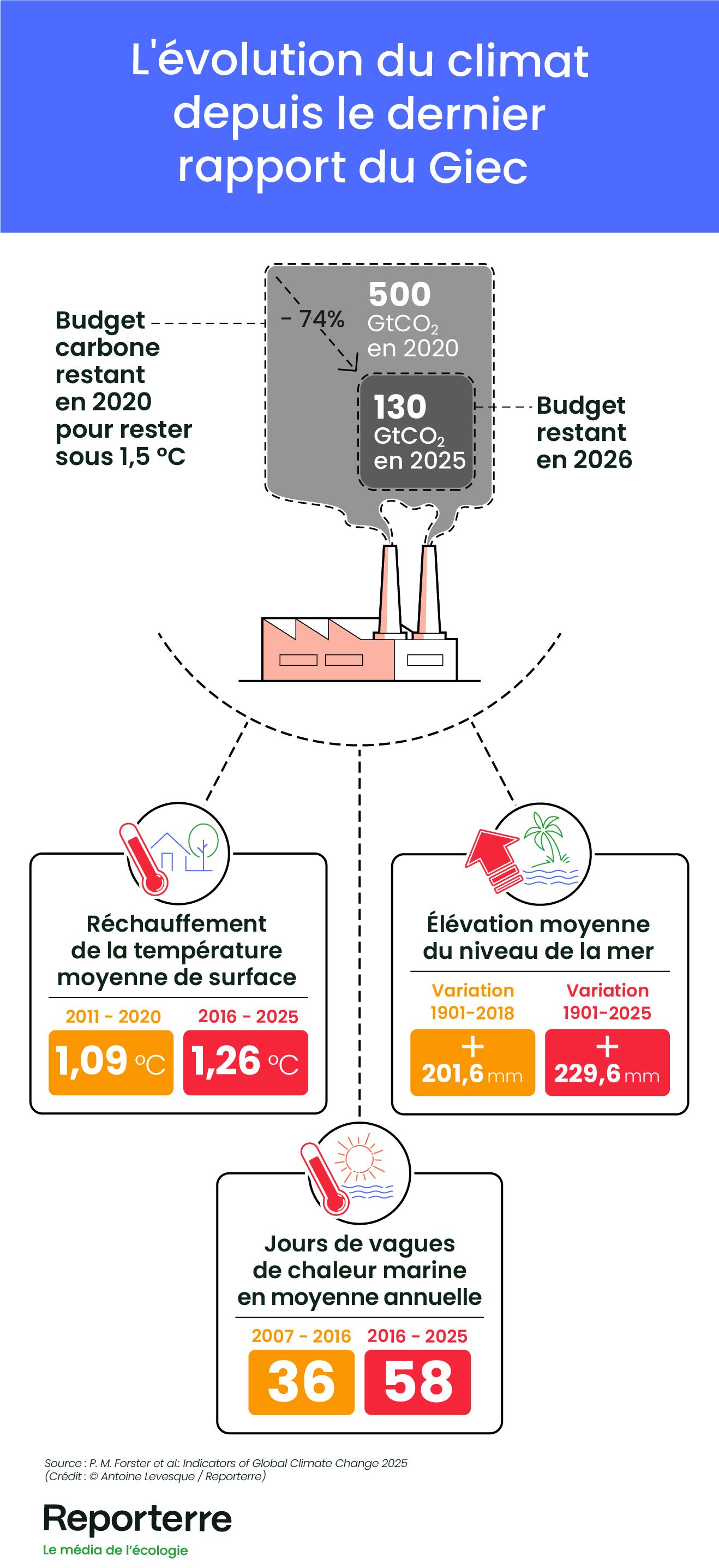
Other key indicators measure the consequences of these emissions. One such indicator is sea level rise, which continues to accelerate. By 2025, this rise will reach almost 23 cm compared to the 1901 level, versus just 20.2 cm in 2018. The level will continue to rise inexorably and at an ever-increasing rate. Over the period 2006-2025, the rate reached the unprecedented average speed of 3.7 mm per year.
The 2026 IGCC report also incorporates a new indicator: the annual number of marine heatwave days. This number has more than tripled between 1991 and 2025, scientists note. The year 2025 was particularly affected, recording 65 marine heatwave days.
These marine heatwaves have devastating effects on biodiversity and disrupt the entire marine ecosystem. For example, another harmful effect is a possible decrease in the ocean’s capacity to absorb CO2. On average, over the past decade (2016-2025), researchers have recorded approximately 58 days of marine heatwaves per year, compared to 36 in the previous decade, representing a 60% increase.
The acceleration of warming in question
These record-breaking indicators demonstrate the recent acceleration of global warming. Over the past five years, the increase has been 0.17°C, the report indicates, which is even faster than the already record rate of 0.27°C per decade. The year 2024, in particular, broke all records by becoming the first in history to exceed the 1.5°C threshold . The year 2025 is projected to reach approximately +1.39°C, according to IGCC researchers.
The authors are, however, extremely cautious about the implications of this very recent acceleration: these new heat records are undeniably partly due to the increase in greenhouse gases, as well as the decrease in emissions of certain polluting aerosols, whose cooling effect masked some of the warming . But the natural variability of the climate can also play a role, and it is impossible to identify a long-term climate trend based on dynamics observed over just a few years.
To try to understand these ongoing changes, climatologists also use another indicator besides temperature: the Earth’s energy imbalance. Measured by satellite, this calculates the difference between the energy arriving on the planet (via solar radiation) and the energy leaving it (reflected solar radiation as well as infrared radiation emitted by the Earth).
The major problem of our time is that the energy entering our planet is greater than the energy leaving it. This is primarily due to the accumulation of greenhouse gases that trap this energy. However, this energy imbalance is not immediately or fully reflected in changes in surface temperature, because this excess energy is also stored elsewhere, particularly in the oceans. Hence the surge in marine heatwaves and the accelerating rise in sea levels, for example.
Twelve more years to avoid 1.7°C
Measuring this energy imbalance is therefore crucial to understanding what is happening in the global climate system. This imbalance has been increasing since the 1970s and has even doubled since the 2000s. In seven years, from the level considered in the last IPCC report to that observed by this IGCC report, the imbalance has increased by 40%.
In other words, the accumulation of energy, and therefore heat, is happening at an unprecedented rate on Earth. This is the consequence of human-caused climate disturbances (greenhouse gases, aerosols, deforestation, etc.) as well as the climate’s response to these disturbances (melting of ice surfaces that reflect solar radiation, changes in cloud cover , etc.).
The big question, which is the subject of much debate among climatologists, is to what extent this energy imbalance could worsen and exceed what climate models predicted. The fear is that this could be a precursor to more intense warming than anticipated.
“ This energy imbalance is starting to reach the limit of what we had imagined and what was simulated. It is not yet a source of concern but an element of vigilance. The evolution of temperatures remains perfectly consistent with our models ,” assures Aurélien Ribes, researcher at the National Centre for Meteorological Research and co-author of the IGCC report.
The only absolute certainty is the urgent need to phase out fossil fuels and drastically reduce our greenhouse gas emissions. Every tenth of a degree of warming avoided mitigates the catastrophes of the ongoing climate atrocity . The authors warn that the remaining carbon budget to maintain a 50% chance of limiting warming to 1.7°C is 500 GtCO2. That’s equivalent to twelve years at the current emissions rate.
source : presse gauche