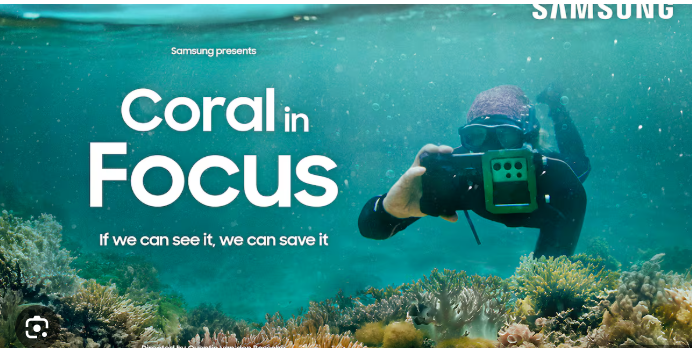
Ocean mode allows researchers and communities to collect high-quality underwater data to better monitor and restore coral reefs.
Samsung Electronics Co., Ltd. Announces today that its « Coral in Focus » initiative has received several awards, thus welling its contribution to the preservation of coral reefs. Optimized by Ocean mode,[1] an advanced photographic feature available on the latest Galaxy smartphones, the initiative received the gold medal in the category « Best Sustainability or Conservation Initiative[2] » at the Halo Awards 2026, organized by Engage for Good.
In parallel, the documentary « Coral in Focus » won the » Coastal and Island Culture Award[3] » at the 23rd International Oceanic Film Festival. And thanks to its mobile innovations in the field of environmental research, Samsung was recognized by Fast Company as one of the most innovative companies of 2026.
This recognition is a testament to Samsung’s efforts to participate in the restoration of coral reefs, in partnership with the American NGO Seatrees and the Scripps Institute of Oceanography at the University of California in San Diego. By combining the photographic capabilities of Galaxy devices, the Seatrees community restoration model and the expertise of the Scripps Institute, Samsung puts the potential of its technologies at the service of ocean preservation.
If coral reefs do not even cover 1% of the seabed, they are home to nearly 25% of all marine life and provide the livelihood of millions of people around the world.[ 4] But due to climate change, pollution and overfishing, many reefs are threatened with extinction by 2050.
Samsung has partnered with Seatrees and the Scripps Institute to meet this challenge by promoting reef restoration in a growing network of sites in Costa Rica, Fiji, the Galápagos Islands, Indonesia and the United States.
Samsung and Seatrees’ Coral in Focus initiative allows partners and local communities to use Galaxy devices equipped with Ocean mode and waterproof boxes to capture high-quality images. These are then used to create detailed 3D photogrammetric models, a process that facilitates the monitoring and evaluation of reefs with valuable data on their condition and regeneration level.
The joint efforts of Samsung, Seatrees and the Scripps Institute are already bearing fruit: to date, more than 20,000 coral fragments have been planted and more than 80 3D reef models have been created to support surveillance and research.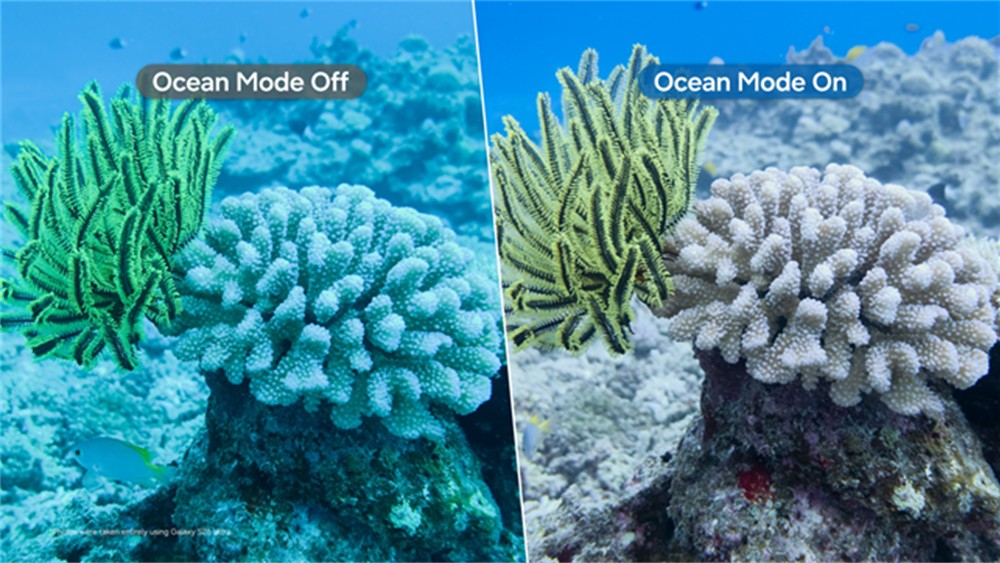
▲ Comparison of coral images captured with the standard photo settings of a Galaxy smartphone (left) and with Ocean mode (right), illustrating appropriate color correction and reduction of underwater motion blur.
Now available on Expert RAW,[5] Ocean mode is invited to consumer smartphones – an advance that allows Galaxy users to immortalize the seabed,[6] without professional equipment. This accessibility is essential to deploy coral reef monitoring on a larger scale, especially in areas where resources and infrastructure are limited.
Samsung’s efforts to preserve marine ecosystems are a testament to a broader commitment to sustainable development, embodied by the global initiative Galaxy for the Planet. Whether integrating recycled materials into Galaxy devices[7] or developing technologies such as Ocean mode by teaming up with partners with common values, Samsung continues to put innovation at the service of the planet.