

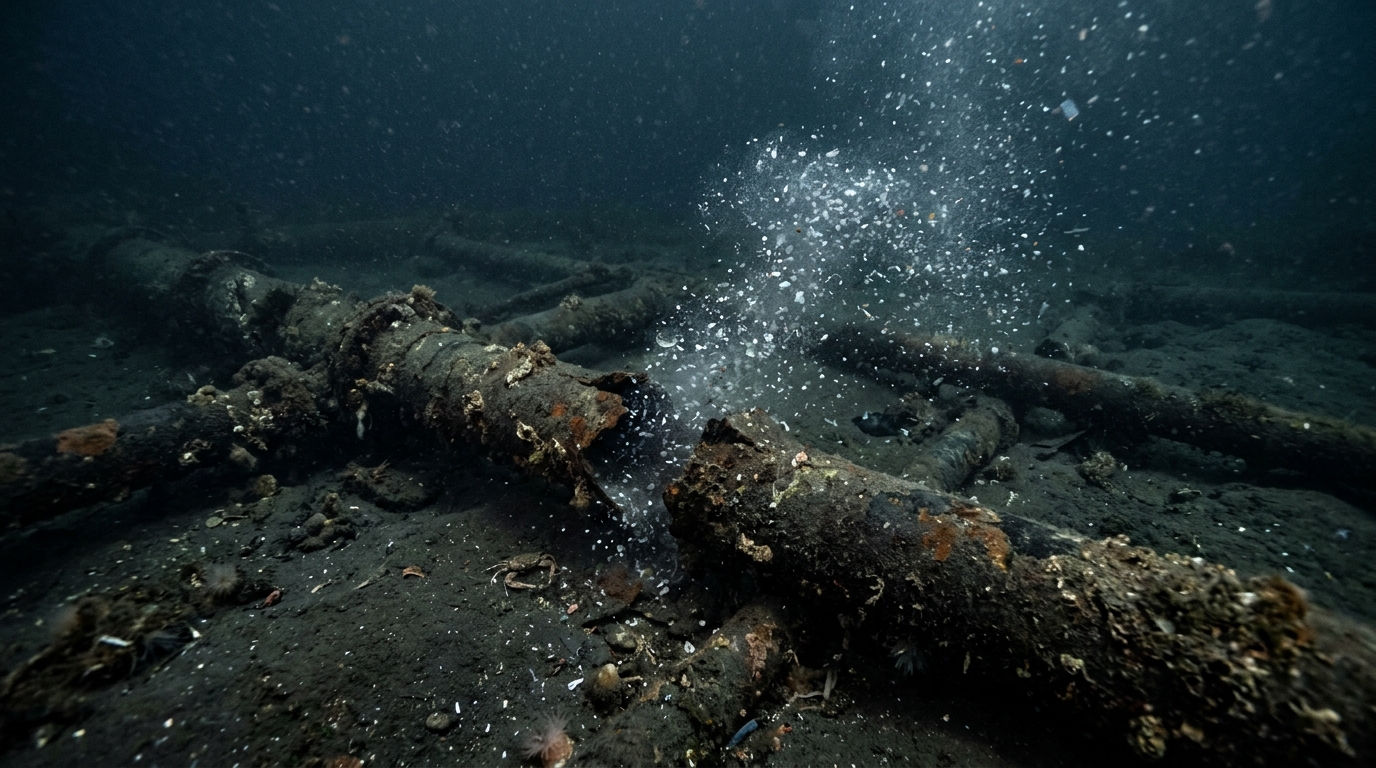
What if the remains of oil exploitation were not content to rust quietly at the bottom of the water? Under the gray waves of the North Sea, away from the eyes and sonars, miles of pipes abandoned for decades lead a discreet but worrying second life. These infrastructures, left on site after the dismantling of oil and gas platforms, would continue to fragment slowly, releasing an anecdotal amount of microplastics into the ocean. A phenomenon that has remained under the radar for years, and which deserves to be seriously considered.
On the British continental shelf, oil and gas exploitation has been in full swing since the 1960s. Generations of pipelines and umbilicals, these cables and pipes that connected the wells to the platforms, were installed, used, then sometimes simply abandoned on the seabed once the deposits were exhausted. What seemed at the time a practical solution to avoid expensive and complex withdrawal operations is now proving to be a largely underestimated source of pollution.
According to estimates, these facilities would release about 500 metric tons of microplastics per year, or nearly 550 tons depending on the US units. To imagine the magnitude of the phenomenon, this figure must be compared to another well-known benchmark of marine environmental specialists: this low level would roughly correspond to what all British rivers dump each year into the North Sea in the form of microplastics. In other words, these pipes forgotten at the bottom of the water act as an invisible river, silent, but just as active as those that wind on the surface of the territory.
Twenty-two years of abandonment is enough to crack the coating
To understand how pipes that are supposed to be robust end up disintegrating, head to the Brent oil field, off the coast of the Shetland. Samples were taken from pipelines and umbilicals owned by Shell UK Ltd, which had been abandoned for twenty-two years. A delay that, on a geological scale, seems ridiculous, but which is obviously enough to seriously alter these structures supposed to withstand the assaults of time.
The scanning electron microscopy analysis revealed cracks and a clear fragmentation on the plastic parts directly exposed to the marine environment. The sand, currents and living organisms that colonize these structures act as a natural sandpaper, gradually wearing out the coatings. Some pipes were protected by an epoxy coating coal tar coated with concrete weights, while others simply carried a fused-linked epoxy coating, without additional protection. Result: concrete sections resist better, but are not spared. Time eventually left its mark, even on what seemed best protected.
More polluting than cosmetic microbeads banned in the UK
To give a more concrete idea of the extent of the problem, a comparison is necessary: in its highest scenario, this pollution would far exceed the emissions of cosmetic microbeads that circulated in the United Kingdom before their ban. These small plastic balls, long used in scrubs and toothpastes, had ended up being banned as their impact on marine ecosystems was considered problematic. The fact that simple forgotten pipes can generate a comparable or even greater volume says a lot about the real extent of this invisible pollution.
This observation also questions far beyond the oil and gas sector alone. If abandoned industrial infrastructure can, year after year, release as much plastic particles as everyday consumer products once pointed out, this raises a broader question about how the long-term environmental impacts of offshore installations, regardless of their nature, are assessed.
120,000 tons still sleeping under the North Sea
If the 500 tons per year are already dizzying, they represent only a fraction of a much larger stock. According to the records of the North Sea Transition Authority, which lists all the pipelines and umbilicals installed over the decades, more than 120,000 metric tons of plastic would remain potentially present in the marine environment, scattered along these infrastructures abandoned after dismantling.
This figure gives a completely different dimension to the phenomenon. It is no longer just a punctual or localized leak, but a real reservoir of potential pollution, scattered over hundreds of kilometers of seabed. The authors of this work insist on an essential point: this source of pollution remains largely underestimated, and could already affect marine life without fully measuring the consequences.
What this story of forgotten pipes reveals is above all the difficulty in measuring the very long-term consequences of our industrial infrastructure. What was installed, exploited and then abandoned without too many questions several decades ago continues today to produce very real effects, out of sight but still below the surface of the North Sea. It remains to be seen whether this awareness will lead to new dismantling practices, more respectful of marine ecosystems, or if these pipes will simply continue to disintegrate in silence for many years to come.