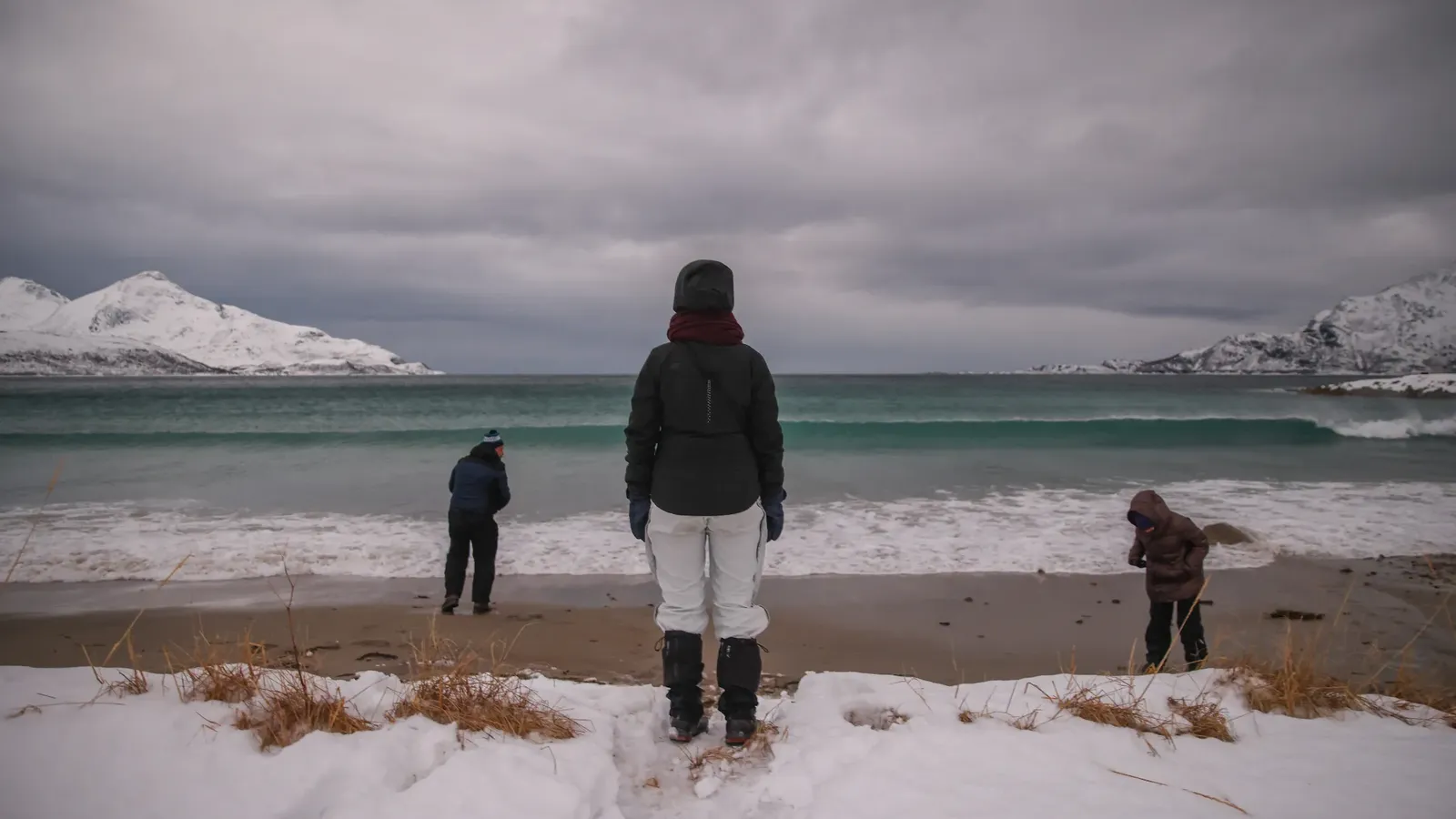
This region, which encompasses the North Pole, is affected by a phenomenon called « amplification », which makes it warm faster than the middle latitudes. The ice floe, emblematic of the region, is the first victim.
The planet continues to warm due to the accumulation of greenhouse gases due to human activities. According to the annual report of the European Copernicus Observatory, 2025 is the third hottest year on record just ahead of 2023 and 2024 with +1.47°C since the pre-industrial era, i.e. before the massive combustion of coal, oil and gas permanently warms the climate.
But this global warming does not translate into the same way everywhere. The Arctic is warming much faster than the rest of the globe. In 2025, the temperature in this region, which encompasses the North Pole, was 1.37°C warmer than the 1991-2020 average, compared to +0.59°C on the entire planet. This abnormality compared to normal makes it the second hottest year ever recorded in the Arctic, behind 2016.
Melting the pack ice
This difference is explained by a phenomenon called « amplification ». In this region of the globe, the pack ice formed by the freezing of seawater, melts naturally in summer and reforms in winter. Due to global warming, the proportion in which it is reformed each winter is declining.
Consequence: there is a decrease in snow feedback, also called a decrease in albedo. The more snow melts, the less sunlight there are reflected, due to the change in soil color. We go from a white surface that reflects solar radiation to one that absorbs it, namely the land or the sea.
It is this phenomenon that also explains why Europe is warming rapidly, with the presence of many mountain ranges and regions located far north that are generally snowy. Thus, the Svalbard archipelago, located in the Greenland Sea, is one of the fastest warming places on Earth.
As revealed by the Copernicus Observatory on Wednesday, the monthly extent of the pack ice began to reach historically low levels for the period of the year in December 2024 and remained at historically low levels during the first three months of 2025. Never before had the pack ice been so small in March.
In February, the combination of an Arctic sea ice expanse at the lowest for the time of year and an Antarctic expanse (at the South Pole) well below average resulted in the world’s lowest sea ice cover for a month since the beginning of satellite observations in the late 1970s.
Ever warmer oceans
The National Museum of Natural History also recalls that the poles are warming faster because they constitute « landing areas of heat masses accumulated in the air and in the water on a global scale ».
« The heat is redistributed to the poles, by oceanic or atmospheric circulation. As a result, the poles are warming two to four times faster than other regions of the globe and are also the most exposed to pollution from currents, » we can read on his website.
Last year, the seas and oceans were particularly suffering from global warming. « The global surface temperature of the sea has remained at a historically high level throughout 2025, » Copernicus points out in his report published on Wednesday. The average annual sea surface temperature for 2025 was +0.38°C higher than the average for the period 1991-2020.
And the trend continues at the beginning of 2026. The sea ice stopped growing on March 15, a week before last year, and is slightly below last year’s level, 14.31 million square kilometers, statistically identical to last year, according to the National Snow and Ice Data Center (NSIDC), based at the University of Colorado in Boulder. This is the lowest level observed in 48 years of satellite observations.
Cascade consequences
If the melting of the pack ice does not directly raise the level of the oceans, unlike the melting of ice on land (ice caps, glaciers), it causes many climatic consequences that threaten many ecosystems. Many species such as the polar bear or seals depend on sea ice to breed and feed and human populations also live there. It is also a place of migration and reproduction for many species of birds forming colonies that can reach millions of individuals.
« Polar zones act as powerful carbon pumps, » the National Museum of Natural History also points out because, on the one hand, CO2 is more soluble in cold waters. « At the biological level, on the other hand, phytoplankton present by mass absorbs carbon to transform it into organic matter (photosynthesis) ».ABOUT THE SAME SUBJECT
The warming of the Arctic and the melting of the associated ice also have geopolitical consequences. In particular, they open up new maritime routes and access to mineral resources.
source : bfmtv