What happens, over time, to the animal populations followed by researchers and volunteers? A few days before the start of the 17th Conference of the Parties (COP17) on biodiversity, which is to be held from October 19 to 30 in Erevan, Armenia, the World Wide Fund for Nature (WWF) publishes, on Thursday, October 8, the update of its flagship indicator for measuring biodiversity erosion, the « Living Planet Index » (IPV). It confirms the overall trend towards the decline of species.
Calculated for almost thirty years, this indicator makes it possible to evaluate the dynamics of evolution of many animal populations, i.e. groups of individuals of the same species coexisting and reproducing among themselves on a given territory. The IPV 2026 indicates that the size of 5,790 species of wild vertebrates, i.e. amphibians, birds, fish, mammals and reptiles, decreased by an average of 73.2% between 1970 and 2022.
This does not mean that there are now 73% fewer wild animals in total compared to 1970, nor that 73% of species or populations are in decline. The IPV measures variations in relative abundance (which will be − 50% both when one population goes from 2,000 to 1,000 individuals and when another goes from 200 to 100 individuals). Overall, the size of vertebrate populations has therefore dropped drastically.
As it is an average, both populations that are doing well and those that are not doing well are added to it; in reality, about half of the populations studied are stable or increasing. This indicates, in counterpoint, the extent of the collapse of nearly 3,000 species.
« The standard deviation around the average increases, this means that half of the populations go a lot
better and that another half is doing much worse, « says Yann Laurans, director of programs at WWF France.
« Dizzying collapse »
The last IPV, published in 2024, already showed a decrease of 72.9% (compared to 69% estimated in 2022), but it should not be deduced that the situation has stabilized for two years. WWF explains that 967 additional populations and 295 new species have been added to the dataset; 669 populations have also been updated. This kind of changes from one relationship to another « give rise to a slightly different index, but progressively more representative, » the authors note.
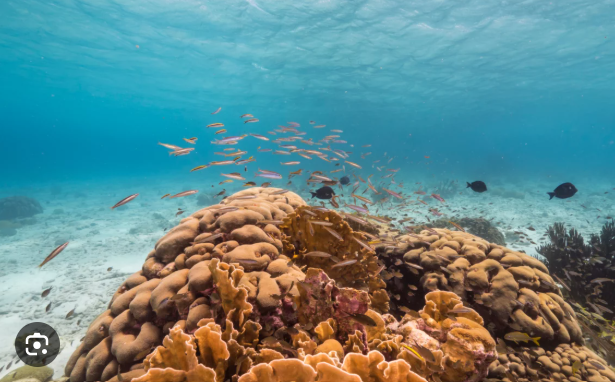
The decline is more marked among freshwater vertebrates (− 85%), both fish and hippos or otters, and among those from terrestrial habitats (− 69%) or oceans (− 59%). The trend is also stronger in Latin America and the Caribbean (− 95%) or Africa (− 80%) than in North America (− 28%) or Europe and Central Asia (− 23%). Simply because in the latter regions, « a large part of the biodiversity (…) was already in a more weakened state as early as 1970, the reference year, » the authors underline.
« We are talking about almost three-quarters of a collapse, it’s dizzying, » insists Véronique Andrieux, executive director of the French branch of the WWF. But there is a message of hope: when conservation is done in the long term, with means allocated over the long term, we can succeed in reversing the curve of decline. «
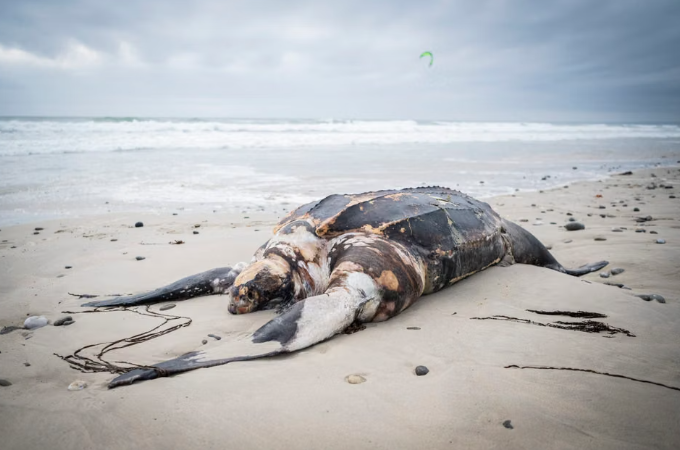
For example, the green turtle is the first sea turtle to have passed, in 2025, from the status of endangered species to that of « minor concern », according to the classification of the International Union for Conservation of Nature. And this, after fifty years of coordinated efforts in nearly 80 countries where the species comes to lay.
The decline in wild vertebrate populations has been increasing for fifty years fishing not at certain important times for the species, » explains Yann Laurans, who warns however that, on the same territory, it is
the lute turtle that could disappear from its historical laying sites.
In metropolitan France, after a century-long exile caused by overexploitation of forests, the black stork has gradually returned since the 1970s. An environmentally demanding species, requiring quality water and a healthy forest ecosystem, it is the subject of a national conservation plan. The same goes for the otter, almost extinct in France, which has benefited in recent years from the policy of restoring water quality in Europe.
Gap data
« This index has several limits: the quality of the data is heterogeneous, and there are certain geographical areas and certain species that are underrepresented, » says Michel Loreau, researcher emeritus at the CNRS. But it has the advantage of giving a trend over the long time and showing the general public the meaning of the story. Unsurprisingly, the most robust data concern iconic birds and mammals (elephant, tiger, etc.) or fish exploited for commercial purposes.
« Even if data on biodiversity have increased sharply in recent years, significant gaps remain, » explains Sandra Luque, research director at the National Research Institute for Agriculture, Food and the Environment. Especially in some parts of the world, including tropical areas, developing countries and the high seas. » This is the whole issue of the difficult biodiversity assessment, whose data are scattered in many databases and institutions, with little long-term monitoring.
In addition, the IPV only reports vertebrate populations, which represent less than 5% of known animal species, and sets aside a fundamental part of biodiversity: invertebrates, in the lead. « However, insects are better indicators of biodiversity, » says Sandra Luque. In particular, the latter have an immediate sensitivity to changes in the environment, and occupy a central place in the food chain. « Conservation alone is not enough, » warns Véronique Andrieux. Without reversing the structural causes of the decline in biodiversity, we will not succeed. Among them, forest overexploitation, the use of pesticides and the artificialization of soils. So many issues that will be debated at COP17.