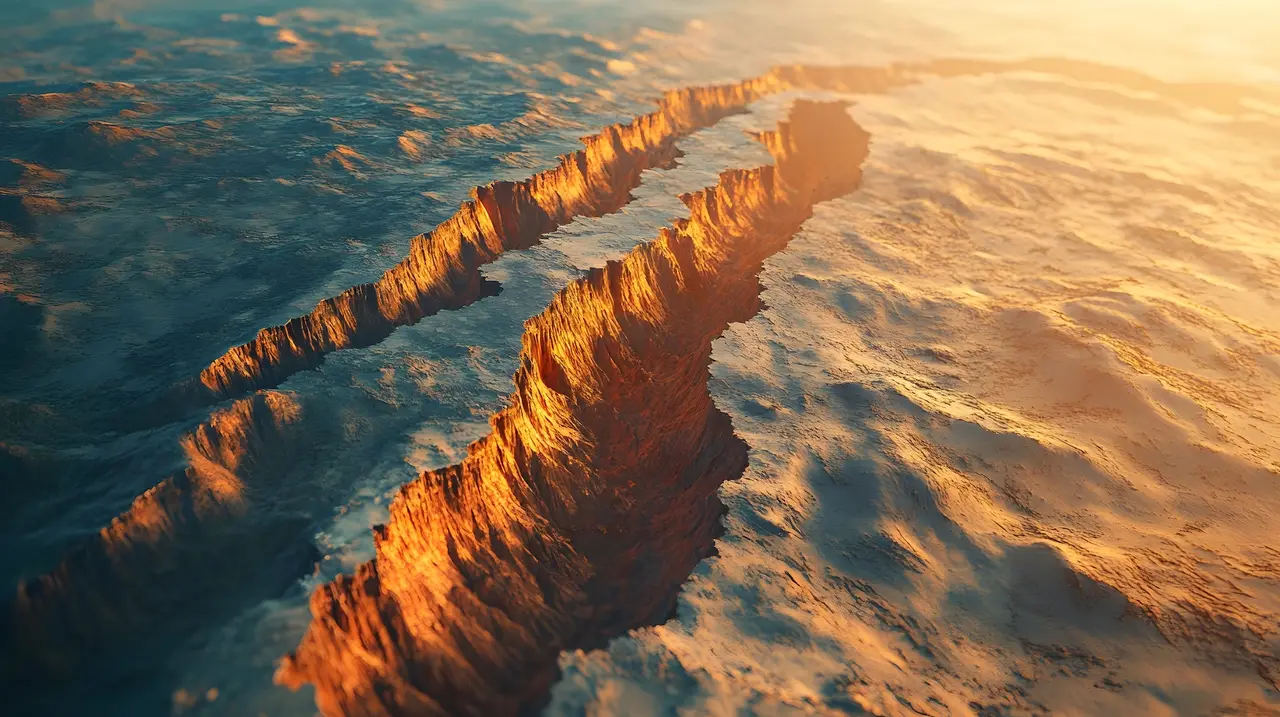
Why are there so many human fossils around Lake Turkana? What if the answer was not only about evolution… but also about geology? A new study proposes to review our vision of this high place of Prehistory.
The Lake Turkana region, located in northern Kenya, is one of the most important sites in the world for archaeology and paleoanthropology. Its richness in hominin fossils is exceptional: many remains ofHomo habilisand Homo erectus, which mark theAubeOf the Homo genre. Fossils of more archaic species (australopithecus for example) have also been found, in association with the oldest cut stone tools discovered to date.
These fossil testimonies have profoundly improved our understanding of human evolution.
An archaeological wealth… but also geological!
However, the region does not only attract archaeologists. It is also of major interest to theGeologists. Lake Turkana is indeed nestled in a long depression, which is called a « Rift« . This is part of the East African Rift system, which extends from north to south over more than 6,000 kilometers from theRed Seato Mozambique.
This vast gap ofCollapseis formed by the slow separation of twoTectonic plateswho are separating: the African plate and the Somali plate. The East African rift thus marks the place of a future plate limit, which will give birth to a new ocean.
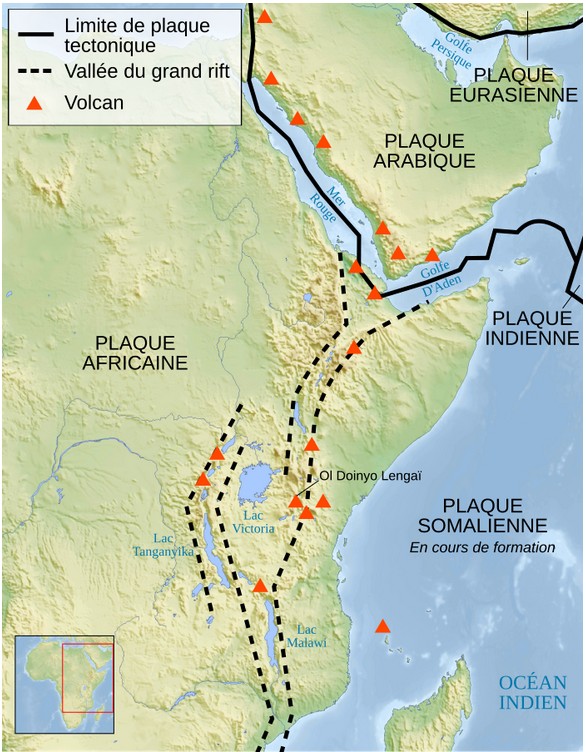 Map showing the location of the East African rift system (between the dotted lines). © Sémhur, Wikimedia Commons
Currently, the two continental blocks are moving away from each other at aSpeedabout 4.7 millimeters per year. This extension, called « rifting« , is accompanied by a progressive thinning of the continental crust. As a reminder, aContinental crust« Standard » measures an average of 35 kilometers in thickness. During a rifting episode, it will eventually thin to 0 via the development of manyFlaps. We then speak of « breakup ».
This break, which will spread to the base of theLithosphere, will allow the establishment of a new center ofAccretionOceanic, a ridge. This is how the oceans are born and the continents fragment.
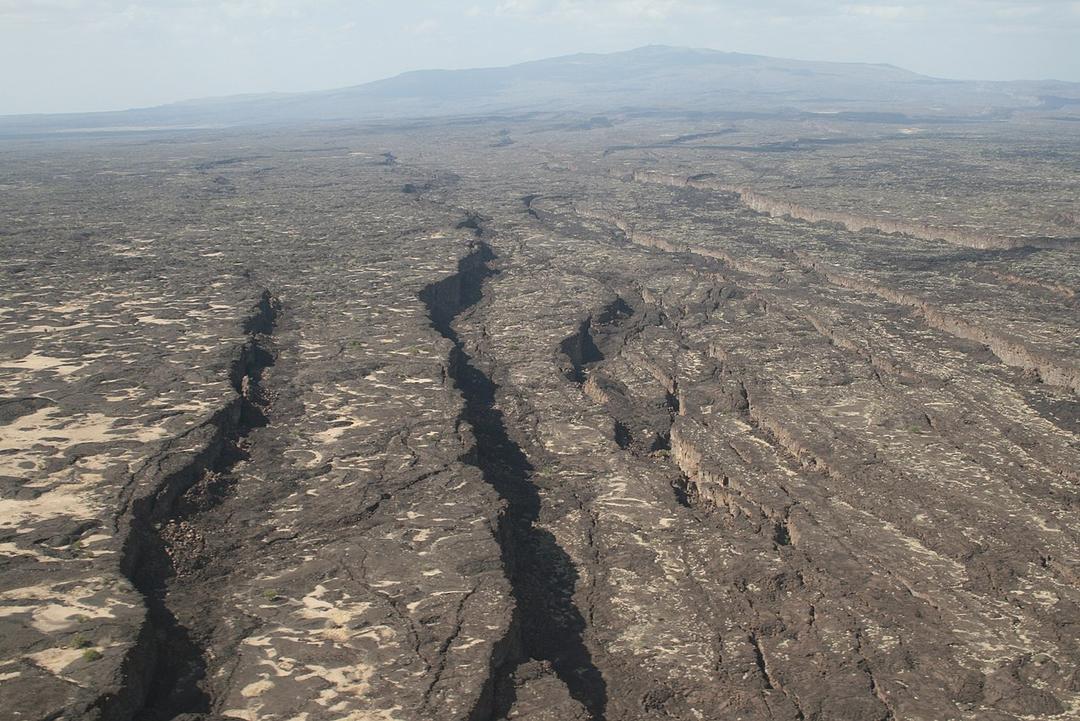 Landscape of the East African rift, marked by a series of normal faults that form a large collapse basin. © DavidMPyle, Wikimedia Commons, CC BY-SA 4.0
The East African rift is thus one of the few places in the world where we can observe live this mechanism, which has shaped the terrestrial geography since the start of theplate tectonics, about 3 billion years ago. It is therefore not a surprise that this rift is the subject of many studies.
A rift in a more advanced stadium than we thought
A team of researchers has just made new discoveries, which help to characterize this rift and predict its future evolution. All rifting episodes do not necessarily lead to the continental break. There are many examples of « abortion » rifts in the world, whose evolution towards the final break was stopped along the way. This is the case for example of theRhine ditch.
But the Turkana rift seems to be on the right track to get there. The seismic imaging carried out in this region reveals that the crust is much thinner than previously thought, indicating that the rifting process is here in a relatively advanced phase called « necking ». Along the axis of the rift, the continental crust is only 13 kilometers thick.
The necking phase is characterized by a sudden thinning of the crust, the loss of levelsDuctilethat until then mainly accommodated the deformation, and the mechanical coupling between the crust and theCoatSuperior. This step precedes the break directly (which may, however, take more or less time).
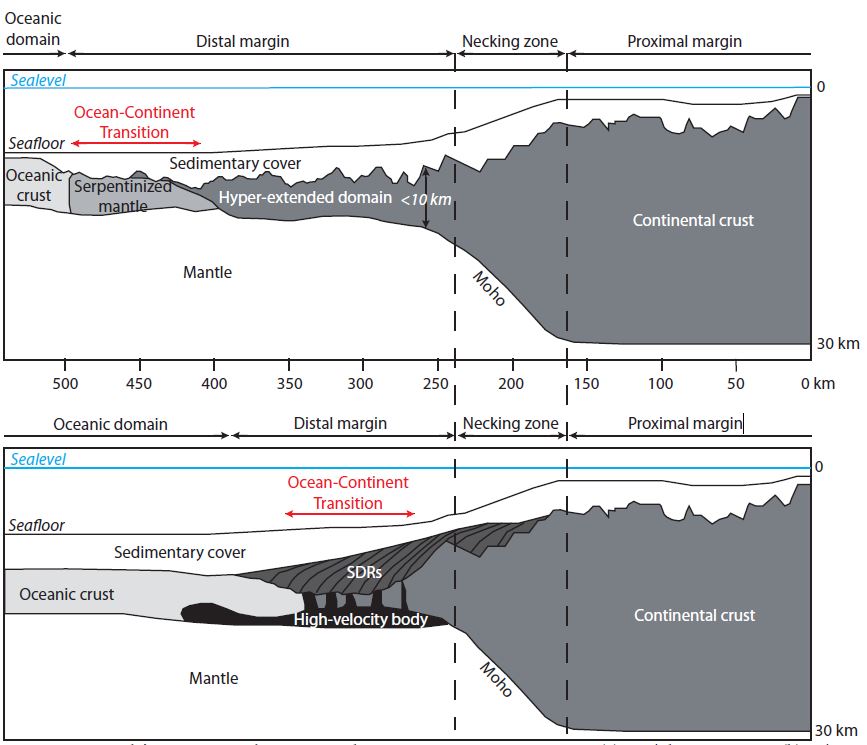 Final architecture of two types of continental margins, at the end of the final breakup and the establishment of a new oceanic crust (magma-poor margins at the top, and rich in magma at the bottom). The necking phase leads to the formation of the « necking zone » which is characterized by a sudden thinning of the continental crust. © Morgane Gillard
« The thinner the crust, the weaker it becomes mechanically, which favors the continuation of rifting, » explains Christian Rowan, author of a study published in the journal Nature communications. « We have reached this critical threshold of continental rupture, » confirms Anne Bécel, co-author of the study.
Note, however, that inGeology, the term « critical » must be put into perspective. It is not tomorrow, not even in 100 or 1,000 years that we will be able to attend theSeparationof the two continental plates. It should be remembered that the Turkana rift began to form 45 million years ago. The researchers estimate that the beginning of the necking phase dates back 4 million years. Or a blink of an eyelid for a geologist. Oceanization could therefore occur in the next millions of years…
A vision of the « garden of Eden » of Prehistory to be modified?
These results also help to better understand the richness of this region in hominin fossils. Until now, paleoanthropologists associated this fossil wealth with a « home of evolution »: the Turkana rift would have been a place where the evolution of human ancestors would have been particularly intense and important.
But these new results upset this vision of things: the researchers suggest that it would not necessarily be a place where evolution has been stronger than elsewhere, but rather a place where fossils would have simply been better preserved! Indeed, the necking episode, which began 4 million years ago, was accompanied by an intenseVolcanismAnd of asubsidencerapid of the rift, conditions that lead to large deposits ofSedimentsFines. And these conditions are particularly favorable to a goodFossilization.
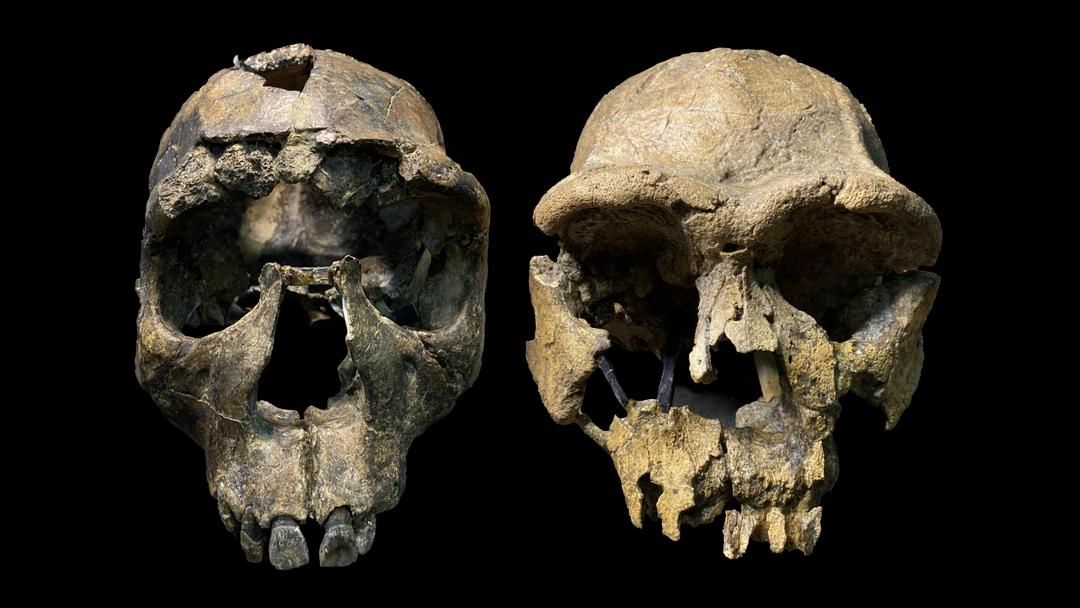 Example of two Homo erectus skulls discovered in the Turkana rift. © John Rowan
In other words, the Lake Turkana region is perhaps not only the cradle of humanity, but also the product of an exceptional geology that has allowed its history to be frozen.
source : futura sciences