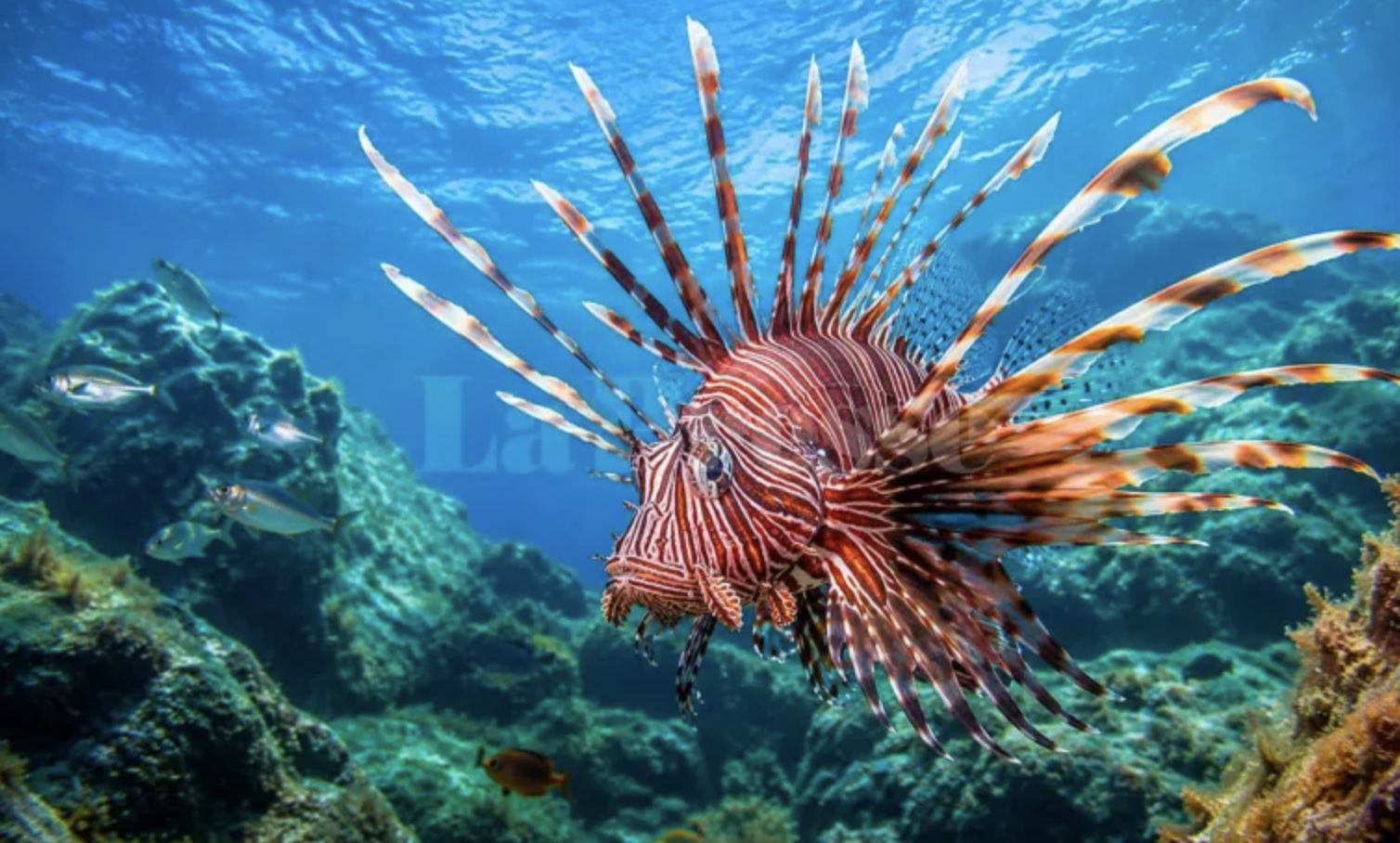
Presumably the marine biome of Tunisia is facing worrying and not negligible environmental fluctuations! Hamdi Hached, engineer and expert in climate issues, is precisely putting the chip in our ears by warning us of many dangers. Among other things, he announced the imminent arrival in Tunisian waters of the poisonous lionfish, a marine species that is as invasive as it is destructive.
Invited this Tuesday, July 7, 2026 to the microphone of Jawhara FM, the expert also warns of the advent of what he called « the era of jellyfish » as well as the rising waters. Two phenomena that, according to Mr. Hached, threaten the country’s coastal infrastructure.
With regard to the poisonous lionfish, the speaker revealed that the scientific community, especially the country’s marine biologists, are now on high alert. « The eyes are focused on the dreaded arrival of the lionfish, an extremely poisonous and predatory species, covered with toxic thorns, » he warns immediately. And to add that even if the technical committees confirm that no specimens have yet been captured in the nets of Tunisian fishermen, the accelerated warming of the Mediterranean Sea as well as the rapid proliferation of this species in the waters of neighboring countries, raises deep concern among scientists ».
Faced with this latent biological threat, Hamdi Hached urges sea professionals and citizens to be extremely vigilant. He insists on the absolute obligation to never touch this creature under penalty of serious medical complications. « In case of observation or suspicious capture, it is absolutely necessary to avoid touching the creatures caught and immediately and urgently contact the competent scientific authorities, including the National Institute of Sea Sciences and Technologies (INSTM), if necessary, contact the sentinel networks of specialized environmental NGOs such as « TunSea » and « Notre Grand Bleu », he insists.
The era of jellyfish…
Ecosystem disorders, notes Mr. Hached, are not limited to this only invasive species. While drawing up an alarming assessment of the proliferation of stinging jellyfish in Tunisian territorial waters, the expert pointed out that this phenomenon can no longer be considered a simple sporadic or temporary seasonal crisis. « The international community now describes this era as a « cycle of jellyfish domination over the oceanic ecosystem ». The steady rise in marine temperatures provides these primitive organisms with considerably elongated breeding windows. And this factor is aggravated by organic and industrial pollution and by the dramatic decline of their natural predators, such as sea turtles. All these conditions are favorable to the proliferation of harmful organisms to the extent that this creates the conditions required for an « ecological disaster ». And I’m talking about disaster because these conditions suffocate biodiversity and threaten food security by decimating fish stocks and Tunisia is unfortunately far from derogating from these sad facts, » he suggested.
Continuous sea level rise
In the same vein, Hamdi Hached recalled that the impact of global warming manifests itself precisely in a physical and violent way on the topography of Tunisia. « The melting of global ice caps combined with the thermal expansion of water molecules leads to a continuous and irreversible rise in the average sea level, » he notes. And to indicate that « this phenomenon directly exposes the coastal plains and low coastal urban infrastructures of the Republic to chronic marine submersion during storms ».
The expert concluded by recalling a striking indicator: « during the recent exceptionally violent storms, the swell and the rise of the water broke the natural barriers to infiltrate in an unprecedented way to the heart of Habib Bourguiba Avenue! Such a phenomenon illustrates the absolute urgency of deploying a large-scale coastal adaptation strategy because the situation is likely to get worse in the coming years and it is essential to prevent possible damage »
source : la presse