

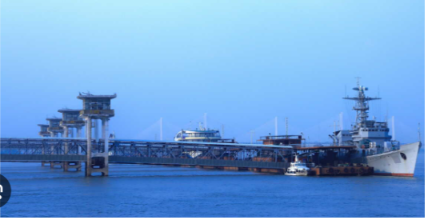
In just a few decades, Beijing has transformed a navy long limited to the defense of its coasts into a force that can venture confidently into the Pacific and beyond. Xi Jinping continues his conquest of the oceans under the worried eye of Washington, now lagging behind in many buildings.
On the oceans, the balance of power is disrupted by the arrival of a new leader. China now has the world’s largest military fleet in number of ships, the Wall Street Journal announced on Sunday, November 1. Its navy is now about 35% larger than that of its great rival, the United States. The Middle Kingdom has 400 warships and submarines, three aircraft carriers, a fourth is also under development, and it is far from over.
Beijing is multiplying shipyards to build, at a steady pace, more and more capacity. For centuries, the country was confined to the rank of continental power. In recent years, he has managed to operate one of the most impressive rearmaments in modern history. « Its sudden emergence represents a challenge for the United States of unprecedented magnitude since the Second World War, » says an analyst to the Wall Street Journal.
« A rhythm not seen for generations »
Every day, a hundred Chinese ships sail on the major Asian maritime routes, where they train or make an appearance on the waters to intimidate their opponents. The rise of this Chinese navy is due to the country’s new status as a « shipbuilding giant » and « first maritime merchant nation ». More than half of the world’s merchant ships are produced every year on its huge shipyards. Beijing chooses to take advantage of these infrastructures and talents also in the military field.
Conversely, Washington is struggling to renew its 290 buildings, to relaunch its projects. Former director of the Naval Intelligence Office, Michael Studeman believes that America suffers from a form of « maritime blindness ». While it retains more imposing ships in terms of tonnage, they are offset by limited construction capacity. China, for its part, mechanically manufactures destroyers, cruisers and amphibious ships « at a pace not seen for generations ».
It also discreetly develops its nuclear submarines. The army could have nine aircraft carriers by 2035, according to the Pentagon’s estimates.
Everything is played on water for Xi Jinping
As early as 2013, Xi Jinping had indicated that he wanted to make his country a « great maritime power », inspired by Admiral Zheng He’s expeditions in the 15th century and the memory of the Opium wars, during which Western powers attacked the territory by sea. What better way than to kill two birds with one stone by exploiting the oceans to meet both commercial and military objectives? Its investments in foreign ports, oceanographic research vessels and shipyards occupy a dual assumed function.
China has also transformed South China Sea reefs into militarized artificial islands, in addition to strengthening its naval bases as in Djibouti.
In Asia-Pacific, the waters surrounding Taiwan, the East China Sea and the South China Sea remain sources of international tension. Beijing wants to strengthen its control, prevent American intervention in the event of a conflict and maintain pressure on Taiwan. For Michael Studeman, China could now « not only challenge, but potentially defeat a large part of the traditional American naval forces », especially in this region.


