

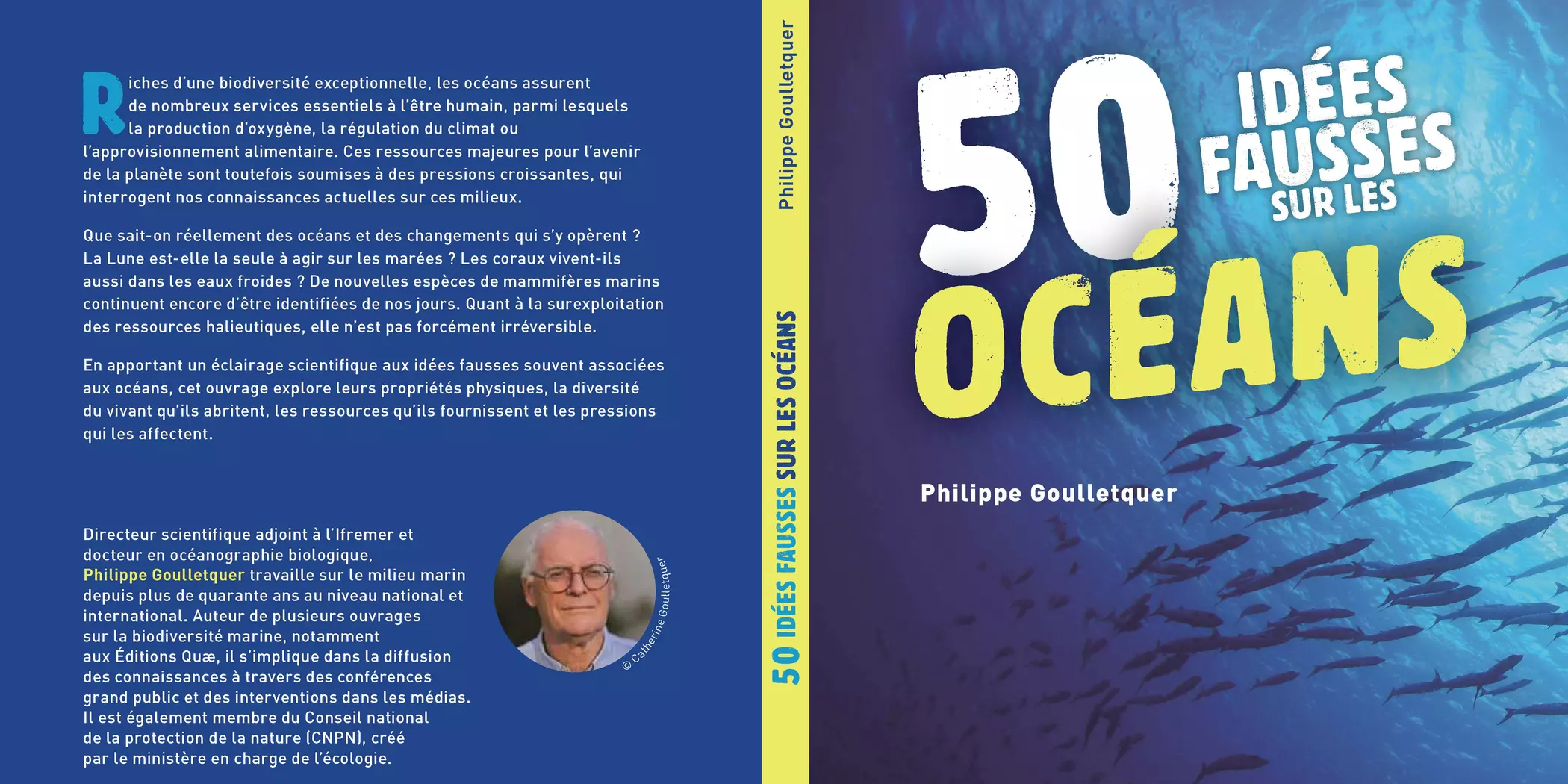
n his new book published by Éditions Quæ, Philippe Goulletquer, an expert in biological oceanography and former deputy scientific director at Ifremer, deciphers 50 misconceptions about the oceans. Accessible, this popular science book sheds a rigorous light on the physical properties of the oceans, marine biodiversity and environmental pressures that affect these environments essential to the planet.
Deconstructing received ideas about the ocean
Is the deep seabed completely obscure? Is the blue color of the ocean due to the reflection of the sky? Do corals live only in warm seas? Can the ocean absorb CO2 indefinitely?
Published on July 2 by Éditions Quæ, the book 50 idées fausses sur les océans confronts received ideas with the most recent scientific knowledge. Through 50 themes, Philippe Goulletquer offers an accessible exploration of the oceans, their functioning and the environmental issues they face.
The book addresses both the physical properties of the oceans and the richness of their biodiversity, the resources they provide or the impacts of human activities on marine ecosystems.
A commitment to the dissemination of scientific knowledge
After more than forty years devoted to marine research within Ifremer, Philippe Goulletquer continues with this book his commitment to the transmission of scientific knowledge to the general public.
The book was born from the many exchanges conducted by the author during conferences, fairs, school meetings and scientific mediation actions. These exchanges have nourished his reflection on the expectations and questions of the public about the ocean and the changes that affect it.
« Our mission as scientists is also to transmit our knowledge to a wider audience, to combat received ideas and to bring nuance through scientific information, » says Philippe Goulletquer.
Better understand the issues of protecting marine biodiversity
Among the topics discussed, Philippe Goulletquer focuses in particular on the issue of the protection of marine biodiversity and associated regulatory mechanisms.
Beyond the international objectives of protecting marine spaces, he recalls that there are many preservation tools still little known to the general public. A better understanding of these mechanisms is, according to him, an essential issue in raising awareness of the challenges of preserving the oceans.
source : ifremer