
Between accelerated warming, water shortage, plastic pollution and toxic discharges, the Mediterranean has become the cruel mirror of a world that disrupts the climate with one hand and transforms the sea into a landfill with the other.
The Mediterranean has long been told as a sea of light, civilizations and passages: that of navigators, merchants, conquests, exiles, myths and exchanges. It remains all that — but it has become, in the same movement, one of the most visible laboratories of climate disorder and human irresponsibility.
It survived the Phoenicians, Romans, Byzantines, Arabs, Ottomans and the wars of the 20th century. Never, however, had it suffered such constant pressure as that exerted today by its own residents. On the one hand, the climate is warming it faster than almost anywhere else on the planet. On the other hand, the 500 million inhabitants of its banks continue to entrust it with their wastewater, their plastics and a large part of their industrial pollution — as if this semi-closed sea had become the largest open-air landfill in a developed world that, between two continents, nevertheless continues to proclaim its love of the environment.
This sea is no longer content to warm up: it suffocates. It receives the excesses of the sky – heat waves, droughts, fires, rising waters – and waste from the earth: plastics, hydrocarbons, pesticides, heavy metals, poorly treated wastewater, industrial discharges… Man asks it to absorb both its fumes, garbage and contradictions.
The scientific observation is now well established: the Mediterranean basin is warming about 20% faster than the world average, making it one of the main hotspots of climate change. This thermal anomaly is doubled by human pressure without equal elsewhere: cities, ports, industries, mass tourism, intensive agriculture and very unequal waste management systems depending on the shore, focus on an almost closed marine space – and therefore particularly vulnerable to accumulation.
A warm sea in a region that is drying up
Mediterranean climate change is no longer a symposium hypothesis. It is already there: in the dams that are struggling to fill, the overexploited groundwater, the crops weakened, the more violent fires, the cities that suffocate under ever longer heat.
The phenomenon is particularly worrying because it combines two dynamics that reinforce each other: the rise in temperatures and the decrease in rainfall. According to regional projections, global warming of 2°C could reduce Mediterranean rainfall by 10 to 15%, with even more severe effects on southern Europe and the Maghreb. Water thus becomes the nerve of the climate war – not tomorrow, but today: Morocco, Algeria, Tunisia, Spain, Italy, Greece and Turkey are already measuring the cost. Drought is no longer an accident, but a structural fact. The Mediterranean climate, once celebrated for its softness, is becoming more brutal, more unpredictable, more expensive; the sun, yesterday’s tourist argument, is changing in places into an agricultural, health and social opponent.
Water, first victim of the new climate
Water is destined to become the great political affair of the Mediterranean century – but it does not weigh in the same way on both shores. In the North, greater financial, technological and institutional resources make it possible to cushion the shock: efficient treatment plants, modernized networks, European policies, agricultural insurance, climate research, massive investments. This does not protect from the crisis, but gives more tools to contain it.
In the South and East, the challenge is tougher. The countries of the Maghreb and the Middle East simultaneously face water stress, urban growth, agricultural pressure, social needs, unemployment, energy bills and constrained budgets — even though they have historically contributed much less to global emissions than industrialized powers. This is one of the great Mediterranean paradoxes: the north shore talks about the green transition while the south bank first fights to secure drinking water and preserve its agricultural land, lest the drought become a factory of social tensions. Europe seeks to become cleaner; the South sometimes seeks, more simply, not to run out of water.
The big trash can between the two banks
The climate is only part of the drama. The other part, even more shameful, is that man voluntarily throws into this sea – which has become one of the largest liquid bins on the planet not by geographical curse, but because it is surrounded by societies that consume a lot, throw a lot and treat their waste very unevenly.
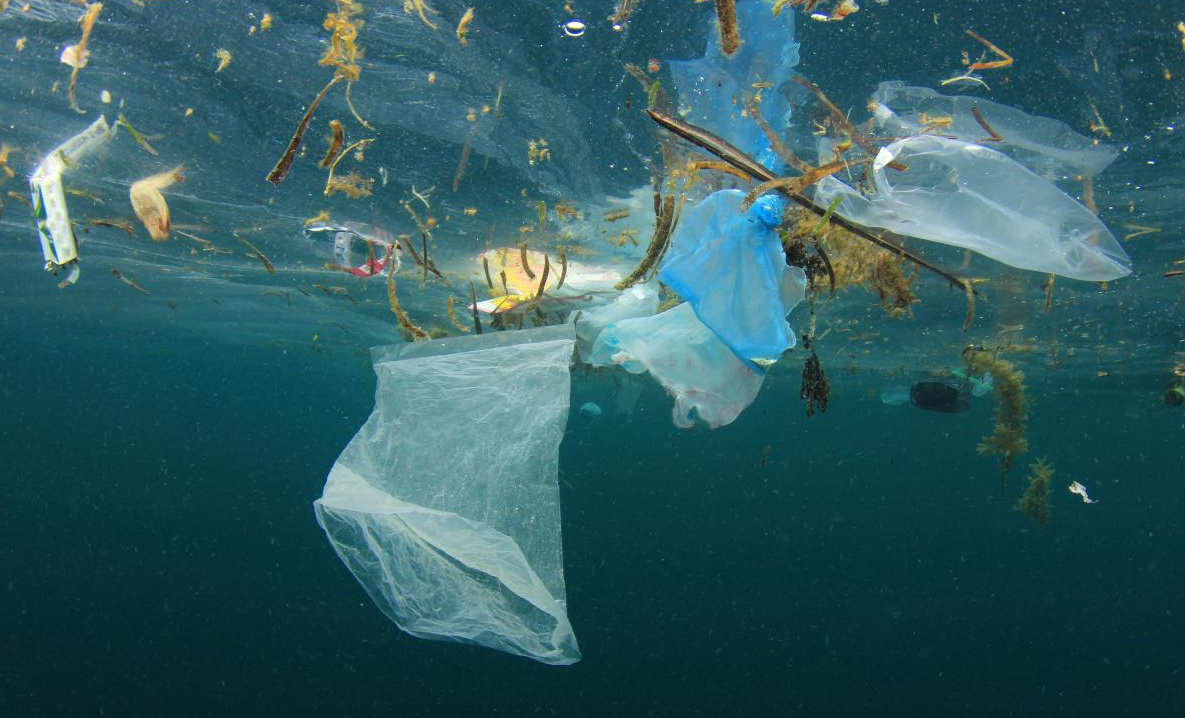
Plastic is the most visible symbol. According to the United Nations Environment Programme, about 730 tons of plastic waste end up in the Mediterranean every day. Plastics represent between 95 and 100% of floating waste and more than half of those found on the seabed; single-use objects alone constitute more than 60% of the waste recorded on beaches.
The abandoned bottle, the bag carried away by the wind, the fishing net lost, the packaging thrown into a waed, the crushed butt near a port: everything converges towards the same destination. The sea receives, patient, swallows, grinds – and sometimes returns what has been entrusted to it, in the form of microplastics found in fish, salt, water, marine organisms and, increasingly, in the human body.
Big polluters in the North, big discharges in the South
We must keep our moral facilities here: Mediterranean pollution is not the work of any exclusive camp, but responsibilities are not distributed equally.
In the North, the large industrialized countries – France, Italy, Spain, Greece, Turkey – bear a heavy responsibility, linked to their level of consumption, their industrial production, their mass tourism, their ports, their maritime transport and their massive use of plastic. Some have better processing infrastructure, but their footprint remains considerable.
In the South and East, Egypt, Algeria, Morocco, Tunisia, Lebanon or Libya face another equation: fewer resources, sometimes failing collection systems, rapid urbanization, poorly controlled landfills, insufficiently treated wastewater, strong demographic pressure on the coasts. Here, pollution is not only a matter of consumption; it also becomes a matter of governance, equipment and public capacity.
Studies on Mediterranean plastic flows regularly point to the major contribution of Turkey, Spain, Italy, Egypt and France – proof that responsibility crosses both shores and resists any simplistic opposition between a virtuous North and a negligent South.
The invisible poison of chemical discharges
Plastic strikes the eye; it is not alone. The Mediterranean also receives less visible, sometimes more insidious pollution: industrial residues, hydrocarbons, pesticides, fertilizers, heavy metals, pharmaceutical residues, solvents, persistent chemical substances. These pollutions do not always float on the surface: they accumulate in sediments, penetrate food chains, contaminate marine organisms and weaken entire ecosystems. European environmental agencies have been warning for years about the cumulative impact of pesticides, agricultural nutrients, industrial activities and certain persistent pollutants.
Hypocrisy, here, is convenient: we can clean a beach before the arrival of tourists, plant two palm trees, repaint a cornice, inaugurate a sea promenade. But the sea does not let itself be made up. It keeps the memory of sewers, factories, ports and bad collective habits – a chemical, patient memory that does not fade to the rhythm of tourist seasons.
Morocco in this Mediterranean equation
Morocco is at the heart of this double challenge. It is suffering from water stress, successive droughts, pressure on dams, overexploitation of water tables and the growing needs of its cities, agriculture and industry. At the same time, it must face the pollution of its coasts, plastic waste, urban discharges, sanitation flaws and tourist pressure that sometimes treats the coast like a holiday backyard.
The Kingdom has committed substantial responses: seawater salination, hydraulic interconnections, irrigation modernization, treatment plants, coastal protection, waste management programs. But the real test is never in the announcement of the project; it is in its execution, maintenance, control and generalization. The climate does not forgive press releases – neither does the sea. A desalination plant produces water; it never replaces a culture of sobriety. A law can prohibit certain plastics; it does not change anything if the bag, bottle, canister, tire and rubble continue to end up in the wadis, on the beaches or in the vacant lot.
An ecological crisis, but also a moral one
The Mediterranean ultimately forces us to look at a disturbing truth: the problem is not only climatic, it is civilizational. We have built societies capable of producing quickly, consuming a lot, throwing away without counting – and then being outraged to find their own waste in the sea. This is undoubtedly the most complete form of what economists call the tragedy of common goods: everyone derives an immediate individual benefit from polluting a little, when the cost is collective, deferred and invisible – until the day when the sea, saturated, ceases to absorb in silence.
Global warming is the big fever; plastic and chemical pollution, slow poisoning. One disrupts temperatures, the other destroys environments. Together, they place the Mediterranean under constant pressure — fires on land, drought in the countryside, rising waters on the coasts, waste in the depths.
The paradox is terrible: never have Mediterranean countries talked so much about ecology, transition and sustainability; never, however, has this sea seemed so saturated by the consequences of our own lifestyles. The Mediterranean is therefore not only a victim of the climate; it is a victim of a model that requires the impossible of it: absorbing our gases, wastewater, plastics, poisons and our bad conscience.
This sea that separates and connects two banks addresses, at the bottom, a lesson of brutal simplicity. The climate changes because man has changed the atmosphere. The sea is suffocating because man pours what he no longer wants to see. And if the Mediterranean is now becoming a big trash between the continents, it is not by geographical accident, but by political abandonment, by collective laziness, and by this old human mania of believing that what we throw away always ends up disappearing.
source : libération