

For decades, the Mapocho River, which flows through Santiago, was an open sewer. In mid-May, a thousand people ran along its banks, a symbol of its reappropriation by the inhabitants of the Chilean capital.
The river that flows through 16 municipalities of this metropolis of nearly 10 million inhabitants received nearly 97% of the city’s wastewater until 2010.
Stretching 110 km, it was highly polluted and no one stopped to look at its brown waters. Those who crossed it held their noses.
« For Santiago, it is a source of pride to recover something that was almost lost, » says Eulogio Cancino, 58, breathless, at the finish of a 10 km race organized to celebrate the saving of the river.
20 km away, in La Ermita, a small town in the Andes mountain range where the Mapocho River originates, Joaquin Moure describes the effects of the vast cleanup program carried out over 12 years.
The river now contributes « to diversity and constitutes a refuge for nature and human beings, » emphasizes the agronomist from the Mapocho Vivo Foundation.
The cleanup, the result of a public-private partnership, required the construction of a 28 km underground network linking 21 wastewater collection points to prevent their discharge into the river.
Transported to new generation treatment plants, the water is decontaminated before being reinjected into the watercourse or used for irrigation, without risk of transmitting typhus or hepatitis, diseases that were common when irrigation was done with untreated wastewater.
« We use all the waste to produce gas, power the plant, and the sludge is transformed into fertilizer for agriculture, » explains Cristian Schwerter, director of planning and engineering at Aguas Andinas, Santiago’s main water treatment company.
For this circular and zero waste economy model, the UN awarded the subsidiary of the French group Veolia at COP24 in Poland in 2018.
– Small endemic fish –
Life has also gradually returned. Around 80 species, endemic, local or exotic, now live around the Mapocho, including coypus, black-crowned night herons and coots.
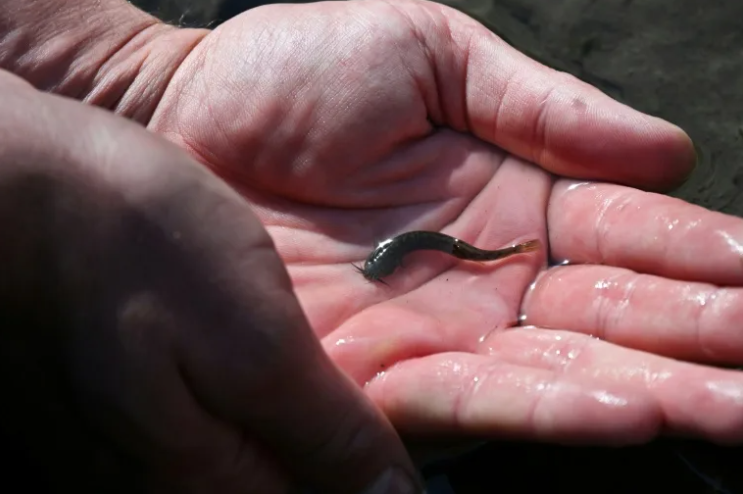
The most emblematic species, however, is the “bagrecito,” a small endemic fish with distinctive whiskers that survives only in clean waters.
“Having a native fish in a water system is good news,” and its return indicates that “everything supporting life is in good condition,” explains biologist Natalia Sandoval, technical director of the Applied Ecology Center.
Holding one of these tiny fish in his hand — barely a few centimeters long and caught as part of an ecological monitoring program — Joaquin Moure is delighted that the Mapocho River has become “safe for it.”
The river was declared an “urban wetland” in January, a status intended to recognize its environmental value and strengthen its protection.
Despite this transformation, waste still remains along certain sections of the riverbanks.
“The Mapocho River changes a lot depending on the neighborhoods it passes through, particularly because several municipalities share its management,” notes architect Margarita Jans from Diego Portales University.
source : yahoo news