
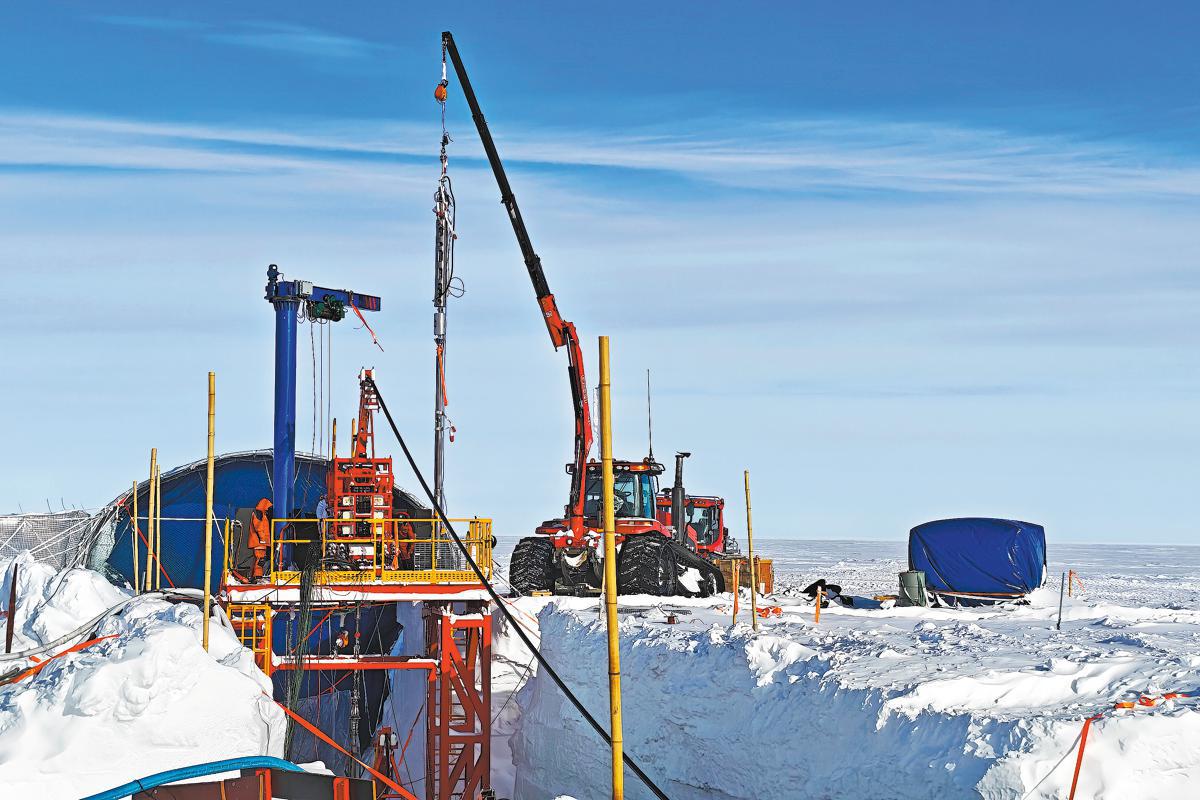
A new step has been taken in the study of Antarctic ice caps with the realization of a drilling up to 3413 meters deep using the Hot Water Drilling system, a non-mechanical technique that uses high-temperature and high-pressure water. It is the deepest well drilled thanks to this technology. The operation allowed access to ancient subglacial lakes which will now be studied to understand the evolution of life in extreme environments, as well as the climatic and environmental variations that occurred in the geological past and whose chemical footprints are preserved in the ice buried in Antarctica.
The news was reported by the Chinese Ministry of Natural Resources and marks the success of the 42nd Chinese National Expedition to Antarctica. From a technological point of view, it is a result of international importance, in addition to being the first well drilled by Chinese researchers with this technology. Previously, a depth of about 2,540 meters had been reached in 2012 in the Greenland ice during the international research project NEEM. The new drilling would be completed on February 5, 2026 in the Qilin subglacial lake region located about 12 kilometers from the Chinese Antarctic resort of Taishan. The drilling technique involves the use of a high-pressure and high-temperature water jet generally above 80 °C, with above 100 liters per minute. The jet gradually melts the ice, creating an access well whose diameter can be up to 30 centimeters.

Compared to traditional mechanical drilling systems, Hot Water Drilling technology ensures greater ability to penetrate the ice, significantly increasing operational efficiency. Indeed, under favorable conditions, it is possible to penetrate a kilometer of ice in a few days. This approach also reduces mechanical disturbances, limits the risk of contamination of the environment and allows you to take cores, i.e. cylindrical samples of ice from depths greater than 3,000 meters. However, many logistical challenges remain, including the transportation of drilling equipment and systems to the remote glacial regions of Antarctica.
From a scientific point of view, this type of drilling makes it possible to reach key interfaces such as subglacial lakes, the base of ice platforms and the subglacial rock substrate. The subglacial lakes of Antarctica, in particular, represent an important new frontier for scientific research. These environments remained isolated for very long periods of time in conditions of extreme pressure, low temperatures, permanent darkness and nutrient shortage. The ice cores extracted from these depths preserve the isotopic composition (including the isotopes of oxygen and hydrogen) of the original water, documenting past temperature variations, atmospheric circulation and the overall volume of glacial masses. Therefore, the study of these systems is fundamental both to reconstruct environmental changes in the Earth’s geological history and to understand the limits of life in extreme environments.
source : libre media