We sort it, we pick it up, we recycle it, but nothing helps: plastic continues to accumulate faster than we can eliminate it. It now pollutes our beaches, the peaks of our mountains, our rivers, our oceans, and even infiltrates our body. In Planète plastique, independent journalist Rémy Bourdillon investigates the origins and harmful effects of this material that has become uncontrollable.
« We talk a lot about recycling, we have developed all kinds of solutions to better manage our waste, but they all have limits. […] The problem is that we produce too much plastic, and it keeps increasing. We must return to the base and reduce production, « says the author in an interview with Le Devoir, a few days before the publication of his book.
Exaggerated to see more and more plastic waste rub shoulders with natural spaces – whether at home, in New Brunswick, or on a paradisiacal beach in the Philippines – he wanted to retrace the path of plastic to understand how we got to this point. His one-year survey led him to Taiwan, a great example of recycling, but also to Southeast Asia, a region that is both a major producer and a large consumer of plastic, which must also deal with waste exported from Western countries.
He also met with people living near production plants, the first victims of plastic pollution, as well as experts and activists who are trying to clean up the planet and attract the attention of decision-makers.
However, the projections are alarming: according to the OECD, global plastic production is expected to triple between 2019 and 2060, from 460 million to 1231 million tons, while plastic waste would rise from 353 million to 1014 million tons at the same time.
From promising invention to plague
Plastic was born from a laudable intention: to replace materials such as ivory or turtle scale, materials then used to make everyday objects, in order to spare endangered species. Inexpensive, practical and infinitely moldable, plastic has quickly become a symbol of industrial modernity and has been massively adopted, in half a century, by both the population and large companies. Coca-Cola, Nestlé, Colgate-Palmolive, Unilever, PepsiCo and Procter & Gamble are now among the largest consumers of plastic in the world.
« In the same way as its parent, oil, plastic is the dream tool that allows capitalism to impose itself all over the planet. It opens juicy markets even where it seemed impossible, it serves the strongest by giving the impression of benefiting to the weak, it constantly increases consumption, but concentrates income in the hands of a small number, « writes Rémy Bourdillon.
In the Philippines, for example, he discovered « the economy of the bag »: shampoo, coffee and laundry soap are sold in individual portions at low prices. A way for major brands to make their products accessible to less-ad-do populations, but which multiplies single-use waste. Bags account for 52% of the country’s non-recyclable plastic waste.
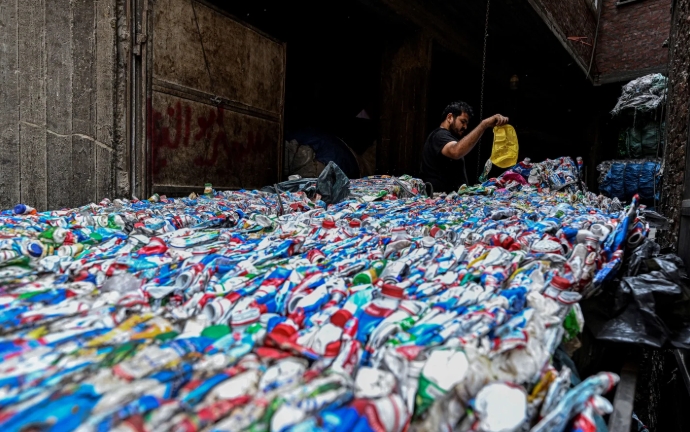
Because the problem is that plastic is difficult to recycle, because it is not degradable, but only fragmentable. Few types of plastic have real recycling value, so that barely 10% of the plastic produced in the world has been truly recycled to date.
« We have the feeling, in the West, that we have good waste management systems. But, in fact, we are big plastic producers. We will point the finger at other poorer countries, while we send our waste there without worrying about their end of life, « explains the journalist.
He says he was outraged to see packaging from Canadian brands such as President’s Choice or Miss Vickie’s in open-air waste disposal facilities in Java, Indonesia. « It’s shocking to see this waste, which has probably been well sorted by someone here, end up on the other side of the world. It’s a form of betrayal. It’s not the contract I signed while recycling, » he says, offended.
Recycling is not the only solution whose limits are highlighted in the book. The author focuses in particular on plastic credits, a mechanism that allows companies to finance the collection or treatment of plastic elsewhere to compensate for their own footprint. According to him, this tool is mainly used to green the image of companies without encouraging them to actually reduce their packaging, the cost of credits remaining too low to create real pressure.
The real solution, says Mr. Bourdillon, is nevertheless known. « The 3R rule: reduce, reuse, recycle. The problem is that we take the problem backwards: we start by recycling when we should reduce first. «
Beyond individual gestures
If consumers can avoid overpackaging or favor plastic-free products, their power remains limited in the face of an industry that is constantly increasing its production.
The responsibility lies above all with governments, which must impose more restrictive rules on companies, believes Mr. Bourdillon. Canada has already banned some single-use plastic products, the author recalls, but we need to go further.
He recognizes that the task is difficult. International negotiations for a treaty on plastic pollution illustrate this well. While some states want to reduce plastic production, others oppose it, especially under pressure from the petrochemical industry.
We must not give up for this. « Writing this book is my way of doing more. I want to shock, I want to awaken consciences, says the journalist. I don’t know if we can solve the problem, but it deserves to be interested, to know it better and to let our governments know that it is a concern, a priority. «