
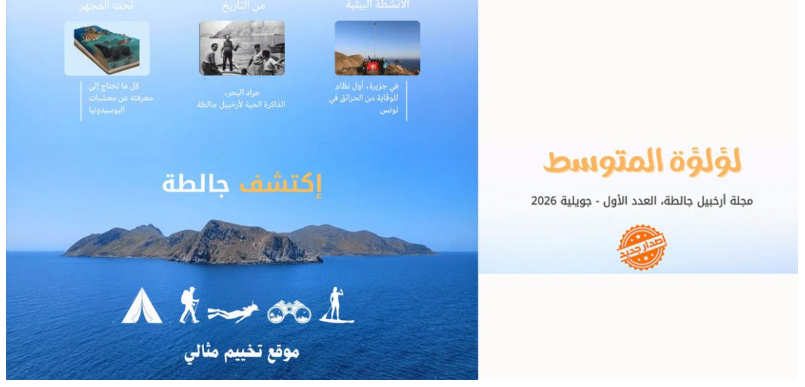
Tell and protect one of the most valuable and least known island ecosystems in the Mediterranean. This is the objective of « Perl of the Mediterranean », a new magazine devoted to the Tunisian archipelago of La Galite, located off the northern coast of the country. The first issue, covering the period from January to July 2026, has just been published.
This initiative, announced by the Tunisian environmental association Méditerranée Action Nature (MAN) and relayed by the TAP news agency, is part of the project « Consolidation of an efficient and sustainable management of the La Galite archipelago », funded by the Critical Ecosystem Partnership Fund (CEPF), an international fund dedicated to the conservation of
of biodiversity.
The publication aims to raise public awareness of the importance of protecting the archipelago’s marine and terrestrial ecosystems, to enhance its historical and cultural heritage, and to document the conservation actions carried out on site, while promoting the sharing of knowledge between researchers, environmental associations and institutions.
The first issue offers several thematic sections, including « Environmental activities » – devoted to protection programs and initiatives – and « Sous le leaupe », which examines in detail the characteristics of animal and plant species as well as natural habitats. A space is specifically dedicated to the history of the archipelago, while the photographic section « Images de La Galite » invites readers to discover the island landscapes, marine fauna and the biological wealth of the area.
Located about 46 kilometers north of Cape Negro, the archipelago includes the main island of La Galite and several surrounding islets. This area, which is distinguished by great marine and terrestrial biodiversity, is a major Tunisian natural heritage, subject to conservation and environmental monitoring programs.
The project supported by the CEPF, entrusted to the MAN association, benefits from funding of about $170,000 for the
period from December 2025 to December 2028.
Among the planned interventions are the strengthening of the participation of local actors in the management of the area, the involvement of fishermen in the monitoring of coralgenic ecosystems, the promotion of sustainable tourism practices as well as the definition of actions in favor of the ecological restoration of terrestrial environments.
This initiative is part of a broader commitment by Tunisia to strengthen the protection of its marine heritage.
According to the International Union for Conservation of Nature (IUCN), protected areas currently cover less than 3% of Tunisia’s marine waters, while the country has launched a program to contribute to the international goal of protecting at least 30% of terrestrial and marine ecosystems by 2030.