The alert is now formal: the ocean, the last major climate regulator, is in turn tilting out of the global security zone. With the acidification of the seas, humanity has just crossed a new critical limit. Seven of the nine planetary limits that guarantee the stability of the Earth have now been crossed. The latter has just been officially exceeded according to the Planetary Health Check 2025 of the Potsdam Institute. One more no-return threshold, while the trend worsens on all fronts.
Until a few years ago, ocean acidification was among the risks monitored, but not yet overcome. This is no longer the case. According to the Planetary Health Check 2025, published by the Potsdam Institute for Climate Impact Research, this limit is now exceeded: for the first time, seven of the nine major balances governing the stability of the Earth are outside their safe zone. This change is not trivial. It means that one of the fundamental pillars of the Earth system – the ocean – is losing its ability to sustainably support human life.
There were nine lines of defense between humanity and climate chaos. Nine natural processes that, for more than 10,000 years, have kept the Earth in this remarkable balance that scientists call the Holocene – this parenthesis of stability within which civilizations have been able to be born, grow, and prosper. Seven of these nine lines have now given way.
The last to fall is the acidification of the oceans. For the first time, the planetary limit on ocean acidification has been crossed. This is not an abstract alert. It’s a diagnosis. That of a planet that loses, one by one, its regulatory capacities.
The Planetary Health Check is an annual report that outlines the state of health of the planet. It synthesizes the latest scientific knowledge on planetary boundaries, while highlighting the most critical evolutions of the Earth system. In its 2025 edition, the researchers dwell particularly on the role of the ocean – and establish, for the first time, that its acidification is now the seventh planetary limit crossed.
An ocean that consumes itself
To measure ocean acidification, scientists use a precise indicator: the rate of aragonite saturation in surface waters, denoted Ω (omega). The average global value of this rate is now 2.84 Ω, just below the global limit of 2.86 Ω. The high-risk zone begins at 2.75 Ω. Humanity navigates between the two, with a trajectory clearly oriented towards the worst.
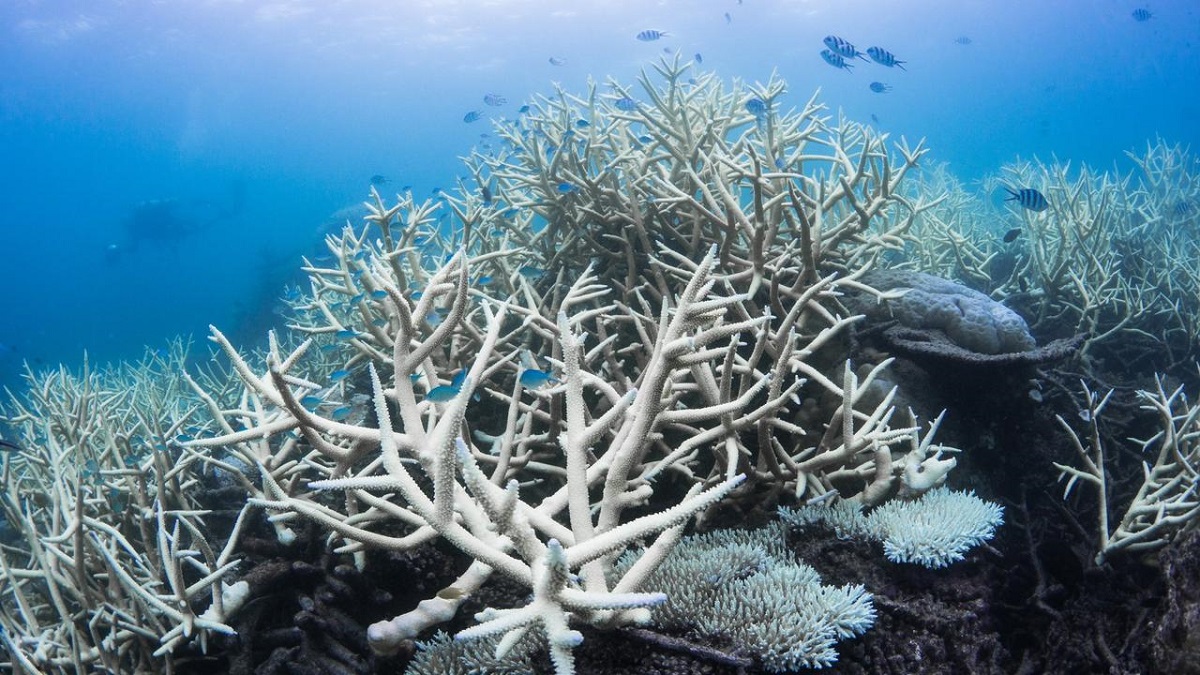
Aragonite is a calcareous mineral on which thousands of marine species – corals, molluscs, crustaceans, some planktons – depend to form their shells and skeletons. When seawater is less saturated, these organisms struggle to build, become fragile, sometimes dissolve. This is not a metaphor: coral reefs, already bleached by heat, are also eaten by acidity.
The only responsible identified by the report is the combustion of fossil fuels, which releases CO2 into the atmosphere. The oceans absorb about a quarter of it — which slows down global warming but chemically transforms them. This buffer role has a cost: dissolved CO2 changes the chemistry of water and lowers its pH. Since the pre-industrial era, this pH has dropped by about 0.1 units, which corresponds to an increase in acidity of 26%. Imperceptible to the naked eye. As a result, since the industrial era, ocean acidity has increased dramatically, reaching a level now considered incompatible with the proper functioning of marine ecosystems.
The Potsdam report acts a turning point: the global limit of acidification is officially crossed; the oceans leave their « safe zone » to enter a zone of increasing risk;
the impacts are no longer theoretical, but already visible.
The great planetary regulator in danger
The living ocean is the largest carbon sink on the planet, its main climate stabilizer, and a major source of oxygen. It represents more than 99% of the Earth’s habitable waters. Without it, the blue planet would resemble Mars – arid, dead, hostile. It is not a figure of speech: it is the literal evaluation of the authors of the report.
Since the 1950s, industrial overfishing, toxic discharges, plastics and noise have contributed to the disappearance of about half of ocean life — from coral reefs to kelp forests, from large mammals to microorganisms. And now, acidification accelerates this bottom movement. A more acidic ocean is a less alive ocean, therefore a less effective ocean to protect the planet from its own human excesses.
Acidification directly weakens marine organisms that depend on calcium carbonate: corals, shells, plankton. This phenomenon triggers a chain reaction: degradation of coral reefs, real nurseries of biodiversity; disruption of ocean food chains; threat to fish resources on which hundreds of millions of people depend. But the issue goes far beyond biodiversity. By losing efficiency, the ocean absorbs less CO2, which accelerates climate change – a formidable vicious circle.
What scientists fear is not only the gradual degradation, but the crossing of tipping points. Beyond certain thresholds, natural systems can change abruptly and irreversibly, creating the collapse of coral reefs, the disorganization of ocean currents, and the lasting loss of the ocean’s ability to regulate the climate.
The Planetary Health Check points out that the more the boundaries are crossed simultaneously, the more likely these changes become.
Seven out of nine: the overall table
Ocean acidification is not an isolated anomaly. It is part of a systemic collapse of the Earth system. The report concludes that seven of the nine planetary limits have been crossed — climate change, biosphere integrity, land use change, change in the freshwater cycle, change in biogeochemical flows (nitrogen and phosphorus), the introduction of new chemical entities, and now ocean acidification. All these limits show a trend towards worsening, suggesting further deterioration in the near future.
Only two limits remain in the safe zone: the atmospheric aerosol load (in slight improvement) and the stratospheric ozone layer (stable). Two victories, seven losses – and all the defeats worsen simultaneously.
The numbers are dizzying. Atmospheric CO2 concentration reaches 423 ppm in 2025, well beyond the global limit of 350 ppm, while total anthropogenic radiative forcing amounts to +2.97 W/m², double the high-risk threshold set at +1.5 W/m². The extinction rate of species is ten times higher than the safety limit. More than a fifth of the lands are experiencing major water cycle disruptions.
The rhetoric of the emergency is no longer enough
This report is not the first to sound the alarm. The framework of planetary limits has existed since 2009, introduced precisely to visualize these critical thresholds before it is too late. However, since 2009, the situation has not stabilized – it has deteriorated on almost all fronts. The natural absorption capacity of carbon is weakening: terrestrial carbon sinks are saturating or turning into emission sources, and global warming seems to be accelerating.
The authors of the report are explicit: it is no longer just a question of reducing emissions, but of understanding that the nine limits interact with each other, reinforce each other in their overrun. Deforestation aggravates climate change that aggravates the loss of biodiversity that reduces the ability of ecosystems to absorb carbon. Acidification weakens the oceans that sequestered this same carbon. Everything is up — in the disaster as in the solution.
The report is a call to action. With each new discovery comes an increased responsibility: protecting global commons, investing in restoration, training a new generation of planetary guardians — before tipping points become points of no return. Seven out of nine. The eighth is not far away.
With the acidification of the oceans, humanity does not cross one more limit — it touches one of the very foundations of planetary stability. The ocean, long considered a silent ally, now shows signs of saturation. And the message of the report is clear: the Earth does not collapse all at once, but gradually slides out of its state of equilibrium.
Doubt is no longer allowed: the planet is tipping over. It remains to be seen whether humanity will be able to transform itself in time to keep its place there because preserving the stability of the Earth is no longer an option, but a vital necessity: it implies bringing humanity back within planetary limits. These thresholds, defined by science, are the safeguards that make the planet habitable. As long as we evolve in this safe space, the Earth remains a reliable home; beyond, we expose our own survival system to potentially irreversible disruptions. However, today, seven of these nine limits have already been crossed.
source : UP magazine