
A new study by Climate Central concludes that human-made global warming, more than the natural El Niño phenomenon, is primarily responsible for global coral reef bleaching episodes observed over the past four decades.
The episodes of massive coral bleaching recorded in the last 40 years are mainly due to ocean warming caused by greenhouse gas emissions related to human activities, according to a study conducted by the Climate Central organization and which will soon be published in the journal Oceanography.
By combining a method of attribution of extreme weather events with the risk models of the National Oceanic and Atmospheric Administration (NOAA), the researchers evaluated the respective influence of human-made climate change and the El Niño phenomenon on marine heat waves responsible for reef bleaching.
Their findings show that rising ocean surface temperatures due to human activities are now the main factor in major global bleaching crises.
Human influence is now decisive
While the major bleaching episodes of 1998, 2010, 2014-2017 and 2018-2025 have long been attributed mainly to El Niño, the study believes that this natural phenomenon alone would not have been enough to cause such events on a large scale.
For the most recent episode, covering the period 2018-2025, the researchers indicate that, among the 71 regions affected, only one would have experienced a moderate risk of bleaching in a scenario free of human-made global warming.
« Without climate change caused by human activities, coral bleaching would have remained a rare and localized phenomenon, » says Andrew Pershing, Climate Central’s program director and lead author of the study.
He recalls that the consequences go far beyond marine ecosystems, millions of people dependent on coral reefs for their food, income and coastal protection.
New episodes expected
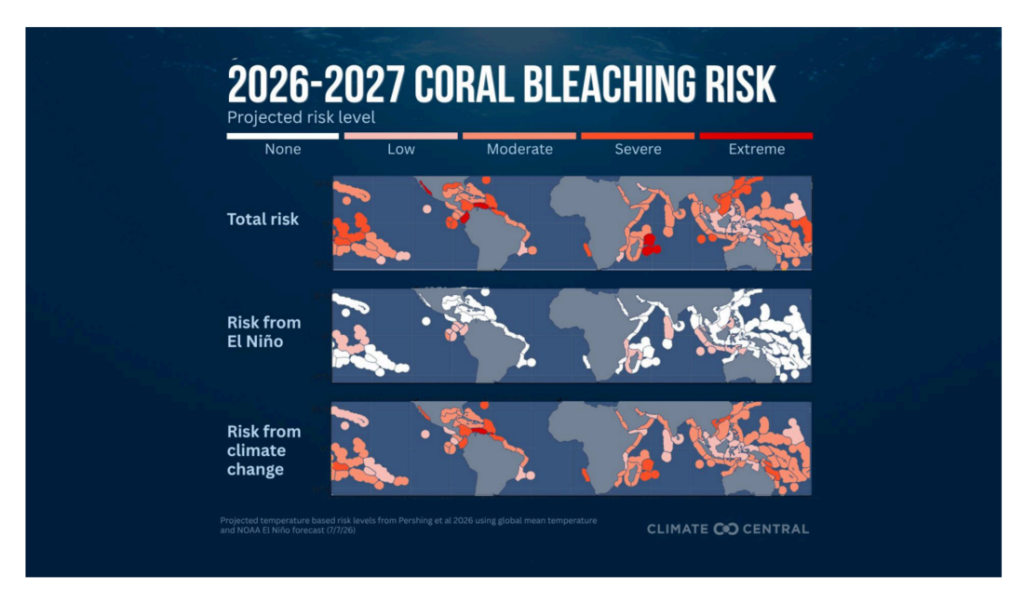
Researchers anticipate new episodes of massive bleaching between 2026 and 2027, especially in the southern Caribbean Sea, on the coasts of Central and South America, as well as in several regions of East Asia.
The study also identifies a major threshold: from 2028, the influence of human-induced global warming should exceed that of El Niño in all reef regions of the globe.
Scientists believe that corals retain a certain adaptive capacity, but warn that only a rapid and substantial reduction in global greenhouse gas emissions will limit the lasting degradation of these ecosystems, which are home to nearly a quarter of marine biodiversity while covering less than 1% of the ocean floor.