

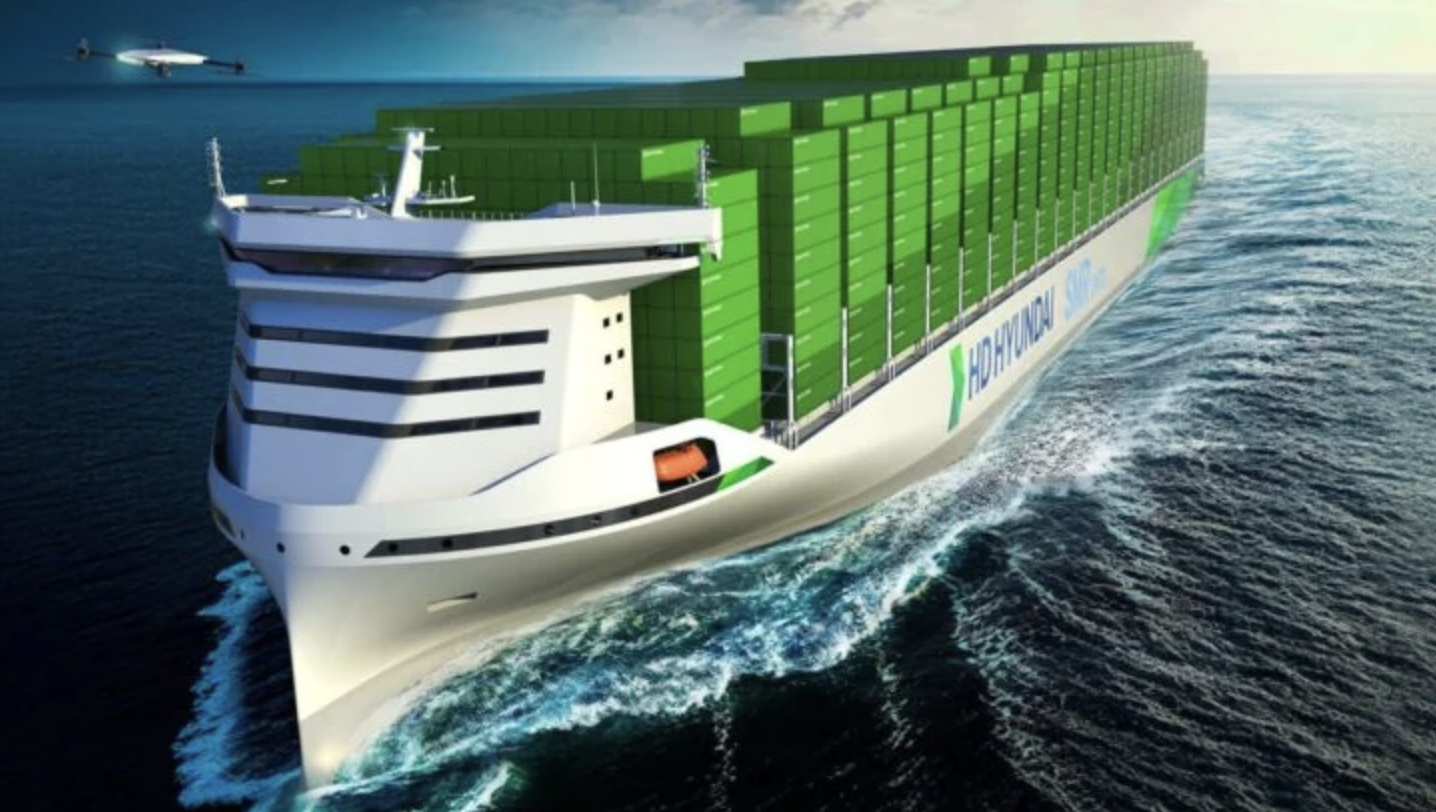
The South Korean shipbuilding giant is developing a nuclear container concept powered by a small modular reactor. This ship could sail carbon-free on the longest sea routes.
The decarbonization of maritime transport is a major technical paradox. Batteries offer a viable solution on short journeys, but ocean crossings require an energy density that only fossil fuels provide today. Hyundai’s nuclear container project offers a radical alternative to this technological lock.
Hyundai joins forces with the U.S. Ship Classification Bureau
HD Korea Shipbuilding and Offshore Engineering, Hyundai’s naval division, signed a joint development agreement with the American Bureau of Shipping (ABS) in March 2026. The goal is to design the first commercial tainer carrier powered by a modular nuclear reactor, with a capacity of 16,000 EVP (equivalent to twenty feet). This ship would be equipped with a double-propeller electric propulsion system, powered directly by a small SMR (small modular reactor) reactor.
The concept is based on a molten salt reactor using thorium as fuel. This technological choice has several safety advantages. In case of emergency, the cooling salt can solidify and stop the nuclear reaction passively. A double stainless steel enclosure also protects the reactor against external aggressions. Unlike heavy fuel oil, this energy source does not emit any carbon dioxide during navigation.
A nuclear container carrier facing the limits of green alternatives
Shipping accounts for about 3% of global human-made CO2 emissions. The International Maritime Organization imposes a 20% reduction in these emissions by 2030 and aims for carbon neutrality by 2050. There are several ways to achieve these objectives, including battery-powered electrification, hydrogen and computer-assisted sailing. However, none of these solutions fully meet the needs of the largest cargo ships on transoceanic roads.
The batteries remain too heavy and bulky to propel a 16,000 EVP ship over thousands of miles. Blue hydrogen, produced from natural gas, is only a transitional solution. Nuclear power, on the other hand, offers an energy density comparable to that of fossil fuels, with the advantage of suppressing carbon emissions. This technology has also proven itself for decades on military aircraft carriers and submarines.
source : science et vie