
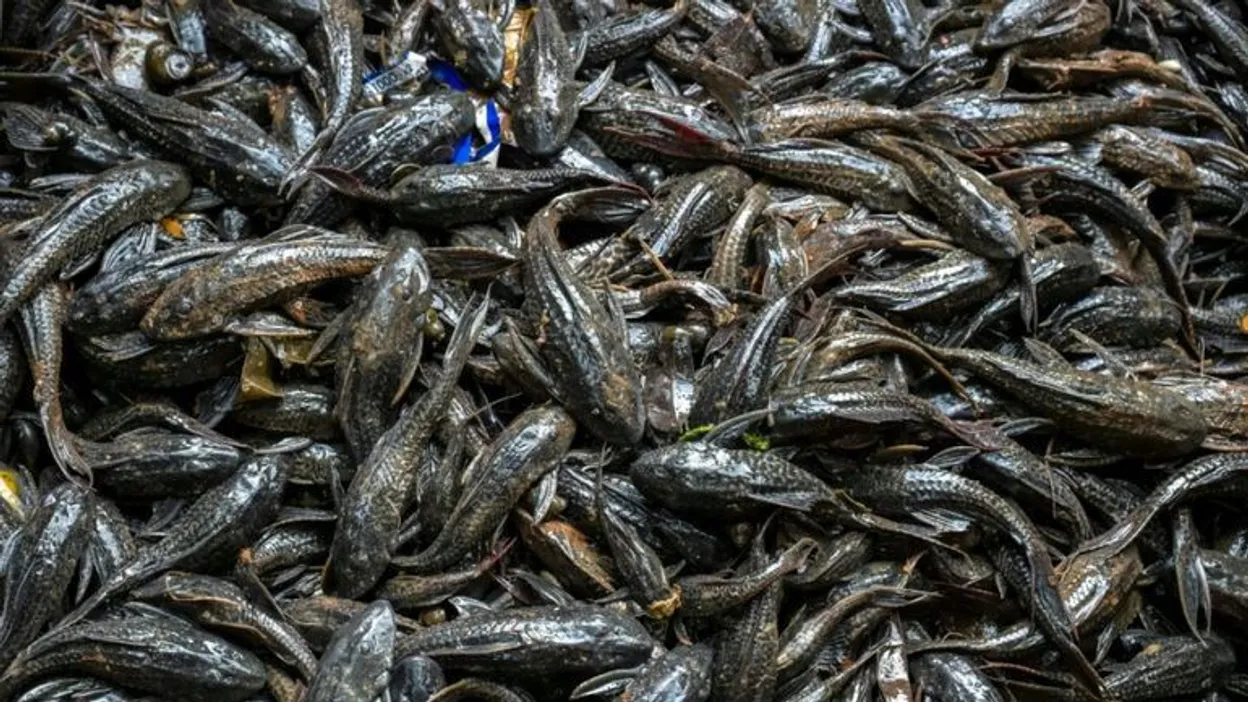
The fruitful catch of the day is piling up on the banks of a river in Jakarta, where a fierce fight is being fought against an invasive fish that thrives in the heavily polluted rivers of the island of Java.
Hypostomus plecostomus or pleco, called sapu-sapu in Indonesia, is a catfish native to South America, introduced decades ago to rid Southeast Asian aquariums of algae.
This freshwater fish that can measure more than 50 cm settled in the Javanese rivers, often after being released because it became too big for its aquarium.
Unlike the Amazon River where it has natural predators, the sapu-sapu quickly invaded Java, surprisingly adapting to polluted waters to supplant native freshwater fish.
« The fact that there are thousands of fish (sapu-sapu) in some of these rivers, where the rivers are deep black, almost smelling of rotten eggs (…) is completely crazy, » says Gary Bencheghib, a river depollution activist.
It accommodates wastewater
Eliminating sapu-sapu does not solve the real problem, adds this man who travels 1200 kilometers between Bali and Jakarta to raise funds for river cleaning.
« The real solution is to clean up the waste that (fish) feeds on (…) and found in these polluted waters, » adds Gary Bencheghib, co-founder of the NGO Sungai Watch.
According to the United Nations Environment Programme (UNEP), more than half of Indonesia’s rivers are heavily polluted, and two of the country’s main river networks are among the dirtiest in the world.
Nationwide, only 7.4% of wastewater is collected and treated properly.
The Greater Jakarta region, a metropolis of 42 million inhabitants facing significant water stress, is particularly affected.
But the sapu-sapu is capable of living in oxygen-poor and polluted waters. They also dig holes in the banks of rivers to lay their eggs, which weakens the walls and can cause them to collapse.
Elimination campaign in Jakarta
In recent weeks, Jakarta has embarked on a campaign to eliminate the species, with the help of residents, maintenance workers, employees of the Ministry of Fisheries and even soldiers.
In two weeks, some 5.3 tons of this fish were removed from the rivers in southern Jakarta alone, said Mayor Muhammad Anwar during an operation on Lake Babakan.
Sapu-sapu are fished with nets, then separated from native fish released into the water. They are then beheaded to make sure they are dead and then buried.
Some animal activists criticize this procedure, believing that it wastes the resource. According to them, the fish skin could be used to make fish leather products and the rest transformed into fertilizer or animal feed.
« A dangerous snack »
But others claim that the fish are too contaminated to be usable.
And certainly unfit for human consumption. Sapu-sapu contains « heavy metals and is dangerous for humans, » says the mayor. Analyses have revealed the presence in some sapu-sapu of traces of lead and mercury as well as E. coli bacteria at levels above the safety thresholds.
This does not prevent some from putting it on their menu. « In some places, it (sapu-sapu) is consumed in siomay (steamed fish balls) and pempek (fish fritters), a dangerous snack, » says the mayor of Jakarta. « Please, » he warns. Be careful when buying fish croquettes. Don’t be seduced by the (low) price.
source : rtbf actus