
The Ma’o Cycling project, underway off the coast of Tahiti, has made it possible to identify and scientifically confirm the presence of smooth hammerhead sharks in the Central Pacific, bringing to three the number of species of this type of sharks in French Polynesia, reports our partner Radio 1 Tahiti.
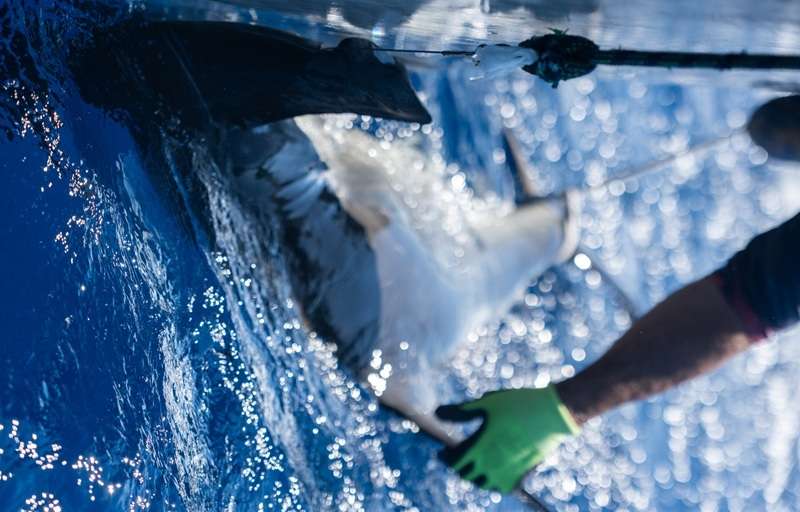
The presence of a new hammerhead shark species in French Polynesia was confirmed with a publication, on March 25, of the teams of the Institute for Research on Mesophotic and Deep Ecosystems (Iremp) in the Journal of Fish Biology, a world reference in research on the study of fish (ichthyological). This confirmation was made possible after the capture of two females, named « Tere » and « Poe », on which morphological and genetic data were collected, thus validating the presence of the smooth hammerhead shark (Sphyrna zygaena) in French Polynesia.
This hammerhead shark has the particularity of having the cephalofoil (distinctive part of the shark, called « hammerhead ») curved and without crease on the front edge of the head, and a solitary and « highly oceanic » behavior, that is to say, which evolves offshore, on the high seas. This discovery « brings to 35 the number of shark species officially confirmed in Polynesian waters, » explains Clémentine Séguigne, head of the Ma’o Cycling project.
Information sharing
This discovery was made possible by the sharing of information from naturalists (divers, sea users, fishermen), who reported to Iremp the observation of solitary hammerhead sharks offshore, which does not fit with the behavior of the halicorn hammerhead shark. The Ma’o Cycling project then made it possible to make observations in the field.
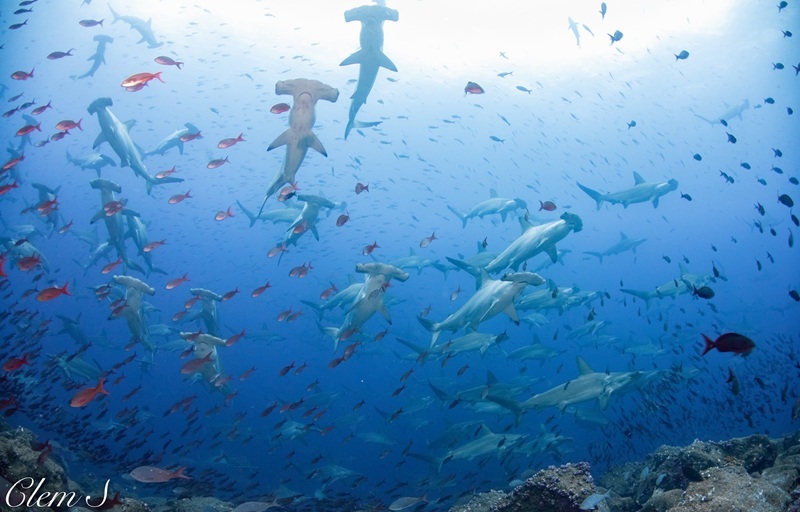
Three different species of hammerhead sharks populate Polynesian waters. Photo Clémentine Séguigne / Iremp
According to the researcher, the smooth hammerhead shark is an antitropical shark, which is found rather in temperate zones, in the northern and southern hemispheres. Until now, it was not known in the Central Pacific, which hypothesizes that it « could make the link between the populations of the North and Southern hemispheres ». But this still remains to be proven, since the veil has just been lifted on a species that has not yet been studied or included in the environmental code, even if it could be present in these waters « for a long time« .
Study deeper and more isolated areas
An interesting element for research as a whole: « This means that there are areas that are much less sampled than others, we study a lot the most easily accessible environments: coastal and shallow environments. It opens up perspectives on the importance of looking at less accessible environments, isolated areas, the wide and deep environments. Today, we must put effort into the study of oceanic and deep biodiversity, » adds the project manager.
This presence officially brings to three the number of hammerhead shark species present in Polynesia, alongside the great hammerhead shark (Sphyrna mokarran) and the halicornia hammerhead shark (Sphyrna lewini), and 35 the number of shark species.
source : Les Nouvelles Calédoniennes