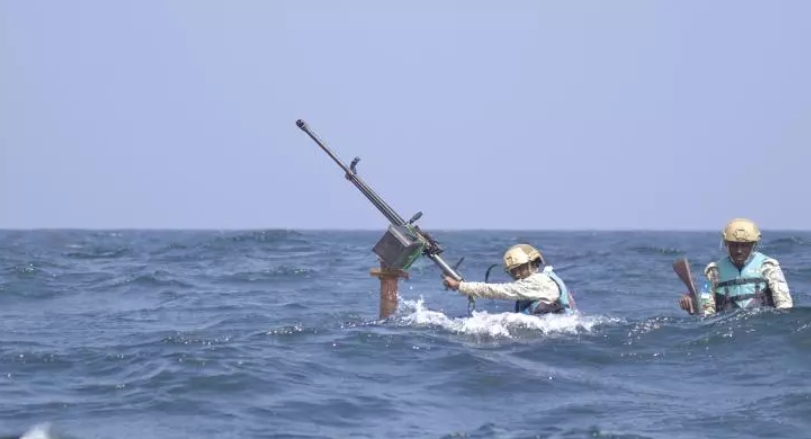
Since April 2026, pirate attacks off the coast of Somalia have multiplied at an unprecedented rate for more than ten years. This resurgence comes at a time when maritime trade is already severely disrupted by the war in Iran and the resulting blockades in the Straits of Hormuz and Bab el-Mandeb.
While Iran and the United States have been fighting for several months for control of the Strait of Hormuz and the Houthis, Tehran’s allies in Yemen, impose a targeted blockade in the Bab el-Mandeb Strait, the Somali coastal pirates take advantage of the chaos to multiply targets. According to maritime security analysis, more commercial ships are approaching the Somali coast to avoid conflict zones.
At least 13 ships were shipped between January and the end of August 2026, six of which were still retained for ransom at the end of the month.« Piracy is always a crime of opportunity, and here, pirates see an opportunity, » summarizes Omar Mahmood, Somalia analyst at the International Crisis Group (ICG), quoted by British radio, the BBC.
(Re)Read Mine-layering Boats, submarines… How is Iran « preparing » to mine the Strait of Hormuz?
With this war between the United States and Iran, the pirates « think that international forces will be monopolized by Hormuz and Bab al-Mandab, and will no longer monitor piracy, » Vice-Admiral Ignacio Villanueva Serrano, commander of the operations of the European Union naval force off the coast of Somalia, told the BBC. According to maritime security analysis, a decrease in anti-piracy patrols has been recorded since the beginning of the conflict.
Symbolic ship catches
Among the last catches, the MV Lutuf, a Cameroonian-flagged cargo ship, was attacked on August 17 off Puntland, a semi-autonomous region in northern Somalia. A few days later, on August 20, the MT Sibu 1, an Eritrean-flagged oil tanker, was randed near the Yemeni coast, on the other side of the Gulf.
The Lutuf has since been released. According to several investigations, the Sibu 1 would belong to an Iranian « ghost fleet » used to circumvent US oil sanctions, which makes its capture particularly lucrative and politically sensitive.
A total of six ships are currently being held for ransoms of several million dollars, including four anchored near Bander Beyla, a fishing port in Puntland known as a source of piracy, according to information collected by the BBC.
Foreign industrial fishing contributes to anger
Locally, the resurgence is also fueled by anger against foreign trawlers who plunder Somali waters, ruining the small-scale fishing that keeps the communities of Puntland alive. « You have this combined effect: fewer naval patrols, but more merchant ships in these waters, and this signals an opportunity, » explains Omar Mahmood, who notes that a successful attack often encourages copies.
The situation has deteriorated further in recent days in Puntland after a drone strike killed four people off the Nugaal region, following the landing of the ship suspected of carrying Turkish weapons.
The first information about the attack (attributed to Turkey, which did not comment) indicated that the victims were pirates. Local accounts then claimed that three of those killed were fishermen and that only the fourth had had contact with the hostage-takers.Tweet URL
The government of Puntland said that there were bombings against fishermen on August 25 and 27. The federal government only acknowledged on Sunday that it had been informed in advance of the strike, but it doubted that the victims were civilian fishermen. Unlike the federal executive, Puntland has close ties with the United Arab Emirates, a rival of Turkey for influence in the region.
Turkey in turmoil
Turkey, which has signed a maritime defense and security agreement with Mogadishu, is said to be directly involved: Puntland security sources and a federal government official say that the Lutuf cargo ship was carrying weapons and satellite equipment for a Turkish training base and a space station under construction north of the capital.
Six international warships (two Turkish, one Spanish, one Danish, one American and one Indian) would have converged towards the Lutuf area, according to these same sources, which are difficult to independently verify. The Turkish Ministry of Defense only says it provides « necessary support » to the Somali authorities, without confirming or denying the deadly drone strikes.
On the ground, the versions diverge: Mogadishu claims to have conducted a joint operation with Turkey, which would have made it possible to liberate the ship by killing 14 pirates. Puntland, for its part, denies and assures that a heavy ransom has been paid, a « serious error » that risks relaunching kidnappings.