
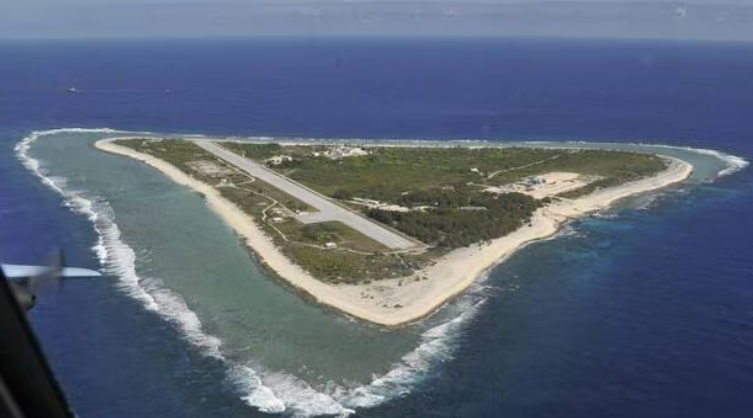
From our correspondent in Tokyo, Johann Fleuri This Monday, the mayor of the Ogasawara archipelago, off the coast of Tokyo, gave his green light for the uninhabited island of Minamitori-shima to be the subject of a study: the decision to build a nuclear waste landfill structure with high radioactive activity, after vitrification, will depend on the results of the latter. Conducted by the company Numo, the investigation is scheduled for twenty years.
Minamitori-shima is added to Sutt-su, Kamoenai and Genkai, the three other municipalities under study since
2020. In recent years, the Japanese government has encouraged municipalities to apply for the reception of this project and hopes to have more: but the prospect of confining radioactive waste underground for thousands of years alarms the local population as much as researchers.
« Minamitori-shima Island has significant volcanic activity within 50 km of its coast, » explains Hajime Matsukubo, researcher and secretary general of the Nuclear Information Center for Citizens. Its seabed is steep and a layer of limestone several hundred meters thick, not very waterproof, has been deposited there, making it difficult to bury safely. »
The researcher continues: « It is 1800 km off the coast of Tokyo.
The transport of waste by sea will be complicated and if there is an earthquake or a tsunami, it will be very difficult to intervene over such a long distance. »
The island is 1,800 km off Tokyo. If there is an earthquake or a tsunami, it will be very difficult to intervene.
In addition to volcanic activity and earthquakes, the government faces another obstacle: the resistance of the inhabitants. In the village of Suttsu, Hokkaido, the study was delayed due to the opposition of a large part of the population, who are rebelly against the project and the fact that their mayor proposed their city as a candidate without consulting them.
At each stage of the survey, municipalities receive subsidies: Suttsu was awarded two billion yen for accepting that the study start. A sum that represents almost half of its annual budget (5.4 billion yen).