

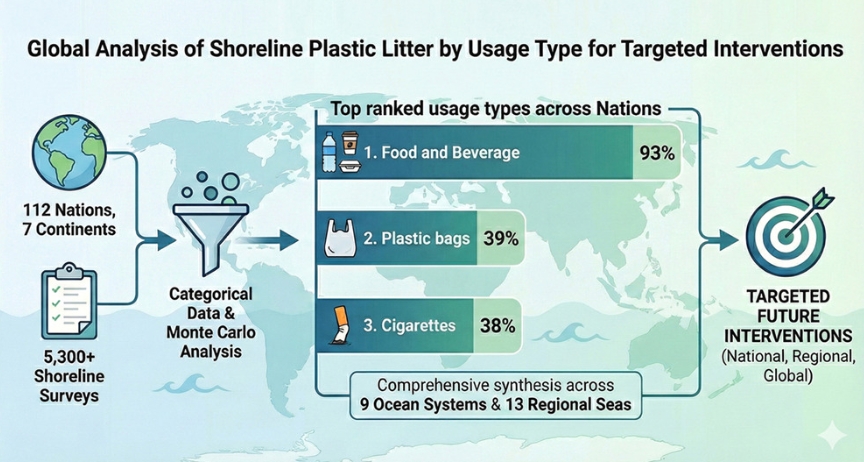
Our planet faces a growing crisis as plastic debris accumulates in every corner of the ocean. This pollution compromises the health of marine ecosystems, threatens food security, and places a heavy financial burden on coastal communities, particularly in low-income countries. While we know the problem is vast, significant uncertainty remains: which specific products are the primary culprits globally? As a result, interventions remain fragmented. We analyzed coastal litter in 112 countries, representing 86% of the world’s population, to identify the most common items based on their use. We show that food and beverages are almost universal as major pollutants, highlighting a clear and priority target. These findings mean that society can move beyond « one-size-fits-all » solutions. By prioritizing the reduction of certain high-impact items at national and global levels, through targeted legislation and sectoral changes, we can more effectively protect environmental and human health.
Summary
Plastic pollution represents a pervasive global environmental challenge. However, the lack of harmonized global monitoring hinders the development of targeted interventions. Here, we develop a ranking-based approach combining over 5,300 shoreline surveys and Monte Carlo analysis to present a confidence-weighted global assessment of marine litter across seven continents, nine ocean systems, 13 regional seas, and 112 nations, representing 86% of the world’s population. The analysis shows that food and beverage plastics dominate rival litter globally, ranking among the top three most abundant types of use in 93% of countries, followed by plastic bags (39%) and cigarettes (38%). More specifically, plastic food packaging, caps/lids, and plastic bottles were among the highest-ranking individual items in more than half of the countries. By identifying the most prevalent elements at national and regional levels, our framework provides essential evidence for public policy as well as associated confidence levels, indicating the need for targeted upstream responses focused on short-lived plastics.