
Mediterranean lagoons are becoming increasingly stifling as climate change progresses. During summer marine heatwaves, it sometimes gets so hot that some of their inhabitants are forced to seek refuge at sea – an escape that risks disrupting their growth and, ultimately, their reproduction. This is the finding of a study published in the journal Marine Ecology Progress Series on April 30, focusing on gilthead seabream , an emblematic coastal population.
“Our work shows that temperature plays a major role in the movements of these fish,” summarizes Jérôme Bourjea, a fisheries and conservation biology researcher at the French Research Institute for Exploitation of the Sea (Ifremer) and co-author of the article. The gilthead seabream does indeed have a seasonal life cycle: from April to September, it inhabits the sandy-muddy bottoms of the lagoons in the Gulf of Lion in search of mollusks, crustaceans, and algae. In October, the cooling of the lagoon water marks the beginning of its migration to its spawning grounds.
Previous work by Jérôme Bourjea and several researchers from French and international laboratories, published on February 23 in Movement Ecology, had helped to pinpoint the destinations of migratory fish. They relied on « acoustic telemetry, » a technique that uses hydrophones to detect the movements of fish equipped with acoustic transmitters. This method, which is used, for example, to assess the impacts of offshore wind farms, has seen spectacular development in Europe in recent years, where more than 3,500 listening stations allow for the continuous monitoring of the movements of 33,000 animals from some 200 species.
Highly sensitive environments
This method allowed researchers to identify the Calanques National Park and the Côte Bleue Marine Park, near Marseille, as major spawning grounds for the 222 gilthead seabream tagged by the scientists. However, some of the seabream, associated with the Leucate lagoon in the Aude region, prefer to spend the mating season in Spanish waters. The fish then return to the lagoons, where they feed and grow.
Mapping migration
Cross-referencing the data from each receiver allows us to reconstruct the movements of the tagged sea bream.
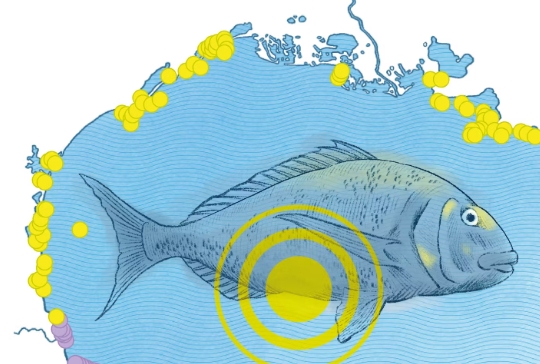
Between 2019 and 2022, the hydrophonic network enabled the tracking of 222 tagged sea bream at nine sites along the coast.
From April to September, sea bream remain on their feeding grounds in lagoons or at sea in an area no larger than a few football fields.
From October to November, they migrate to Marseille to breed. They favour the rocky areas of the Côte Bleue Marine Park and the Calanques National Park, but part of the population from the Leucate lagoon migrates to Spain.
After reproduction, the sea bream return to their original lagoons, followed by the larvae and eggs, carried by the current.
These findings could contribute to the implementation of management measures at breeding sites, a crucial phase to protect stocks under pressure due to intense recreational and commercial fishing activities.
Water temperatures play a major role in the movements of gilthead seabream. They represent the « determining factor » of their departure and return from migration, and also cause the fish to flee to sea if the lagoons become too warm.
This is where the problem lies: these shallow coastal environments are highly sensitive to summer heatwaves. In July 2019, the water temperature in the Prévost pond reached 31.9°C. This lagoon in the Hérault department, located near the town of Palavas-les-Flots, was closely monitored by researchers. They combined hydrophones with temperature recorders and used sensors to measure oxygen saturation in the water to better understand the movements of the 72 fish fitted with transmitters.
“We wanted to know what they were doing in the lagoon: do they come out when it’s hot? Do they stay in the same place?” explains Mr. Bourjea. This data allowed researchers to observe gilthead seabream venturing out to sea when the lagoon overheated. The scientists then combined this movement data with a study of the heart rate of individuals placed in Ifremer tanks under different temperature conditions. The results suggest that a temperature of 29°C represents a warning threshold for the species.
Beyond this level, which may be lower in the natural environment, the heart rate plateaus. This indicates « that the heart was no longer able to meet the increased metabolic oxygen demand and that the animal’s activity levels would become increasingly limited, » note the researchers, who believe that the gilthead seabream’s summer trips to sea are actually « refuge migrations » in response to the heat. Moreover, they don’t wait until the temperature reaches 29°C to leave the lagoon: numerous departures have been observed when water temperatures exceeded 27°C.
“Fewer reserves”
This knowledge is all the more crucial given that the Mediterranean is on the front lines of climate change. « We are in an area of the world that will be particularly affected by extreme events, » notes Lydie Couturier, a marine ecology researcher at France Energies Marines, who was not involved in the study and praises the work as « very comprehensive. »
Even brief sea voyages by gilthead seabream have significant consequences: it means less time for the fish to feed in these coastal environments. « The seabream will build up fewer reserves and therefore be less productive in terms of reproduction, » warns Mr. Bourjea. « Ultimately, with rising temperatures, there could be an entire summer period when the lagoon waters are too warm for them to remain. »
The question arises as to the future of the species, whose life cycle is likely to be increasingly disrupted, like other Mediterranean populations also highly prized by fishermen. « Mobile species have the ability to seek out thermal refuges that are beneficial to them, » emphasizes biologist Philippe Lenfant, professor at the University of Perpignan and co-author of the first study published in February. « But is the habitat available? It’s not necessarily a given. » Implicitly, the question of fisheries management also arises in these waters, which are highly exposed to warming.