
Once a maritime power that controlled the western Mediterranean gateway, Spain would now see its strategic influence dissolve in step with the rise of Morocco, the disappearance of its merchant flag and the cooling of its Atlantic ties, revealing a historic shift in the geopolitical center of gravity between the two shores at the Strait of Gibraltar.
Spain is witnessing the gradual weakening of one of the historical pillars of its external power: its dominance of the maritime routes linking the Atlantic and the Mediterranean, which for centuries allowed it to occupy a decisive position between Europe, Africa, and the Americas. This occurs at a time when the Spanish Association of Military Writers and the Naval Reflection Center, in a document entitled » The Degradation of Spain’s Geostrategic Position and its Role as a Geopolitical Pivot , » describe a state « once a strategic player, now reduced to the role of a geopolitical pivot whose mere presence can still influence the movements of the major powers . » According to the document, « the security of the Strait of Gibraltar and the flow of maritime transport in both directions, especially from east to west, depend on [Spain’s] position , » emphasizing that « Madrid’s dominant position in the Strait of Gibraltar should constitute the very axis of official geopolitics . » Through this extremely harsh reading of the Iberian situation, the image emerges of a country which, despite its two archipelagos, its North African points, its 7,661 kilometers of coastline, its major Mediterranean and Atlantic ports as well as an EEZ of more than 1.2 million square kilometers, would see its capacity for influence in the Euro-African space gradually dissipate in favor of Morocco.
This geopolitical decline is presented as a historical rupture. The text recalls that Spain remained, until 1898, an actor capable of directly influencing global balances before gradually slipping into a more passive role as a mere geographical pivot. The Iberian Peninsula appears here as one of the « vital peripheries » of the contemporary world, to use Zbigniew Brzezinski’s terminology, precisely because it controls access to the Strait of Gibraltar, the Atlantic routes, and maritime traffic between Europe, Africa, and the Near East. This geographical centrality still offers Madrid major strategic value, even if the Spanish power no longer possesses the political and diplomatic means to fully exploit it.
Spain’s maritime vocation permeates the entire text as a historical given, almost forgotten. Without the sea, it is reminded, the Spanish presence in America and Asia for three centuries would never have been possible. Today, Spain remains one of the European countries most deeply oriented towards the maritime world: nearly 40% of its population lives near the coast, the country has 46 state ports, and it is still among the best-connected nations in global maritime trade. Spanish geography is described as a region naturally projecting towards the sea, from the Canary Islands to the Balearic Islands, including the Strait of Gibraltar.
This potential power, however, would be hampered by a form of political and strategic disarmament. The analysis draws on Alfred Thayer Mahan, a classical theorist of naval power, who believed that a state’s maritime greatness depended not only on its geography and population but also on the quality of its leaders and their commitment to a genuine national maritime culture. It is precisely on this point that the judgment becomes most scathing: Spain is currently failing « resoundingly » to preserve this strategic awareness.
The vastness of Spain’s maritime territories also fuels the concerns raised in the text. Since 1999, Madrid has submitted several requests to extend its Exclusive Economic Zone (EEZ) in order to add nearly 500,000 square kilometers to its maritime jurisdiction. One of the most sensitive areas concerns the western Canary Islands and Mount Tropic, a disputed territory with Morocco and Portugal, where significant deposits of strategic metals such as tellurium and cobalt are believed to be located, metals that have become essential for modern technological industries. This silent competition over underwater resources appears to be one of the new geopolitical fronts in the Eastern Atlantic.
The Strait of Gibraltar becomes the scene of Spain’s retreat in the face of Rabat
The Strait of Gibraltar is the focus of most of the concerns expressed in this particularly bleak geopolitical vision. This maritime passage, used by nearly 110,000 ships each year, is presented as one of the world’s major « chokepoints, » that is, one of those corridors whose control can alter regional and international balances. According to this interpretation, Spain would gradually relinquish its dominant position within this strategic area.
Gibraltar stands out as the most visible symbol of this erasure. The Rock remains described as « the last colonial territory of its kind in Europe , » whose return should have been a constant priority for all Spanish governments. Brexit is portrayed as a missed historical opportunity: instead of weakening the British enclave, the UK’s departure from the EU would have primarily served to prolong its economic and diplomatic influence.
The criticism becomes particularly virulent when the successive expansions of Gibraltar’s territory are mentioned. The text denounces « the entry, for years, of thousands of tons of stone from Spanish quarries to enlarge the territory of the Rock , » the continuous dumping at sea, and the bunkering activities carried out in waters that Madrid maintains it never ceded in the Treaty of Utrecht. The construction of the airport on the disputed isthmus is also presented as a demonstration of Spanish sovereignty being progressively eroded under the passive gaze of national and European authorities.
Added to this historical pressure are more contemporary threats. North of Ceuta, the occupied enclave, the Russian « ghost fleet » is reportedly conducting oil transshipment operations to circumvent sanctions imposed by the EU and the G7. Further north still, drug trafficking networks have allegedly transformed part of Spain’s southern coast into a « lawless zone , » dominated by armed groups capable of defying the authorities. This accumulation of vulnerabilities makes the Strait of Gibraltar less a lever of power than a revealer of Spain’s fragilities.
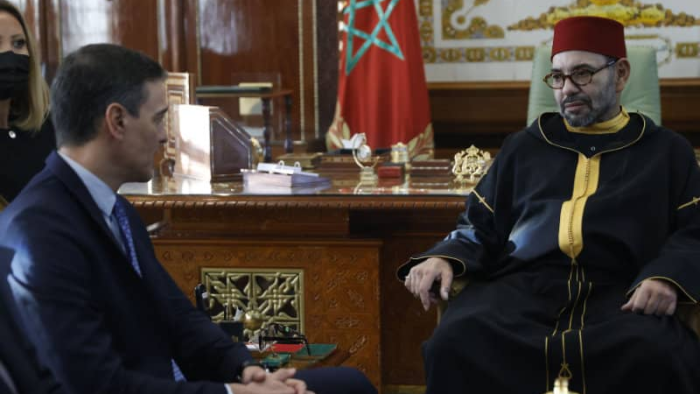
Spain’s diplomatic shift on the Sahara is presented as another turning point. Pedro Sánchez’s decision in March 2022 to support Morocco’s autonomy proposal is described as a brutal break with half a century of Spanish doctrine. Then came the now-famous image of the meeting between Pedro Sánchez and Mohammed VI in April 2022, during which the Spanish flag appeared upside down in the official photograph. This scene is described as a further diplomatic humiliation illustrating the deteriorating balance of power between the two countries.
Moroccan port expansion accentuates the feeling of Spanish decline
The Sahara issue, however, goes beyond mere symbolism. Control of Western Sahara’s airspace remains ensured from the Canary Islands by Spanish controllers of the Canarias FIR, even though the UN continues to consider the territory non-self-governing and awaiting decolonization. According to this interpretation, a loss of control over Saharan waters and the FIR would open a new phase of vulnerability for the Canary Islands and for Atlantic access to the Strait of Gibraltar.
This concern is amplified by Morocco’s growing port power. The Moroccan Royal Atlantic Initiative, launched in 2023, is presented as a vast strategy designed to transform the kingdom into a tri-continental geo-economic axis linking Africa, Europe, and the Americas. Tangier Med, Nador West Med, Casablanca, and Dakhla Atlantic would form the pillars of a maritime architecture intended to redistribute regional trade flows to the benefit of the kingdom.
Madrid’s silence in the face of this transformation is being harshly criticized. No large-scale program to adapt Spanish infrastructure has been launched to protect ports directly exposed to Moroccan competition, notably Algeciras, Valencia, the Canary Islands, Ceuta, and Melilla. The text describes a political inertia deemed all the more worrying given that Moroccan ports are rapidly gaining ground on their Spanish competitors.
Marsa Maroc’s acquisition of a stake in Boluda Maritime Terminals in 2025 appears to be a particularly revealing episode in this evolution. Through this transaction, the Moroccan company gained access to nine Spanish port terminals, notably in Las Palmas, Tenerife, Cadiz, Seville, and Santander. The presence among the shareholders of Tanger Med Port Authority, an actor already engaged in direct competition with Algeciras and Valencia, reinforces the idea of a gradual erosion of Spanish sovereignty over its own maritime infrastructure.
The picture painted of the Spanish port system further accentuates this impression of growing dependence. The CSP Valencia and CSP Bilbao terminals already have significant Chinese participation, while Hutchison Ports BEST manages the largest container facility in the port of Barcelona, which has become one of the main entry points for Chinese vehicles into the Mediterranean. This growing foreign presence is described as a strategic threat to a country where nearly 90% of foreign trade is conducted by sea.
The decline of the national merchant fleet completes this bleak picture. In 1985, the Spanish merchant navy comprised 601 ships representing nearly five million tons. Forty years later, the fleet controlled under the Spanish flag within the REC (Regional Economic Cooperation) numbered only 84 vessels and no longer included a single container ship. For the first time in centuries, Spain had fewer than 90 merchant ships flying the national flag and with a gross tonnage of less than two million.
Fishing follows a similar trajectory. The Spanish fleet has shrunk from over 20,000 vessels in the late 1980s to fewer than 8,600 units in 2025. This contraction fuels the feeling that the country is gradually turning away from its historical maritime vocation at the very moment when Morocco is expanding its own naval and port presence.
The cooling of relations with Washington and Tel Aviv is finally being presented as one of the most worrying aspects of this strategic deterioration. Madrid is accused of having waged a « crusade against Israel and the United States, » leading to the banning of port calls for certain ships suspected of carrying equipment destined for Israel and restrictions on the use of the Rota airbase by American aircraft bound for the Gulf. This approach has reportedly provoked a hostile reaction within a segment of the American political class, with some officials even raising the possibility of a withdrawal of American forces from Rota and Morón.
Relations with several Latin American governments labeled communist, including Cuba, Venezuela, Mexico, and Bolivia, have also contributed to damaging Madrid’s image among its Western partners, it has been claimed. This accumulation of diplomatic, maritime, and port-related tensions suggests a historic shift: Spain, once the dominant power at the western Mediterranean gateway, is now watching the strategic center of gravity of the Strait gradually shift toward the southern shore.
source : barlamane