

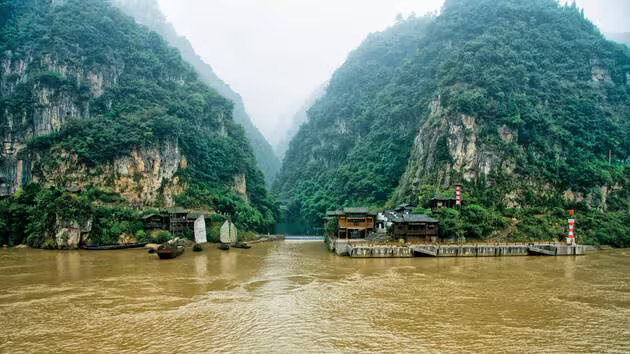
Three years and a drastic policy of banning commercial fishing were enough to preserve the Yangtze River ecosystem in China. Scientists are formal: the reduction of human activity to its strict minimum has allowed endangered species to bail out their schools.
t leaves the highlands of Tibet to snake to the Yellow Sea for 6,300 kilometers. Difficult not to be seduced by its long laces hidden in the middle of the gorges. Yangtze is the largest river in China and the third in the world behind the Amazon (Brazil) and the Nile (Egypt). The exploitation of this titanic arm (as much for its biodiversity, its power with hydraulic dams, or the irrigation of rice fields that it allows) would represent 40% of China’s gross domestic product. The policy of rapid economic development has had real harmful effects on the country’s biodiversity since the 1950s.
The exploitation of this freshwater basin has led to the extinction or near-extinction of endemic species such as the Yangtze dolphin (Lipotes vexillifer) or the Chinese spatula fish (Psephurus gladius) and a severe impoverishment of its biomass in general (i.e. the amount of living matter existing in an aquatic ecosystem).
Biomass has more than doubled in 3 years
The country had tried to create protected areas (for a budget of $300 billion) in some areas of the river, in vain. So, to try to preserve the species, China has put in place a drastic policy: abandoning all commercial fishing activities over ten years, from 2021, and regulating sand extraction, bank development, chemical industries and navigation.
In just three years, real positive effects have been observed this time, according to a study published by Science on February 12, 2026. Overall, biomass has more than doubled. For example, the population of the Yangtsee marsouin (Neophocaena asiaeorientalis asiaeorientalis), the only freshwater mammal on this river, increased by one third, from 445 in 2017 to 595 individuals in 2022. The study states: « Threatened fish species, such as the Yangtze sturgeon (Acipenser dabryanus), the Chinese miller (Myxocyprinus asiaticus) and the tube fish (Ochetobius elongatus), although still rare, also showed signs of initial recovery. To analyze this evolution, scientists sampled 57 different sections, first from 2018 to 2020 and then from 2021 to 2023.
This moratorium is not without costs. The People’s Republic of China (PRC) reportedly invested $2.74 billion in « 11 provinces and municipalities bathed by the Yangtze ». It was also necessary to reinstall the 231,000 fishermen and their 111,000 boats.
No miracle solution to reconcile human activity and biodiversity
The study calls for vigilance: « These trends are observed in the short term. It is impossible to say that the recovery indicator is sustainable or only transient. With this plan, not all species are spared either. Migrations, for example, are always prevented by certain works, such as the Chinese sturgeon (Acipenser sinensis), blocked by the huge Three Gorges dam.
While the quality of the water has improved significantly, microplastics or pharmaceuticals still pollute the river. The website of the Ministry of Agriculture of the PRC announces a program in place since 2021 to guide fishermen laid down towards the « primary, secondary and tertiary sectors of the fishing industry ». It is therefore difficult to know what has happened to the latter. In the meantime, the PRC intends to continue this fruitful experiment over the next five years.
source : ouest France