
With a view to ecological transition and structuring the circular economy in Tunisia, the issue of the integration of informal plastic collectors, commonly known as « barbachas », is now a central issue of environmental, economic and social policy.
It is in this context that the president of the Tunis Clean Up association, environmental activist Houssem Hamdi, presented a project to integrate these actors into a formalized waste sorting, recovery and recycling chain. The initiative, presented on May 11, 2026 on the airwaves of Express FM, is part of a logic of progressive structuring of a sector still largely dominated by informality.
« Snas » at the heart of the Tunisian circular economy
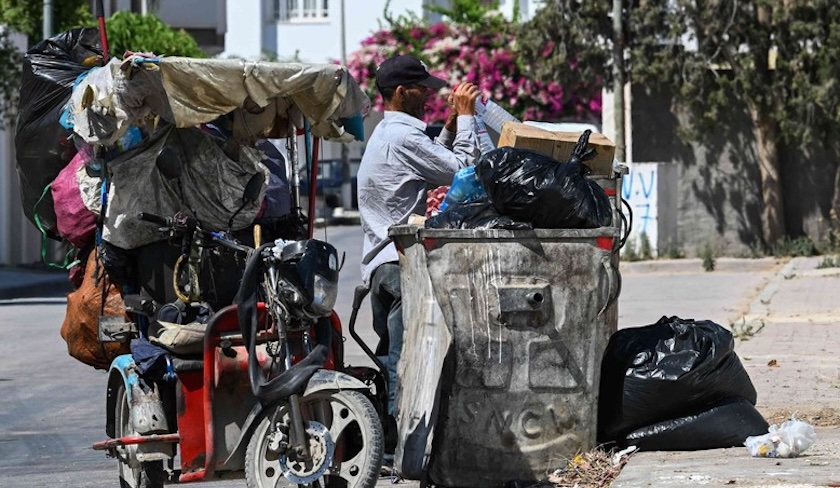
Waste collectors actually play a decisive role in the recovery of recyclable materials, including plastics. In Tunisia, their number is estimated, according to Houssem Hamdi, at more than 8,000 individuals, contributing significantly to the increase in recycling rates, despite the absence of a protective legal and social framework.
The project presented is based on a simple but structuring hypothesis: there is no efficient recycling system without the integration of field actors. These collectors constitute, de facto, the first link in the solid waste recovery chain. Their work makes it possible to reduce the volumes of ultimate waste, feed recycling chains and support a secondary economy based on the recovery of raw materials.
Houssem Hamdi also stressed that the initiative aims to extend pilot experiments already conducted in the northern periphery of the capital, where selective sorting devices have reduced the share of non-organic waste while promoting its reuse, either by industrial recycling or by artistic recovery.
The Medina of Tunis as a laboratory for selective sorting and integrated recycling
The project now plans to extend to the Medina of Tunis. This territorial choice is not trivial, according to the initiators of the project: it is a space with a high artisanal and tourist density, generating significant flows of recoverable waste. The objective is to develop an integrated circuit combining a selective sorting center, processing chains for recycled materials, and an exhibition space dedicated to products from recovery.
This structuring would make it possible to transform waste management into a real economic and cultural ecosystem, integrating both the environmental, artisanal and tourism dimensions.
One of the main axes of the project lies in the gradual integration of informal collectors in an organized framework. Even today, their activity remains precarious, characterized by a lack of social protection, institutional recognition and professional security.
The approach thus aims to train them in selective sorting techniques, safety standards and valorisation circuits, while establishing structured links with local economic actors – restaurateurs, hoteliers and artisans.
According to Houssem Hamdi, a first phase has already been initiated, including training and awareness-raising actions on occupational safety and good sorting practices.
Beyond the social issue alone, the project highlights a broader problem: that of the transformation of production and consumption patterns. Waste management cannot be thought of independently of purchasing, consumption and sorting behavior at source.
In this perspective, the generalization of selective sorting appears as a structuring condition. It must be accompanied by a redesign of the collection circuits and an increase in the skills of the actors involved.
source : business news