Every year in the Western Pacific, at the end of summer and at the arrival of September, typhoons are not far behind. Typhoons are the most impactful extreme weather events affecting Japan and East Asia, and due to climate change, extremely strong typhoons are likely to become more frequent. To adapt critical infrastructure to these massive storms and protect coastal areas, it is essential to establish an accurate account of their future impact.
The assessment of the disaster risks of a typhoon season involves quantitatively predicting the intensity and frequency of storms, relying heavily on the characteristics of regional weather fields and the natural variability inherent in the climate system. Although the variable characteristics of typhoons are related to sea surface temperatures — OHS — probabilistic assessments of OST have been insufficient.
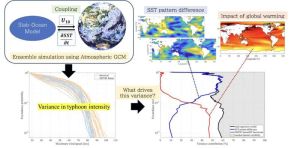
This motivated a team of researchers from the Kyoto Disaster Prevention Research Institute to analyze the intensity of typhoons through OSH spatial diagrams. They combined an ocean-plate model with the Global Atmospheric Climate Model developed by the Japan Meteorological Agency’s Meteorological Research Institute, resulting in a unique simulation that successfully represents atmosphere-ocean interactions on a global scale.
As a result, the team conducted specialized overall experiments in the evaluation of typhoons, probabilistically assessing the relationship between the spatial patterns of OSS in the Pacific and the intensity characteristics of typhoons. They carried out these simulations under historical and future conditions to evaluate the changes while taking into account natural variability.
In addition, they led the experiments to both a conventional resolution of 60 kilometers and a horizontal scale of 20 kilometers. The study is published in the Journal of Climate.
The team’s results revealed that about 50% to 60% of the variance in typhoon intensity can be explained by the combination of spatial differences in OSH patterns and the increase in the average OHS due to climate change.
The probabilistic assessments of typhoons made possible by this study also led the team to discover that, although extreme typhoons occur once every 100 years in the current climate, they can occur four to five times per century in future scenarios. « The impact of the influence of OHS on the intensity of typhoons during violent typhoons is clearer than expected, as is the impact of global warming on the increase in the frequency of violent typhoons, » says team leader Nobuhito Mori.
This study provides a framework for high-resolution overall experiments worldwide using combined atmosphere-ocean models, reducing uncertainty in climate projections by providing a highly reliable basis for risk assessment. These results have particular potential for decision-makers involved in infrastructure development, such as coastal protection and disaster management planning.
Then, the team intends to further refine its model to strengthen its results. « We want to understand how extreme weather conditions evolve because of climate change, » says first author Yoshiki Matsuo. « This is an important challenge, both from an engineering and a social point of view. «
source : catnat