
The modernisation of maritime transport and the renewal of the national fleet are essential levers for economic sovereignty and the competitiveness of foreign trade.
Thus, the government intends to give a new impetus to national maritime transport, with the ambition to gradually regain market share in the transport of goods and passengers, while accompanying the rise of trade and exports.
It is in this perspective that the development of the sector and the modernization of the national fleet were on the agenda of the government meeting held yesterday, under the presidency of Prime Minister Sifi Ghrieb. According to the press release of the services of the Prime Minister, this file is among the national priorities defined by the President of the Republic and is part of the extension of the strategy of modernization and development of commercial ports.
The approach adopted aims to boost a sector considered strategic, to improve the quality of services in accordance with international standards and to support foreign trade, particularly exports, which have recorded a sustained increase in recent years.
To this end, members of the government reviewed the efforts undertaken to develop port infrastructure and logistics facilities, but also to renew the national fleet dedicated to the maritime transport of goods and passengers.
The national flag at the reconquest of the freight market
Beyond the modernization of its logistical resources, the issue is above all economic. Algeria’s dependence on foreign shipping companies represents a significant outflow of foreign exchange, with an annual sea freight bill estimated at nearly $5 billion. The reconquest of part of this activity is thus an imperative of economic sovereignty, but also a means of better controlling costs and supply and export channels.
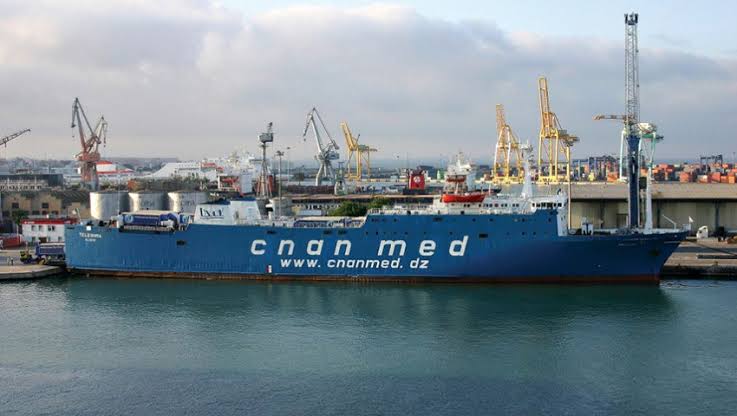
The restructuring of the sector around the Algerian Maritime Transport Group (GATMA), which oversees national freight and passenger transport companies, reflects this desire to strengthen national capacities and better position the Algerian flag on international lines. The group aims to increase its share to 20% of the country’s trade volume in the medium term.
To achieve this goal, the renewal of the fleet is a priority project. The planned programme includes the acquisition of new vessels adapted to the needs of foreign trade, in particular for the transport of cereals and the transport of iron ore from the Gara Djebilet deposit to export markets.
In this context, the GATMA had announced a project to acquire three ships, including two Panamax-type bulk carriers, with a capacity of between 50,000 and 65,000 tons each, as well as a feeder container capable of carrying 2,000 EVP. The use of the international market for the acquisition of bulk carriers should in particular make it possible to meet the needs of the Algerian Interprofessional Cereals Office (OAIC), while accompanying future iron ore export operations.
Port modernization and ecological transition
However, the relaunch of maritime transport cannot fully produce its effects without a parallel upgrading of port infrastructure. The program of modernization of the country’s ten major commercial ports, including Algiers, Oran, Béjaïa, Annaba and Djen Djen, is an essential link in the national strategy in this regard.
The establishment of continuous work, the acquisition of state-of-the-art handling porties, the dredging of basins to accommodate larger ships and the digitization of procedures, in particular through the interconnection with customs services, contribute to the improvement of the performance of the port chain.
This modernization is particularly important in view of the country’s new export ambitions. The increase in port and maritime capacities must accompany the flow of national industrial production surpluses to the African, European and Asian markets, especially in the cement, clinker, steel and fertilizer sectors.
In addition to these operational issues, there is that of the environmental transition. GATMA is called upon to gradually adapt its vessels to the new requirements of the International Maritime Organization (IMO), in particular with regard to the reduction of the sulphur content of marine fuels. In this perspective, cooperation with Sonatrach and Naftal is underway to develop local production of low-sulphur fuel. Technical adaptation work is also being considered in order to improve the energy efficiency of operating ships and reduce their polluting emissions.
In the end, the approach examined by the government goes beyond the mere renewal of means of transport. It aims to build a more efficient maritime and port ecosystem, capable of supporting export diversification, supporting major industrial projects and reducing the bill for international services. The challenge is to make the national flag a real instrument of commercial competitiveness and economic sovereignty.