
The desire to secure the port of Hamburg, a critical infrastructure, finally pushed the German government to ban the transaction, says Isabelle Chaperon, columnist at the « World » Economy Department.
In 2023, German Chancellor Olaf Scholz authorized the Chinese shipping company Cosco to take shares in the port of Hamburg, Germany’s largest. Eager to go a step further, the giant intended to take 80% of the capital of Zippel, a small German logistician from the great port of the North Sea. Failed, he will stay at the down.
At the end of a Council of Ministers held on Wednesday, October 7, the German government announced that it was opposed to this transaction, for reasons of « national security ». Berlin fears that this acquisition may « strengthen dependencies » on China and « endanger the resilience of Germany’s and European Union supply chains ».
Zippel is a German family operator, employing about 350 employees, whose job is to store and transport to the rest of Germany and its neighbors, by road, rail or river, the goods landed on the docks of Hamburg and Bremerhaven. And vice versa.
More than Zippel himself, it was the accumulation of Chinese interests at the heart of Germany’s logistical lung that made Berlin tick. The prospect of Chinese cargo ships unloading Chinese goods into the Tollerort container terminal – of which 24.9% of the capital belongs to Cosco – then transported to Munich or Düsseldorf by Zippel trucks, owned by Cosco, was dizzying. Knowing that China ships or receives a third of the containers transiting in Hamburg.
Position of strength
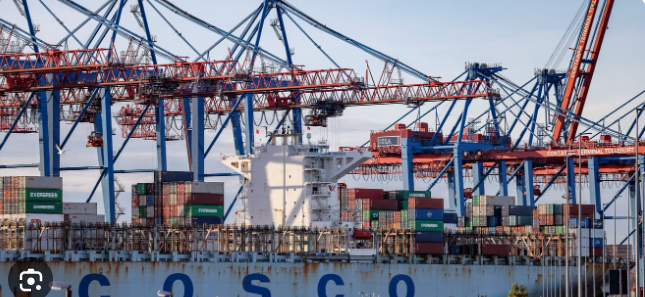
What if Beijing used this position of strength to put pressure on Germany, as it does with its rare earths? And what would happen in the event of a conflict? Already in 2023, the arrival of Cosco to the capital of the company operating one of the four container terminals of the port of Hamburg had caused a vast outcry in Germany. The container carrier « Cosco Pride », from the company China Cosco Shipping Corporation, in the port of Hamburg, Germany, on October 26, 2022.
Chancellor Scholz had chosen not to anger his first trading partner, for fear of reprisals suffered by the country’s industrialists. The weakening of the Chinese market and the surge of cars or steel made in China towards Europe have changed the game, as already evidenced by Chancellor Friedrich Merz’s turnaround on trade relations between Europe and China.
At the same time, the rise of international tensions is leading states to secure their critical infrastructure, especially ports. From Antwerp to Athens via, since June, through Tarragona (Spain), Cosco already holds the key to many maritime gateways to the Old Continent. A concern for the whole of Europe, not just Germany.