
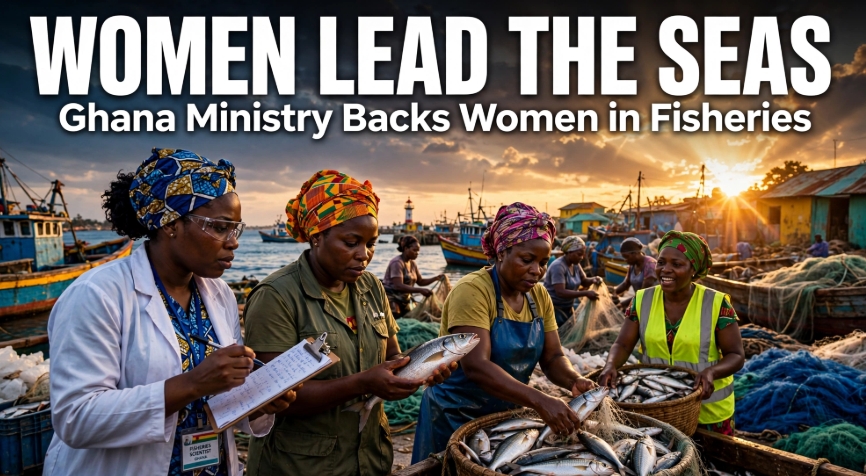
The Ghanaian Ministry of Fisheries has officially opened its doors to the country’s women aquatic scientists. On Wednesday, October 7, 2026, a delegation from the Women in Aquatic Science and Management Network (WASMaN) met with the Minister of Fisheries and Aquaculture, the Honourable Emelia Arthur, at the Department of Accra, and left with a public commitment to support: the ministry is ready to collaborate with the network in practical areas to develop, promote and make visible women working in Ghana’s fishing and aquatic resources.
For a sector where women dominate the processing and trade of fish while remaining underrepresented in the fields of science, management and policy, this commitment counts. This is not a funding announcement or a signed agreement — and this post does not claim otherwise. What it is is a ministerial commitment to work with an organized network of women professionals, in research, mentoring and capacity development, so that women have a greater say in defining the future of fisheries in Ghana. This distinction deserves to be kept, because this is exactly how institutional change usually begins: not with a check, but with a place at the table.
The meeting at a glance
| details | What happened |
|---|---|
| Date | Wednesday, October 7, 2026 |
| Place | Ministry of Fisheries and Aquaculture, Accra, Ghana |
| Delegation | Women’s Network in Aquatic Science and Management (WASMaN), led by its president, Dr. Alberta Sagoe |
| Host | The Honourable Emelia Arthur, Minister of Fisheries and Aquaculture and Member of Shama |
| Objective | Present the work of WASMaN and explore collaboration to strengthen women’s participation in the fishing sector |
| Areas of collaboration covered | Research, mentoring, capacity building and other initiatives to increase women’s contribution and visibility |
| Consequences | The Minister welcomed the initiative and expressed the Ministry’s willingness to collaborate in practical areas |
Who is WASMaN?
WASMaN — the Women in Aquatic Science and Management Network — was created to strengthen women’s participation in aquatic science and management by connecting practitioners, supporting research and mentoring, and providing evidence in political discussions. Its scope of action is deliberately broad, covering fishing, aquaculture, freshwater and marine sciences, coastal management, conservation and development. This magnitude is the goal: a woman studying lagoon ecology, another managing an aquaculture farm and a third writing fisheries policies all do aquatic science and management, and the network considers them as a single professional community.
The network is organized around a management committee and a secretariat that coordinates its activities, and it includes membership categories for students, early career professionals, professionals, fellows and associate or allied members. In other words, it is built as a career scale, not as a one-time club: a student member can become a fellow, and allies — including men working in the sector — can support work without replacing the women it is intended to serve.
What WASMaN really does
| Initiative | What it is |
|---|---|
| Research Spotlight | A platform for members to share their research through webinars, articles and other formats – including, for example, a focus on the Cape Coast Fetu Afahye festival, lagoon management and sanitation at the Fosu lagoon |
| WASMaN: Knowledge | One-page dissertations on knowledge sharing on issues at the intersection of science and management, written to be read and used, not classified |
| Mentoring and Capacity Building Programs | Programs designed to support women at different stages of their career, from students to senior professionals |
| Community engagement | A priority area for expansion, so that the work of the network reaches fishing communities, not just conference rooms |
An honest detail of the meeting deserves to be highlighted: WASMaN currently operates in self-financing. Dr. Sagoe told the ministry that the network had submitted several proposals as part of its efforts to obtain funding to expand its programs, in particular community engagement. The ministry’s commitment to collaboration therefore falls at the right time — institutional support is often what transforms the proposals of a self-financed network into funded programs, because the donors ask who is already at the table with you.
Why the Minister’s commitment is important
Minister Emelia Arthur reaffirmed the government’s commitment to promoting women’s participation in Ghana’s fisheries and aquatic resources sector, and discussions focused on a common goal: to ensure more opportunities for women to contribute — and shape — the future of the sector. Three reasons are important.
First, visibility changes that is counted. When a ministry works with a network of women, women’s work in research, extension, treatment and management ceases to be considered substantive work and begins to be registered, cited and funded as professional expertise. WASMaN’s Research Spotlight and Knowledge are designed precisely for this: to transform the individual work of women into a visible corpus of evidence.
Second, mentoring fills the pipeline gap. Peach science loses women at every stage of its career — from student to early career professional to leadership. A network with members, students, beginners, professionals and members, as well as planned mentoring, is designed to retain participants at each of these steps rather than making them give up.
Third, the evidence comes to politics more quickly. WASMaN’s stated goal is to provide evidence in political discussions. A direct line with the ministry means that research on, for example, lagoon management or post-harvest losses can move from a researcher’s notebook to a policy office without waiting years for the usual channels.
Part of a broader history in Ghana
This commitment is not alone. The small Hanean fishing community is organized on several fronts at the same time. The Small-Scale Fishing Academy, managed by the Ghana Canoe and Fishing Vessel Owners Association (CAFGOAG), extends from 8 to 20 coastal communities, thus developing facilitation, dialogue and leadership skills among the fishermen themselves. The ministry also pushed for increased social protection for artisanal fishermen, especially in insurance and boarding, and warned fish processors against dangerous processing methods at the Central Regional Fish Fair 2026. Reading together, the pattern is clear: Ghana is trying to professionalize its fisheries from the community upwards and the institution downwards – and women are at the heart of both parts of this effort.
The same lesson is well transmitted. In South Africa, 20 small-scale fishermen from eight cooperatives obtain skipper, radio and first aid certificates through a fully funded SANParks program – proof that targeted and funded training is changing who can direct on the water. And at the continental level, the African Union’s ten-year fisheries transformation program for 2026–2035 places governance, aquaculture growth and trade at the heart of the continent’s future of fisheries. Channels like WASMaN are the way people these great programs are supposed to serve find their voice in their design.
What this means for Indian readers
India’s fishing landscape has the same gap and opportunities. Women dominate the processing, drying, distribution and marketing of fish in India, yet their formal recognition as fish workers — and their representation in fisheries policy and decision-making — is still disputed, as the fishing workers themselves have mentioned in recent consultations on small-scale fisheries in India. Recognition and practical support programs: Bihar’s free training program reached 9,685 fish farmers spread over 332 promotions, and ICAR-CIFRI’s women-focused programs in the Sundarbans distributed alevins, food and technical advice to hundreds of women fish farmers. Ghana’s WASMaN model adds an additional ingredient worth copying: a professional network that treats women scientists, managers and practitioners as one organized base that a ministry cannot ignore.