At a time when climate change is melting most of the world’s glaciers, the 25-kilometer retreat of the Hektoria Glacier in Antarctica is unlike any other: it’s a record that scientists considered impossible. NASA researchers believe they have succeeded in determining the reasons behind this baffling event.
Twenty-five kilometers less in 15 months: this is the unthinkable evolution of the Hektoria Glacier located in East Antarctica . This observation was made between early 2022 and spring 2023. The glacier even lost eight kilometers in the space of two months—unprecedented!
Why is the Hektoria glacier melting so much faster than others? Three main reasons have led to this unprecedented retreat, according to theNASA :
- global warming;
- the instability of the sea;
- the glacier’s particular shape and structure.
The Hektoria glacier begins on land and ends in the ocean: » its outer part forms amass« of floating ice called a glacial tongue , » NASA explains. The glacier has lost ice on both sides: on land and at sea, which obviously contributes to the rise in sea level.
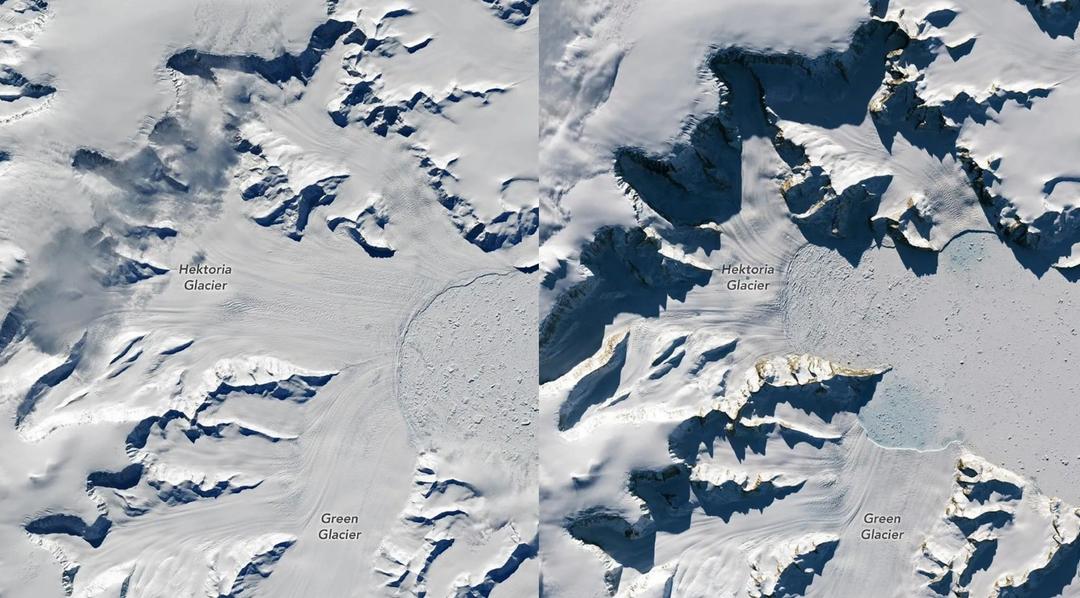 The glacier’s retreat is visible between October 2022 (left) and March 2024 (right). © NASA
A combination of several factors was involved.
After remaining relatively stable for about twenty years, the sea ice along the coast suddenly broke apart. Scientists believe the event was likely caused by strong swells. This coastal ice acted as a support, and once it broke, the Hektoria glacier became completely destabilized.
The floating ice tongue then began to calve repeatedly, causing the glacier to lose 16 kilometers. The ice tongue subsequently stabilized during the winter. However, another part of the glacier then began to melt: thanks to the measureslaserSatellites have revealed that the ice continues to melt beneath the surface, even in the middle of winter.
The specific topography of the area, a rocky plain, allows seawater to seep under the glacier attidehigh. This water also breaks up pieces of ice , allowing them to detach. This is what is believed to have caused the second phase ofcast ironrapid passage through the glacier, during which he lost eight kilometers.
Climate change has therefore acted as an aggravating factor: it has weakened the ice, which was already easily unstable due to the glacier’s structure, the terrain on which it rests, and the specific ocean currents of the area. This is therefore theconjunctionof all these phenomena that would have led to the record melting of the Hektoria glacier. This glacier is not the only one to combine all these aggravating factors: this is also the case for many others, present in Greenland and Alaska , announces NASA.
Studying the evolution of the Hektoria Glacier remains difficult: the last images of its retreat date back to spring 2024, as 2025 was marked by excessive cloud cover, preventing satellites from analyzing the glacier. What happened next? Scientists believe the period of record retreat is likely over and that the glacier is now continuing to melt, albeit more slowly. It is expected to gradually lose its glacial characteristics and transform into afjord.
source : futura