
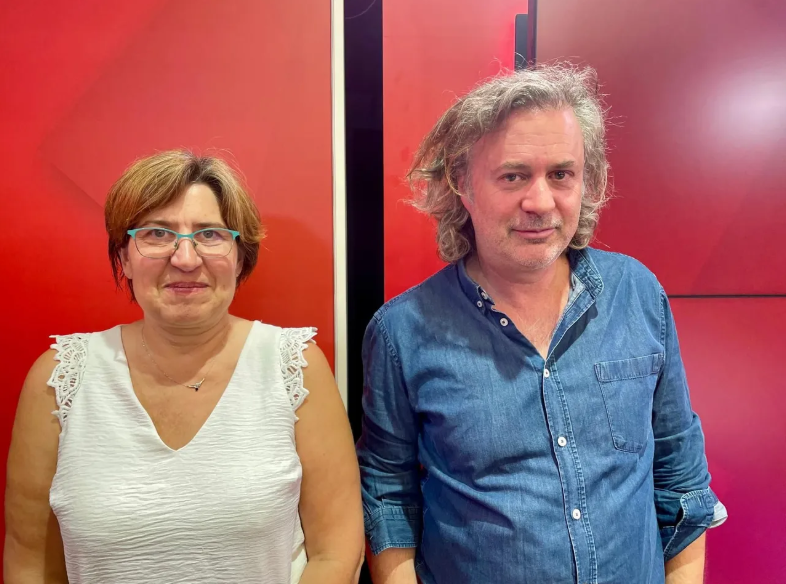
Valérie Masson-Delmotte is a climatologist renowned for her commitment to raising awareness of climate issues. Her numerous popular science books help to make knowledge about climate change and its causes accessible.
Editorial by Charles Pépin: « This morning I’d like to tell you the story of a woman, a scientist, a climatologist, who one day, in the aftermath of a heatwave, finds herself summoned by the head of state. A head of state with the best intentions in the world: he wants to understand, he wants crash courses, he acknowledges that he’s come a long way; he wants to catch up. He has gathered his key advisors. What is climate? Why is it warming? How is it human activity, and not the natural order of things, that is producing such warming? What can be done? »
This could be the beginning of a beautiful fairy tale. A head of state in his gilded palace. A researcher in her laboratory, cluttered with files. A summit meeting. She has prepared like never before. The stakes are high: if the head of state understands, everything could change. She is precise, pedagogical, she is an expert; this is her subject. And him, the President of the Republic, as she shows him the warming curve, as she emphasizes our ability to alter this curve, his eyes shine. She sees it in his eyes: he understands. She sees it: he is convinced. He asks the right questions. She, meanwhile, reviews her entire life, her career choice, her fight for the climate, and before the President’s shining eyes, she tells herself that she hasn’t done all this for nothing. She leaves brimming with pride, joy, and anticipation. « Mission accomplished! »
In the days that followed, there were a few announcements. She was able to believe them for a few days… But then, nothing. These announcements were not followed by any real policy. This same president would later even make decisions completely contrary to the vision she had outlined. Months passed, and then years. With each new crisis, a few announcements. And then, nothing. No real policy. No real turning point, no real surge of action. And our house continues to burn. And she, she hasn’t forgotten the president’s eyes. She doesn’t understand, or perhaps she understands perfectly well. Why do we have so much trouble grasping the urgency of the climate crisis? Do we refuse to see? What are we waiting for to finally change our lives, our vision, our habits?
To discuss this this morning, I have the pleasure of welcoming a woman whom Time magazine ranked among the 100 most influential people in the world. Chair of Working Group I of the IPCC from 2015 to 2023, climatologist and even paleoclimatologist, Valérie Masson-Delmotte has joined us this morning under Plato’s sun, and in her company, we will try to understand what prevents us, individually and collectively, from doing what is necessary to ensure our planet remains habitable.
The observation of global warming and its causes
Valérie Masson-Delmotte explains that the observed warming, which continues at a record pace, is a consequence of human activities: « We’ve reached a global warming level of 1.4 degrees Celsius. It might not seem like much, but it’s what’s causing, for example, heat waves in France to intensify so dramatically, and instead of having temperature peaks of 35 degrees Celsius, as in the mid-20th century, we’re now exceeding 40 degrees. And that’s where we enter the danger zone. So the primary cause of global warming is combustion, the use of fossil fuels: coal, oil, and gas. This primary cause accounts for three-quarters of the additional greenhouse effect. » She then discusses the food system as a whole: « Deforestation, agricultural production, fertilizers, livestock farming… It represents roughly a third of global greenhouse gas emissions. »
But in France, it’s not like the rest of the world, as Valérie Masson-Delmotte explains : « We’re a bit unique because, since the 1970s and for reasons of sovereignty, our electricity is decarbonized, therefore nuclear-generated. There’s also hydroelectricity, with a rise in renewable energy production. So, in our case, it’s a little different from other countries, since what weighs most heavily is transportation – roughly a third – and within transportation, private cars account for roughly half. » Then, the second largest factor, roughly equally important in France, is agriculture and buildings. « Agriculture includes the use of nitrogen fertilizers and ruminant livestock farming, and as for buildings, heating with fuel oil and gas weighs most heavily. »
To summarize, it depends on the scale at which we look at things: « If it’s at the global level, it’s about phasing out coal for electricity production. If it’s at the French level, it’s about substituting decarbonized electricity for all other energy uses, so electrifying, for example, with heat pumps for heating or cooling. It’s about using electrified vehicles, for example, instead of vehicles that use petroleum. »
What level of responsibility is there at the individual level?
Valérie Masson-Delmotte explains that on an individual level, the situation is very heterogeneous; we are not all equal in terms of responsibility. « Greenhouse gas emissions are disproportionately higher for people with the highest incomes. But for a significant portion of the French population facing precariousness at all levels, the challenge in this case is to make low-carbon solutions accessible to those with the most limited incomes. » She explains that it’s not at all the same depending on income level: « If we consider individual carbon footprints, some people will travel very frequently to the other side of the world, by private jet, yacht, plane, etc. And other people will have poorly insulated homes, which will only be heated in a very expensive way, or will have old, inefficient vehicles. The challenge then is to make home insulation accessible or to provide more efficient vehicles. » She adds: « In the poorest countries, where 3.5 billion people live who are particularly vulnerable to global warming, their emissions represent less than 6% of historical greenhouse gas emissions. »
She’s a climatologist and doesn’t want to lecture anyone. But for her, there are several ways to take action as an individual: « First, the most important thing is to engage with our representatives, our elected officials, about public policies on climate, reducing greenhouse gas emissions, and adaptation, because those are the two pillars. Then, you can calculate your own carbon footprint; you can visit the website nosgestesclimat.Opens in a new tabYou can see , based on your lifestyle, what emits the most, and discuss it with your loved ones. You can also make intelligent and informed choices yourself; that’s what I do personally, and we do it in the research world as well.
source : radiofrance