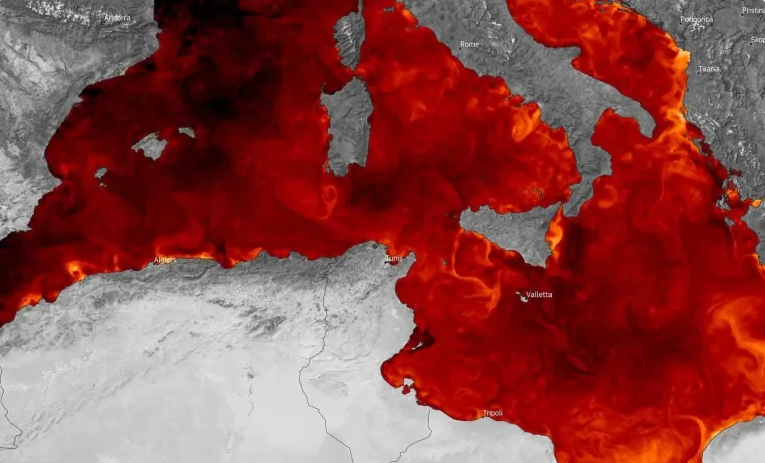
Environmental engineer and climate expert Hamdi Hached confirmed on Wednesday, July 22, 2026, that the US National Oceanic and Atmospheric Administration (NOAA) has classified the marine heatwave currently affecting the Mediterranean Sea as a « Category 4 » for the period of July 20-21. This is the highest level on the scale, classified as an « extreme marine heatwave. »
Speaking on the radio, the expert explained that several areas of the Mediterranean are experiencing an exceptional rise in sea surface temperature. Temperatures are exceeding seasonal averages by more than 5C, reaching up to 31C in some areas.
He explained that these unprecedented temperatures do not only threaten the marine environment. They also fuel the violent storms currently hitting parts of Italy and Croatia, while causing a significant increase in humidity levels, which intensifies the feeling of heat stress.
The climate expert reminded everyone that marine heatwaves are classified from category 1 to category 4. Reaching this highest level indicates a rare and exceptional maritime phenomenon, where the sea transforms into a veritable « thermal reservoir, » storing considerable energy. This situation has serious consequences for marine ecosystems: mortality of certain species, degradation of seagrass beds and reefs, disruption of fishing activities, in addition to providing more energy and moisture to atmospheric disturbances.
What is particularly striking about this phenomenon, according to Hamdi Hached, is that it is the fifth consecutive marine heatwave recorded as severe or extreme in the Mediterranean. The recurrence of these events at such a rapid pace proves that these are no longer isolated anomalies, but a clear indicator of the ongoing warming of the Mediterranean and climate change.
Climate Outlook and Winter Forecasts : Regarding the climate outlook, Hached predicts episodes of intense rainfall over short periods, along with the possibility of continued high temperatures throughout the winter season. He calls for an approach based on declaring a climate emergency and preparing for rapid changes.
He also pointed out that temperatures did not fall below 37C for 12 consecutive days. According to him, the unique nature of the summer of 2026 lies not only in the record highs reached, but also in the combination of three major factors: a high temperature threshold, a prolonged duration, and the absence of nighttime cooling.
Confirmation of these data at the end of the current wave could well place the summer of 2026 among the most stifling periods that Tunisia has experienced in recent decades.
Finally, the expert indicated that temperatures should return to normal levels within the next two weeks. He specified that Tunisia is currently experiencing the peak of this heat wave and that temperatures will gradually decrease in the coming days. Even if a further increase were to occur, it should not reach the intensity, severity, or duration of the current wave, he concluded.
source : la presse