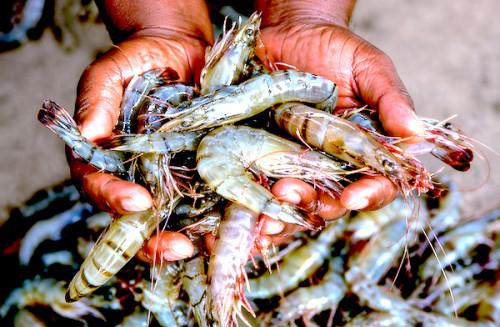
Closed in Cameroon since 2009, following breaches of hygiene requirements in the sector, the door to the European market could again be opened for Cameroonian shrimp. To achieve this, the actors in the sector are now relying on the expertise of the Pasteur Center of Cameroon, called upon to contribute to the health upgrading of the entire value chain.
This initiative is led by FISH4ACP, with the support of the Food and Agriculture Organization of the United Nations (FAO). It aims to restore the credibility of the Cameroonian health control system, an essential condition for a return to the premium markets of the European Union, but also of the United States, which is also closed to Cameroonian shrimp.
The Pasteur Center of Cameroon was thus asked to develop a manual identifying the prerequisites necessary to comply with the health requirements of international markets. The challenge is to more rigorously supervise the entire shrimp sector, from fishing to export, through conservation, processing and packaging.
At each link, the objective is the same: to reduce biological, chemical and physical risks that could compromise the conformity of products. Clearly, the sector wants to demonstrate its ability to deliver shrimp that meet health standards comparable to those required by the major importing powers.
A sector of 26 billion FCFA weakened by heavy failures
The economic stakes are high. According to a study conducted in 2026 by FISH4ACP, the German cooperation, the European Union and the Pasteur Center of Cameroon, the shrimp sector generates a total added value estimated at $47 million, or about 26 billion CFA francs. It brings more than 11,000 direct actors to life, including fishermen, mareyeurs and processors.
In Cameroon, the sector now mobilizes more than 4,000 fishermen, spread over nearly 1,200 landing points and a hundred processing units. More than 200 operators are involved, for a dozen exporting companies.
But this productive base remains weighed down by serious logistical and health inadequacies. According to the same study, 100% of the sites observed have breaks in the cold chain. In detail, 88% of fishermen lack ice, 89% of units report losses before landing and 75% of local carriers do not have any conservation system.
Direct consequence: visible discoloration was noted on all shrimps observed at landing sites. These dysfunctions cost the sector dearly, with annual losses estimated at nearly 4 billion CFA francs.
The bet of a return to premium markets
Despite these weaknesses, the Cameroonian sector retains assets. The study highlights in particular the quality of the local prawn, its large size and its recognized organoleptic qualities. Artisanal production is estimated at approximately 6,002 tonnes per year, a volume that allows the sector to maintain significant weight on the national and regional market.
At the moment, 80% of production is absorbed by the domestic market. The remainder is exported to destinations such as China, Malaysia, Vietnam, Nigeria, Gabon, Chad and the Central African Republic.
However, the return to the European and American markets would represent a change in scale. Beyond access to new outlets, it would especially offer the Cameroonian sector the opportunity to reposition itself on segments with higher added value. In other words, the health battle fought with the support of the Pasteur Centre goes beyond the sole issue of conformity: it conditions Cameroon’s ability to remake shrimp into a real competitive export product.