Our planet, 70% covered in blue, has not escaped humanity’s expansionist ambitions. Both land and water are areas of tension where vital interests of nations reside, as evidenced by contemporary struggles for the appropriation of Exclusive Economic Zones (EEZs) and their underwater resources. Despite the unpredictability of these spaces, civilizations have been committed to governing and legislating over the seas, imposing their laws upon them. « The sea is a space of rigor and freedom. To lose rigor there is to lose freedom, » wrote Victor Hugo. The renowned writer emphasizes the untamable nature of the waters and the need to correlate this with the effectiveness of a robust control mechanism.
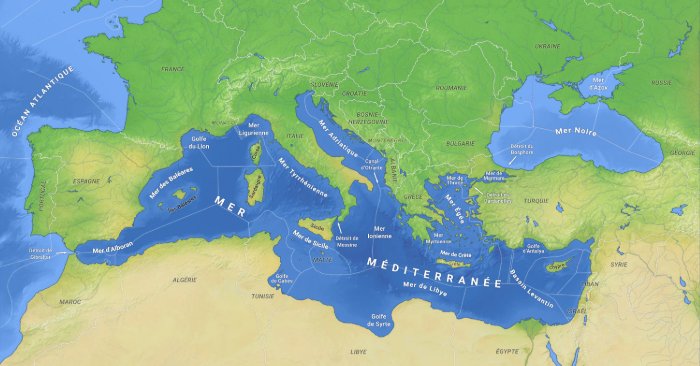
The seas bear witness to wars, migrations, trade, and power struggles. From the Delian League to the Montego Bay Convention, the sea has been subject to regulation in order to protect each state’s territory in the maritime wilderness. While the European Union (EU) has gained powers, its maritime policy remains underdeveloped. Due to these shortcomings, European cooperation began its regulatory framework with the Barcelona Agreements. The Catalan capital was not chosen by chance, as it borders the largest sea on the European continent: the Mediterranean. The EU’s strategic position in the Mediterranean, at the crossroads of the Maghreb and the Middle East, motivates Europe to propose a pragmatic and regulatory response to a shared space and a key crossroads of the European economy.
The Mediterranean Sea: the setting for an unprecedented collaboration in a turbulent sea
The desire for cooperation between the countries of the Mediterranean basin and the European Union was endorsed at the Euro-Mediterranean Ministerial Conference of 27 and 28 November 1995. This brought together, around a single dialogue, the 15 foreign ministers of the European member states as well as 12 third countries including Algeria, Cyprus, Egypt, Israel, Jordan, Lebanon, Malta, Morocco, Syria, Tunisia, Turkey and the Palestinian Authority.
The diversity of the actors underscores the unprecedented nature of this collaboration. Indeed, the nations of the Levant (eastern Mediterranean coast) suffer from a conflictual political context in which Israel, the Palestinian Authority, and Lebanon are implicated. Consequently, the Barcelona Conference follows a momentum toward pacification in the Mediterranean basin, initiated by the 1993 Oslo Accords, the scene of the famous handshake between Yitzhak Rabin (Israel) and Yasser Arafat (Palestinian Authority). Furthermore, the international context of market liberalization, supported by the creation of the World Trade Organization (WTO) in 1995, as well as the reversal of demographic trends benefiting the countries of the Global South, motivates this collaboration among Mediterranean nations.
Furthermore, the Mare Nostrum (« our sea » in Latin, enshrining Rome’s total hegemony over the Mediterranean basin) remains a crucial transit point for international trade. It is the entry and exit point of the Suez Canal (Egypt), which saw the passage of 15,051 ships in 1995. Moreover, the sea facilitates the flow of goods and people. For example, in France, the proportion of immigrants coming from countries in the Mediterranean basin reached 53% in 1990. Morocco and Algeria accounted for 31% of all French immigration.
The Barcelona Process: the idea of a stable and peaceful Mediterranean
The Barcelona Declaration (BD) , also known as EuroMed or the Barcelona Process, addresses “economic, social, human, cultural and common security issues” . Following the dialogue, the Union proposes a bilateral agreement to each of the Mediterranean third countries (MTCs), in order to develop a cooperative framework and, ultimately , to enhance “peace, stability and development in the region” .
To achieve this, the EU outlines three key areas. First, the agreement provides for a space of “stability” through political and security objectives. The agreement supports respect for the Universal Declaration of Human Rights, the rule of law, sovereignty, the prohibition of interference, the right of peoples to self-determination, and the fight against the proliferation of nuclear weapons and against terrorism, while encouraging participation in international cooperation systems.
Secondly, the declaration advocates for a balanced socio-economic partnership between the EU and the Mediterranean Countries and Territories (MCTs), aiming for “shared prosperity” around the Mediterranean. Through reforms that reduce customs barriers, promote market economies, and foster the integration of the MCTs, the partnership aspires to establish a Free Trade Area (FTA). In addition to an FTA, the declaration plans to encourage economic cooperation between the MCTs and small and medium-sized enterprises (SMEs), industry, and agriculture. Finally, the EU guarantees increased financial cooperation through the work of the European Investment Bank (EIB).
Finally, the DB concludes its work program with the desire to accentuate intercultural exchanges between the civilizations of the basin, to develop an educational program respectful of cultural identities, to fight against illegal immigration and to promote the development of the health sector.
Thus, through the lens of this partnership, the EU aims to integrate a legal cooperation framework, in order to control flows and instill a prosperous peace, through the dependency system of the FTA.
EuroMed: cyclical and institutional limitations
Moreover, Mediterranean collaboration is not without its challenges. Despite the €3.5 billion budget allocated to the MEDA program, the partnership’s financial framework, only 28.6% of the committed funds have actually been spent.
On the one hand, the failure lies in the difficulty of bringing a project to fruition; this is explained by a lengthy call for proposals procedure, subject to ex-ante evaluations . For a project to secure funding, 28 different administrative requirements must be met, leading to a conclusion up to six years after the application. On the other hand, the current situation is not conducive to collaboration, given ongoing or emerging conflicts such as, respectively, the » Black Decade » in Algeria and the Second Intifada in Israel. Furthermore, the slow ratification process by the 15 national parliaments is seen, according to the PTMs, as a lack of European commitment that undermines the project.
Following the Euro-Mediterranean Ministerial Conference in Marseille in November 2000, the MEDA 2 program was launched. Its objective was to address the shortcomings of the first version by incorporating EIB funds, with the aim of boosting the economies of southern countries. This program facilitated the opening of decentralized offices throughout the Mediterranean region to counter the centralized decision-making in Brussels and the associated administrative complexity. While this reform sought to resolve certain obstacles, Europe positioned itself as the primary donor to the participating countries, granting it unchecked decision-making and impetus power.
Thus, the obstacles and dysfunctions of the Barcelona Process are undermining the partnership, which is gradually losing momentum. At the same time, Brussels is preparing to change its diplomatic dogmas, which will gradually replace EuroMed.
The Neighbourhood Policy (ENP): Continuing Collaboration in the Mediterranean
On March 11, 2003, the European Commission published a communication to the Council and the European Parliament entitled « Enlarged Europe – Neighbourhood: A New Framework for Relations with Our Eastern and Southern Neighbours . » The Union’s Neighbourhood Policy aims, in the words of Romano Prodi, former President of the Commission, to create « a circle of friends » with neighbouring states and beyond. Initially, the countries involved in the Euro-Mediterranean Partnership were integrated into the ENP; subsequently, in 2009, it incorporated the Eastern Partnership, composed of states from the Caucasus.
The legal basis for the ENP is found in Article 8 of the Treaty on European Union (TEU) : « The Union shall develop privileged relations with its neighbouring countries with a view to establishing an area of prosperity and good neighbourliness, based on the Union’s values and characterized by close and peaceful relations based on cooperation. » Consequently, the EU endorses a policy of cooperation, notably by opening access to European policy areas and the benefits of the single market. Signatory states are entitled to an individualized program, allowing them access to the four freedoms: free movement of persons, goods, services, and capital.
Beyond the economic aspect, the ENP includes access to cross-border cooperation programs, research, education, culture, and media. However, the aforementioned provision of the Treaty on European Union (TEU) stipulates that the partnership is “based on the Union’s values” ; this implies that beneficiaries of the Neighbourhood Policy are unilaterally subject to respecting the EU “values” referred to in Article 2 of the TEU . This demonstrates that this openness is “subject to progress made by partner countries in political and economic reforms ,” in accordance with Brussels’ values. Furthermore, the “privileged relations” mentioned in the article provide for a bilateral relationship tailored to the specific circumstances of the cooperating country; that is to say, the Neighbourhood Policy does not include roundtables or multilateralism, which are nevertheless central to the ambitions of the Barcelona Process.
On the one hand, March 11, 2003, marked the end of the Barcelona Process; henceforth, this initiative remains secondary, and the EU is turning to the more advantageous Neighbourhood Policy, which abandons cohesion and collective meetings in favor of individualized agreements. While EuroMed provides a bilateral normative framework between the Mediterranean Territorial Cooperation (MTC) countries and the EU, the ENP is based on unilateralism. On the other hand, the Union’s rigidity is intensifying; policy in the Mediterranean Sea is becoming more restrictive for the MTC countries, which are subject to scrutiny of their economic and political progress.
The Barcelona Process: Renaissance and Paradigm Shift
In 2008, during France’s presidency of the European Council, the new head of state, Nicolas Sarkozy, redefined his ambitions in the Mediterranean Sea. Indeed, while holding a rally in Toulon on February 7th as part of his 2007 presidential campaign, the former Minister of the Interior presented his proposal to create a Union for the Mediterranean (UfM). This would be based on collaboration between the states on both shores of the Mediterranean on issues such as water, the environment, energy, and transport. Through this collaboration, the objective was to restore a climate of peace in the Mediterranean basin.
To this end, the French President convened the Northern and Southern Mediterranean countries (NSMCs), along with Turkey, the EU, and non-EU European states, in Paris on July 13, 2008. Following this summit, the Union for the Mediterranean (UfM) was established, and Egyptian President Hosni Mubarak stated: “This is not about erasing Barcelona; it is about building on the Barcelona acquis and doing more .” To achieve this “doing more ,” the organization’s structure was designed to be more balanced, which is why a system of co-presidency was implemented between the Northern and Southern countries: the European Union on one side, and Egypt and later Jordan on the other. To strengthen collaboration, inter-ministerial meetings were organized. They remain an unparalleled forum for discussion, bringing together 43 states, EU institutions, and the League of Arab States, during which proposals requiring unanimous approval are examined. Nevertheless, limitations persist. In this instance, achieving consensus is difficult within an organization of 43 states, including governments at war.
While the Barcelona Declaration was ambitious, it faltered in the face of the limitations of collaboration. However, the Union for the Mediterranean persists and remains the only vestige of unity in the basin, despite its structural limitations.
source : taurillon