
In 1976, the Mediterranean countries and the European Community adopted the Barcelona Convention to protect the marine and coastal environment, placing sustainability at the heart of regional cooperation. Created in 1977 by France, Plan Bleu is one of the Regional Activity Centres of the United Nations Environment Programme / Mediterranean Action Plan (UNEP/UNEP), operating within the framework of the Barcelona Convention for the protection of the marine environment and the coastal region of the Mediterranean. Plan Bleu supports Mediterranean countries in promoting sustainable development through foresight studies, policy-oriented research, the creation of scenarios and strategic recommendations addressing the main environmental, social and economic challenges across the region.
As part of its mission to promote evidence-based policy development and regional cooperation, Plan Bleu regularly launches calls for papers on key sustainability issues affecting the Mediterranean. These initiatives aim to promote innovative thinking, strengthen scientific and political dialogue, and support the development of concrete solutions adapted to the Mediterranean context.
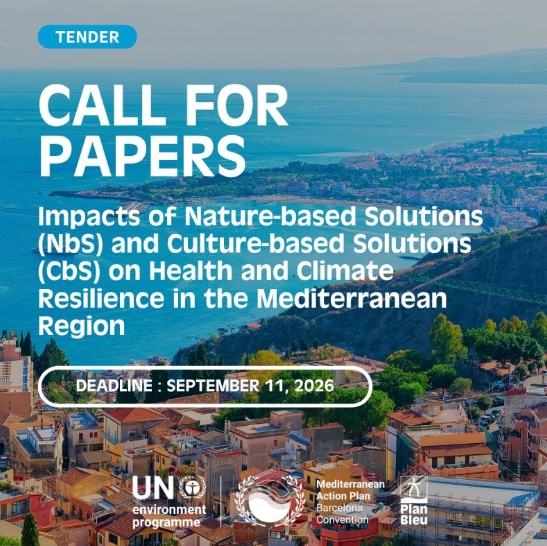
This call for papers focuses on the role of Nature-Based Solutions (NbS) and Culture-Based Solutions (CBS) in improving human health and strengthening climate resilience across Mediterranean territories. It seeks to mobilize researchers, practitioners and experts working at the intersection of climate adaptation, public health, urban planning and territorial planning, ecosystem restoration and environmental governance.
A total of 11 articles will be selected and financially supported in the context of this call (including 2 specifically dedicated to the financing of urban NbS and CBS via mixed financing mechanisms).
Introduction
The Mediterranean region is recognized as one of the most vulnerable climatic hotspots in the world, warming 20% faster than the rest of the world. Rising temperatures, prolonged droughts, accumulated extreme weather events, flash floods, water scarcity, biodiversity degradation, forest fires and growing urban pressure are already affecting ecosystems, economies and human welfare throughout the basin (IPCC, 2022).
This vulnerability is deeply linked to the demographic dynamics of the region: urbanization rates in the Mediterranean exceed the world average, with nearly 150 million people representing two-thirds of the total coastal population currently living in growing coastal urban centers. Fast-growing coastal metropolises on the south shore, such as Alexandria, which has 6.5 million inhabitants and has seen its unregulated urban expansion rise by almost 47% over the past two decades, perfectly illustrate these growing demographic and environmental risks. Mediterranean cities are therefore particularly vulnerable because of their high population density, compactness and an aging population. These impacts are expected to intensify in the coming decades, with disproportionate consequences for vulnerable populations, coastal areas threatened by rising sea levels and coastal erosion, as well as densely populated urban areas. In particular, the urban heat island effect (UHI) presents serious health risks, aggravating mortality and heat-related morbidity during increasingly frequent heat waves and heat waves. Recent assessments of the health impact in European and Mediterranean cities show that urban warming significantly increases preventable deaths during the summer, and that the increase in urban tree canopies and blue-green infrastructure (BGI) could significantly cool urban environments and prevent premature mortality.
At the same time, more and more evidence shows that Nature-Based Solutions (NbS) can play an important role in solving interconnected challenges related to the environment, climate and public health. NBS are systemic and resource-efficient interventions that protect, restore, sustainably manage and improve natural and modified ecosystems while simultaneously generating multifunctional social, economic and environmental benefits (Cohen-Shacham et al., 2016). These solutions are very cost-effective compared to traditional engineering infrastructure (grey), offering a systemic approach to urban adaptation that integrates natural processes into the built environment at different scales (from building envelopes to regional landscapes). NBS are increasingly recognized as effective approaches to climate adaptation and urban resilience, while supporting biodiversity and human well-being.
In addition, in parallel with NbS, urban architecture and Cultural Solutions (CBS) must be integrated in order to offer global and culturally adapted climate adaptation. This is particularly crucial on the southern shore of the Mediterranean, where extreme heat, prolonged droughts and water scarcity significantly affect the growth of vegetation and the viability of purely green infrastructure. Here, the integration of traditional ecological knowledge (TEK) and vernacular architecture is crucial to ensuring the viability of green infrastructure.
More specifically, in urban and territorial contexts, NbS include interventions such as urban forests, wetland restoration, green roofs, permeable surfaces, bioswales, restoration of coastal ecosystems, urban agriculture, green corridors and blue-green infrastructure systems. These approaches can contribute to climate adaptation and mitigation while improving air quality, reducing the effects of urban heat islands, strengthening biodiversity, improving mental and physical health, supporting social cohesion and increasing resilience to climate-related risks (Kabisch et al., 2016; Frantzeskaki, 2019).
Recent research highlights that NbS generate multiple co-benefits that go beyond environmental performance alone. They can promote social inclusion, improve public spaces, support community well-being, strengthen local governance and contribute to more resilient and habitable territories (Frantzeskaki, 2019; Kabisch et al., 2017). However, despite growing political attention and implementation in Mediterranean cities and regions, significant knowledge gaps remain regarding:
- the long-term impacts on the health and biopsychosocial resilience of NbS;
- methodologies to assess synergies and compromises between climate mitigation and adaptation co-benefits;
- governance, financing mechanisms and cost-benefit comparative analyses compared to grey infrastructure;
- the dimensions of social equity, environmental justice and accessibility;
- long-term maintenance, irrigation requirements in dry climates and monitoring;
- the scalability of successful interventions in various Mediterranean contexts.
In addition, the Mediterranean territories have very differentiated climatic, ecological, socio-economic and institutional conditions, ranging from arid and semi-arid areas to coastal cities, mountainous regions, wetlands, islands and delta systems. This diversity makes the region a particularly relevant laboratory for studying how NbS can support climate resilience and public health under variable environmental and governance conditions. Recent studies also highlight the importance of participatory governance, social perceptions and equity dimensions in the implementation of NbS in Mediterranean urban contexts (Noblega-Carriquiry et al., 2023; Johnson et al., 2022).
In this context, Plan Bleu launches this call for papers to encourage rigorous, policy-relevant research, exploring the role of nature-based solutions and culture-based solutions in promoting healthier and more climate-resilient Mediterranean societies.
OBJECTIVES OF THE CALL
The goal of this call for documents is to support high-quality research and policy analysis examining how nature-based solutions and culture-based solutions can help improve health outcomes and strengthen climate resilience in Mediterranean cities. A key priority of this call is to fill the current gaps in geographic knowledge by strongly encouraging research focused on the southern and eastern coasts of the Mediterranean, as well as interregional comparative analyses (e.g., North-South or East-West perspectives) to ensure a comprehensive understanding at the basin level.
These selected documents will be directly integrated into a broader Plan Blue initiative, which includes:
- A volume edited by Plan Bleu/UNEP/MAP bringing together the knowledge produced on the impact of urban green infrastructure (NbS) and urban architecture (CBS) on the health and climate resilience of Mediterranean cities.
- A regional online workshop to present and discuss the technical study with national experts, and explore possible strategies to implement climate-resistant and health-promoting green urban infrastructure.
More specifically, the call is aimed at 1. Identify and evaluate the co-benefits for the health, environment, social and economy of NbS; 2. Analyze how NbS contribute to climate adaptation and resilience; 3. Explore governance, funding and implementation challenges; 4. Document successful practices and lessons learned in Mediterranean contexts; 5. Support evidence-based policy development and territorial planning; 6. Promote regional dialogue and the exchange of knowledge between researchers, practitioners and decision-makers.
THEMATIC PRIORITIES
This call for papers invites researchers to explore new approaches and ideas. All documents must present evidence-based analysis and propose pragmatic political recommendations. Communications with various axes are welcome, including regional (multi-country) analyses, comparative perspectives and local case studies. Submissions may cover, but are not limited to, the following thematic areas:
1. Nature-based solutions and public health
The benefits of Sclérie Noble and its impact on health are increasingly appreciated in our societies, especially in urban adaptations with the greening of streets and parks; where these changes lead to an improvement in the health of citizens (Castelo et al., 2023).
For this reason, articles can explore the impacts of NbS on physical and mental health; reducing thermal stress and mitigating the urban heat island effect (UHI), improved air quality (for example, by absorbing suspended particles such as PM10, PM2.5, NO2 and SO2) that aggravate respiratory and cardiovascular diseases, as well as access to green and blue spaces for people. We strongly encourage articles exploring how contact with nature builds « biopsychosocial resilience » (adaptive biological, psychological and social capabilities) to help individuals cope with acute and chronic environmental factors. Articles evaluating dynamic thermal comfort using high-resolution spatial metrics, such as physiological equivalent temperature (PET), in dense urban environments are particularly encouraged to demonstrate the direct health benefits of NbS.
2. Nature-based solutions and climate resilience
Contributions in this thematic area could explore how NbS can strengthen climate adaptation and resilience in Mediterranean cities facing growing environmental and climate pressures. The articles may examine the role of the NbS in combating extreme heat, droughts and water scarcity, floods and rainwater management (including sustainable drainage systems (SuDS), permeable sidewalks and « spongy city » concepts), forest fires, biodiversity degradation, as well as other climate-related risks affecting urban, coastal and peri-urban areas. Research should therefore also consider restoring coastal ecosystems (e.g. salt marshes, wetlands and dunes) to mitigate waves and protect against rising sea levels.
Comparative perspectives on the effectiveness of NbS in various Mediterranean contexts are particularly encouraged. Similarly, research on « hybrid NbS » combining engineering (grey) and natural (green) elements, as well as building-scale interventions (e.g., green roofs and living walls) for densely urbanized areas, is very relevant.
The submissions can also analyze how NbS contribute to reducing vulnerability, improving ecosystem services, strengthening adaptability and supporting long-term territorial resilience in changing weather conditions.Comparative perspectives, integrated approaches and evidence-based assessments of the effectiveness of NbS in various Mediterranean contexts are particularly encouraged.
3. Governance, participation and social equity
This thematic area focuses on the governance, social and institutional dimensions of Nature-Based Solutions (NBS), with particular attention to participation, inclusiveness and fairness in Mediterranean contexts. Contributions may examine how governance frameworks, institutional arrangements and participatory processes influence the planning, implementation, management and long-term sustainability of NbS initiatives.
Nowadays, due to the territorial, social and ecological complexities of the Mediterranean region, it is essential to treat the governance of NbS through transdisciplinary approaches and « mosay » governance models. This is why it is essential to approach the governance of nature-based solutions from an interdisciplinary perspective, involving citizens, scientists and decision-making points jointly (Dell’Ovo et al., 2025).
Communications can therefore explore participatory governance models, community engagement and co-creation processes, institutional coordination mechanisms and multi-level governance approaches supporting climate adaptation and resilient territorial development. Contributions to environmental justice, social inclusion, accessibility to green and blue infrastructure, and inequalities in the distribution of environmental benefits and risks are particularly encouraged. Bids must address the risks of land speculation, greenwashing and « green gentrification », in order to ensure that NbS do not lead to nature-formed dispossessions for vulnerable communities. In addition, the role of « urban life laboratories » and transdisciplinary approaches to co-create and co-oversee solutions with citizens should be highlighted as an inclusive management tool.
The submissions can also analyze the social perceptions, acceptance and appropriation of NbS by local communities and stakeholders, including the role of cultural, socio-economic and territorial factors in the formation of public support and participation. Particular attention will be paid to studies examining how NbS can contribute to more equitable, inclusive and socially resilient Mediterranean cities.
4. Evaluation methods, indicators and monitoring
Contributions may focus on methodologies for assessing health and climate impacts related to NBS and monitoring frameworks, on the evaluation of ecosystem services, cost-benefit analysis or spatial and GIS-based analysis. Assessments incorporating spatially explicit microclimatic modeling (e.g., ENVI-met), quantitative health impact assessments (HIA), and holistic cost-benefit analyses (CBA) or life cycle assessments (LCA) demonstrating the economic viability of NbS compared to conventional grey technologies are strongly encouraged. It is crucial to carry out longitudinal studies that monitor NbS over long periods, taking into account seasonal variations, the effects of aging and the dynamics of vegetation in the long term.
5. Mediterranean Case Studies and Comparative Perspectives
Submissions may include local or regional case studies in the Mediterranean region, comparative analyses between countries, cities, villages or communities, linking urban, coastal, rural, mountain or island contexts. In addition, submissions could include transferable lessons and best practices; and preferably they should be inter-Mediterranean cooperation initiatives. We particularly encourage case studies located on the southern shore of the Mediterranean, where climate change and aridity significantly affect vegetation, by exploring the impact of combining urban green infrastructure (NbS) with urban architecture (Culture-based solutions – CbS). This specifically includes the study of the integration of traditional ecological knowledge and « biophile design » present in Mediterranean vernacular architecture (such as the Kasbahs and the Ksour), which intrinsically promote thermal regulation, biodiversity and sustainable resource management without resorting to energy-intensive technologies.
6. Financing of urban nature and culture-based solutions: the role of mixed finance
(Note: Exactly 2 of the 11 selected articles will focus specifically on this sub-theme).
Obtaining public and/or private funding to increase the growth of urban NbS and CBS is a major obstacle to achieving urban sustainability goals, as municipal budgets are often constrained. Although NBS are recognized for their profitability, their high unrecoverable costs and the difficulty of monetizing their long-term social and health co-benefits often slow down their implementation. Therefore, these two articles should specifically address how “mixed finance” — the strategic use of public or philanthropic capital to reduce risk and catalyze private investment — can be applied to green/blue urban infrastructure and culture-based adaptation in the Mediterranean.
The bids in this category should analyze alternative financing (AF) models designed to support resilient urban environments. Topics of interest include the development of « green public-private partnerships » (green PPPs), green bonds, environmental impact bonds and crowdfunding platforms that align private sector incentives — such as corporate social responsibility (CSR) and environmental, social and governance (ESG) criteria — with public health and climate resilience objectives. The articles can also examine how these financial tools navigate the « problem of double externality » of eco-innovation, overcome barriers to valorisation and avoid social risks such as greenwashing and green gentrification in Mediterranean cities. Contributions should explore how addressing the lack of standardized economic valorisation of non-monetary and intangible profits (e.g., mental health, social cohesion and aesthetic value) can help develop a stronger economic record to attract private investment and overcome institutional fragmentation.
TYPES OF CONTRIBUTIONS EXPECTED
Plan Bleu welcomes a wide range of contributions combining scientific rigor, political relevance and practical applicability. Submissions may include academic research papers, policy-oriented analyses, interdisciplinary studies, comparative regional assessments, case studies at the territorial and urban levels, as well as applied research and implementation experiences related to nature-based solutions, health and climate resilience in the Mediterranean region.
Contributions may address theoretical, methodological, governance, financial, environmental, social or operational dimensions of nature-based solutions in different Mediterranean contexts. Qualitative and quantitative approaches are encouraged, including mixed research, spatial analysis, participatory research, modeling approaches, impact assessments and evidence-based policy assessments.
Particular attention will be paid to contributions that provide concrete recommendations, transferable lessons, innovative methodologies or relevant comparative analyses for policy makers, local authorities, practitioners and regional stakeholders working on climate adaptation, public health, urban resilience and sustainable territorial development.
ELIGIBILITY
The call is open to researchers, academics, practitioners, consultants, public institutions, civil society organizations and experts working on issues related to nature-based solutions, climate resilience, public health, sustainable urban development, environmental governance and ecosystem restoration in Mediterranean countries who are contracting parties to the United Nations Environment Programme (UNEP/UNE) Mediterranean Action Plan.
This includes: Albania, Algeria, Bosnia and Herzegovina, Croatia, Cyprus, Egypt, France, Greece, Israel, Italy, Lebanon, Libya, Libya, Malta, Monaco, Montenegro, Morocco, Slovenia, Spain, the Syrian Arab Republic, Tunisia, Turkey.
Interdisciplinary and multi-author submissions are encouraged. Researchers from the southern and eastern Mediterranean, including women and doctoral students, are particularly encouraged to participate. If they are shortlisted, candidates must demonstrate their legal capacity to sign contracts and issue invoices in accordance with the legislation of their country.
DELIVERABLES
Selected authors will have to submit:
- A first draft of the research article (about 15 to 20 pages);
- A revised and final version of the research article that incorporates the feedback received during the evaluation process;
- A brief summary of the main conclusions and recommendations.
The final documents must be written in English and policy-oriented, scientifically rigorous and accessible to a wide audience of policy makers and practitioners.
Compensation
A total of 11 articles will be selected as part of this call. Each item will receive a gross amount of €2,000. A first (advanced) payment (30%) will be made at the signing of the contract (the exact date of payment will depend on the time of distribution of the UNEP/MAP). A second payment (30%) will be made upon receipt of the first draft of the document. A third (final) payment (40%) will be made after the submission of the final draft, provided that the peer review is positive and that the item meets the established quality standards. Payment will be made after satisfactory submission and validation of the final document by Plan Bleu.
SELECTION CRITERIA
A total of 11 proposals will be selected by Plan Bleu as part of this call for documents. Proposals will be evaluated by Plan Bleu according to objective criteria, including:
- the clarity, consistency and structure of the proposal, including a concise presentation of the research objectives, methodology and the expected contribution of the article;
- the relevance of the proposed topic in relation to the objectives and thematic priorities of the call for documents;
- the scientific quality, originality and interdisciplinary dimension of the proposed research;
- the political relevance and practical applicability of expected conclusions and recommendations;
- the relevance of the proposal for Mediterranean environmental, climate, health and territorial challenges;
- the feasibility of the proposed approach, including the adequacy of the methodology and the expected results;
- and the inclusion of an indicative bibliography and relevant references.
Particular attention will be paid to proposals dealing with cross-cutting dimensions such as climate resilience, public health, governance, social equity, ecosystem restoration and urban or territorial sustainability through nature-based solutions.
The final selection can also be subject to adjustments to ensure a geographical, thematic and gender balance between the selected contributions. Articles already published, or already accepted for publication, will not be accepted. All submitted drafts may be subject to a plagiarism verification process. No single author may submit more than two proposals, either independently or jointly with other authors. Projects must be submitted in English.
Submissions that do not comply with current guidelines or that exceed the scope of the call will not be considered.
SUBMISSION PROCESS
Interested researchers are invited to submit the following documents by 11 September 2026:
- A detailed conceptual note for the research thesis (5 to 7 pages) including:
A cover page (1 page) with:
- The summary of the article states:
- The purpose of the article
- The lack of knowledge and added value of the article
- Methodology/approach
- Expected results and implications for regional policy
- Presentation of the author(s) and the subject of the research as follows:
- Name of the author(s)
- Their affiliation
- Contact information (including email)
- Address, city and country
- Which of the research topics mentioned will they address?
The remaining pages of the concept note must include the following:
- Research statement explaining the problem addressed, brief literature review, the knowledge gaps that the article will address and a preliminary plan.
- Research methodology setting out the research question, the hypothesis to be tested, the methodology (e.g. case studies, empirical evidence, econometric analysis, comparative policy analysis, etc.) and the justification for the use of the chosen methodology.
- Expected results and political implications: how research results and results will translate into policy recommendations? Recommendations must be related to analysis, accurate and operational.
- The CVs of the author(s) including the list of publications
- For experts/consultants based in France:
- a document certifying their registration with the Trade and Companies Register, or their professional identity card attesting to registration with the Trades Directory, or their certificate of registration with the URSSAF.
- In addition, a certificate of conformity from the Social Security for the self-employed (« certificate of vigilance ») from the Social Security for the self-employed, if they are not affiliated with the general Social Security scheme.
For experts based outside France, they will have to provide an affidavit certifying that they are up to date with their tax and social security obligations in their country of residence.
SUMMARY AND SCHEDULE OF THE CALL FOR PAPERS
- September 11, 2026: Deadline for submission of conceptual notes
- Mid-September 2026: Evaluation and selection process
- End of September 2026: Announcement of selected projects
- December 11, 2026: Submission of the first draft
- December 2026: Regional online workshop
- March 26, 2027: Submission of the final version
- Summer 2027: Publication in the volume published by Plan Bleu.
USE OF ARTIFICIAL INTELLIGENCE
Clause 1 – Controlled use of artificial intelligence
The service provider is authorized to use generative artificial intelligence (AI) tools, provided that their use is strictly limited to support functions: structuring assistance, brainstorming, document exploration or editorial optimization. The use of AI can in no way replace the analytical work, verification of the source or the writing of experts expected as part of the assignment. Artificial intelligence should in no way replace human expertise or rigorous scientific methods. In particular, it cannot be used to produce numerical estimates or to generate modeling results (economic, econometric, mathematical or other), which must be based on validated and documented approaches implemented by the service provider. Any reference to a study, article, digital data or academic source must be rigorously traceable and verifiable by precise references (title, author, publication, date or link).
Clause 2 – Content and Transparency Responsibility
The service provider remains fully responsible for the quality, accuracy, reliability and consistency of the deliverable, including in the case of partial use of artificial intelligence tools. All information, data or citations in the final deliverable must have been verified by the Consultant, regardless of the production method. In the event of a manifest violation (fictitious sources, quotes manufactured, inconsistent data), Plan Bleu reserves the right to request a review at no additional cost, or even to terminate the contract and to cancel all or part of the payment in the event of non-compliance with the deadlines. The consultant is required to explicitly state any use of AI tools in the preparation of deliverables. The consultant must transparently indicate the parts of the work carried out with the help of an AI tool and may be asked to provide the methodology or requests (prompts) used.
Clause 3 – Quality Responsibility
The consultant remains solely responsible for the accuracy, originality, verification and professional quality of deliverables, including those produced or assisted by AI. The use of AI tools cannot in any way justify factual errors, plagiarism, bias or privacy violations.
Clause 4 – Non-compliance and consequences
In case of non-compliance with this clause, the customer may ask the Consultant to:
- review deliverables at no additional cost
- or, in the event of a serious or repeated violation, to apply the contractual provisions relating to non-compliance or termination.
Contact
For any questions related to this call for documents, please contact Éloïse LEGUÉRINEL (Nature-based Solution (NbS), Resilience Cities and Territorial Project Manager Foresight) eleguerinel@planbleu.org, and Pilar Montaner Pastor (Intern on NbS) pmontaner@planbleu.org with the following subject in all correspondence: « Plan Bleu Call for Communications – Solutions based on nature, health and climate resilience ».