Faced with plastic pollution at sea, mussel farmers in the English Channel are experimenting with biodegradable nets until September 2027. An innovation designed to reduce the impact of fishing and aquaculture on the oceans.
These are biodegradable nets specially designed for mussel farming. From the laboratory where they are manufactured near Caen (Calvados) to their use by mussel farmers in the English Channel, microplastics follow a long process of transformation.
Starch completes oil
At the origin of the nets, there are small white balls that look like plastic. It is the raw material in the raw state. In most cases, these plastic balls come from the oil industry but in this laboratory located in Mondeville, we work from plant material.
We will start from cornstarch that we will ferment. This fermentation will create chains of molecules that we recover to manufacture our raw materialVincent Pesquinelli, Natureplast Production Manager
Plastic is not one hundred percent of plant origin, it is necessary to add a liquid of petroleum origin, a synthetic binder that strengthens the strength and stability of the molecule. « This does not prevent biodegradability. Our petroleum-based plasticizer is biodegradable. In the marine environment this material can be ingested, for example by fish, and digested, » says Vincent Pesquinelli.
It is therefore an ideal raw material that combines the advantages of traditional plastic without the disadvantages associated with pollution in the natural environment.
/regions/2026/05/27/6a170a6d32982583123315.jpg)
These plastic balls, raw material of processed objects have the appearance of traditional plastic but without the disadvantages. • © S.Lemaire / France Televisions
This product is still in the testing phase. From the laboratory to industrial production, there are necessarily phases of adjustment, adjustment.
The manufacture of nets
From the laboratory, the plastic balls are sent to Lille to an industrialist who pulls a thread. This wire is sent back to Filt in Mondeville, a specialized industrialist, partner of this project. Here, the yarn spools become net after knitting and spinning.
We have a product that is successful because we have the right granules, we have the right spinning, and behind we must have a yarn that is knitable and that we can knit at an optimal speed to be competitive in the market.Jean-Philippe Cousin, President of Filt, in charge of research and development
For the industrial, working with biodegradable materials to produce these mussel nets means solving several difficulties:
- the environmental challenge,
- the strength of materials,
- remain competitive compared to petroleum-based and non-biodegradable products.
« For the moment, the first mussel nets were developed in October 2025, so it’s been several months of observation on the ground. The net is promising but we have to go to the end of the mussel cultivation process, » says Jean-Philippe Cousin.
The test with professionals
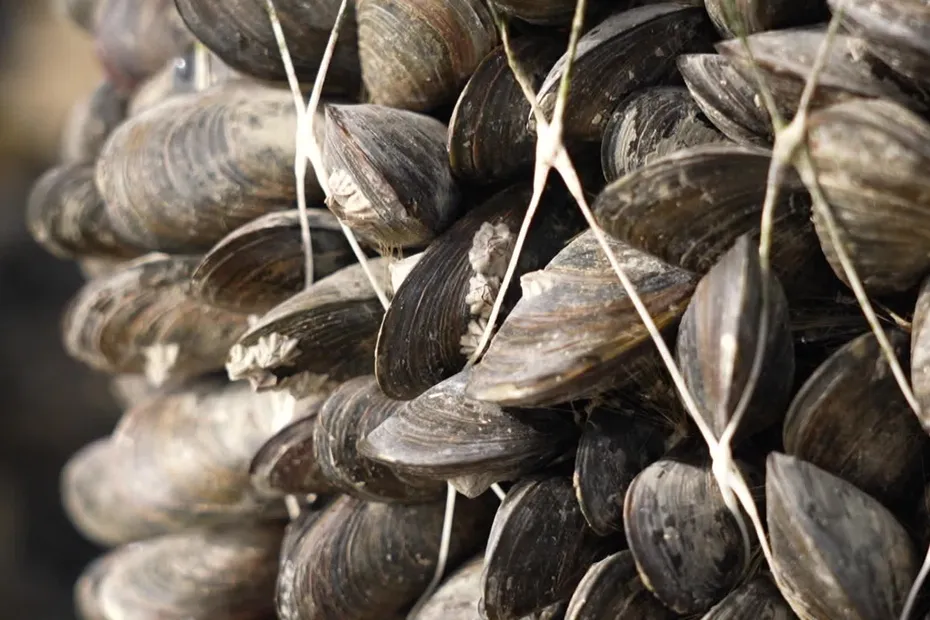
For the moment, these biodegradable nets are installed at two mussel farmers who volunteered to test them. In Bricqueville, in the English Channel, Vincent Onfroy placed these nets on the bouchots where he raises his mussels. « For the moment the net keeps its promises in terms of resistance and biodegradability, » he assures. For the mysticulturist, the real test will take place over time.
source : franceinfo