MAINTENANCE. While a global treaty is being negotiated, François Galgani, a pioneer in the fight against plastics at sea, warns of the extent of ocean pollution while believing that concrete solutions exist.
There was a time, in the 1990s, when François Galgani was an original, because he worked on the pollution of the oceans by plastics. The subject was then confidential. If he became a global cause, it is largely thanks to this Frenchman. Scientist at Ifremer for almost 40 years, now president of the Échos d’Océans association and editor-in-chief of the journal Marine Pollution Bulletin, he has coordinated many expert groups for the United Nations and the European Commission.
Le Point met him in early May aboard the Commander Charcot, of the company Le Ponant (owned, like Le Point, of the Artemis group). With icebreaker capability, Commander Charcot is the only cruise ship capable of reaching the North Pole and touring Antarctica.
It allows scientists to collect data in the least accessible seas on the planet, to draw up a broader inventory of plastic pollution. The latter are a global problem that will not be resolved overnight. François Galgani is nevertheless reasonably optimistic. Awareness has taken place and there are ways to act.
Le Point: Where are we regarding the pollution of the oceans by plastics?
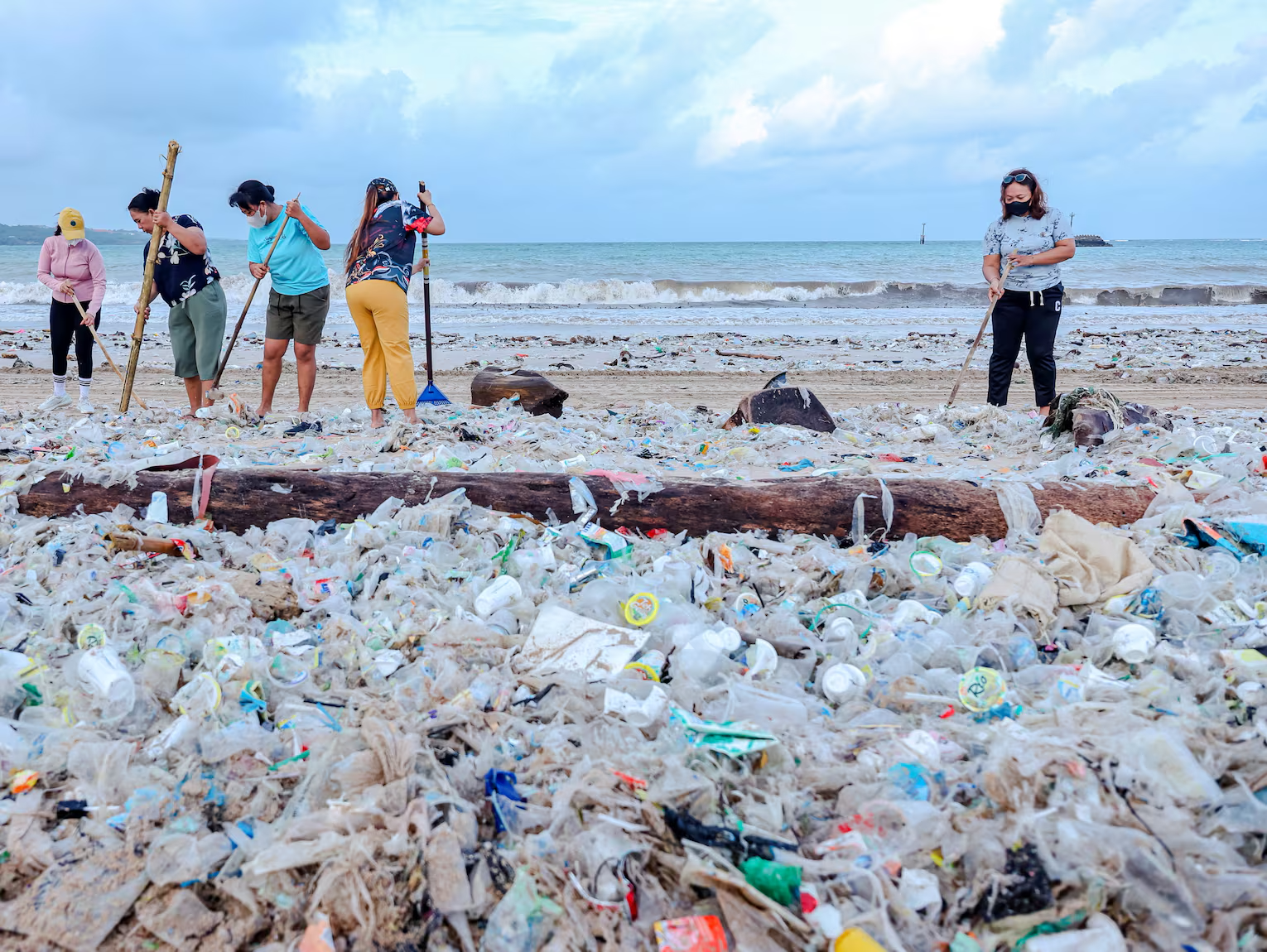
François Galgani: We have an estimate, which is starting to date a little, of eight million tons of plastics released into the sea each year, with large disparities. Southeast Asia produces almost as many plastics as Europe and it retires almost nothing. In this region of the world, but also in Africa, I have seen areas covered with plastic waste in phenomenal quantities. In Lebanon, we evacuate wild landfills at sea, with bulldozers…
What happens to all this waste?
Some disintegrate under the effect of the sun and bacteria. Macro-waste becomes microplastics, which then becomes nanoplastics. They travel very long distances, and they are at the center of the « gyres » – or convergence zones – these vast whirlpools created by ocean currents. This is where the plastic continents are located, an expression that is not to be taken literally, in the sense that we would see these continents. It means that plastic densities are important in these gyres, but not as important as in the Bay of Bengal or certain areas of the Mediterranean.
Finally, some of the waste is heavier and sinks. In the Mediterranean, at 2,200 m, the ocean floor is most often soiled off the coast of large metropolises. Ifremer’s submarine pilots even know how to spot the bottom of canyons by the presence of waste. At these depths, there are still remains of brands that have now disappeared for several dozen years, because waste is degrading very slowly, due to lack of light and enough oxygen.
A plastic bottle may have the value of an amphora in 500 years, which is nothing more than a bottle, but for the moment it remains a problem. The ocean, in short, gives a good picture of the pollution that comes from the earth. In the case of Europe, the choice of measures taken by the Commission to ban single-use plastics, such as packaging bags or cutlery, is derived from the data collected at sea by the Member States.
The generalization of biodegradable plastics will take time. There are other avenues of work.
How to act?
One of the problems of plastic pollution is that there are as many sources as humans on Earth. We all use plastics. 430 million tons are produced per year, with polymers used from packaging bags to prostheses, fishing gear, and even composites, including in the most demanding sectors, such as the aeronautical sector. Fishing suffers from this pollution, but it also generates significant quantities.
We must be realistic, we will not do without plastic entirely, because it is inexpensive and very useful. Moreover, we will never control everything. The 2011 tsunami in Japan released millions of tons of waste into the sea, an amount of the same order of magnitude as an average year of plastic inputs into the oceans. Occasionally, however, the problem can be dealt with. About thirty years ago, we used about 30 billion cash bags per year in France. That’s about one million per hour! Large-scale distribution alone fell from 15 to one billion, a reduction of more than 95%.

Orange camemberts represent the production of plastics, and the red share the proportion that is not taken care of and disperses in the environment. This share is residual in the United States and Europe, but it is very important in Asia, with the exception of South Korea, Taiwan and Japan.DR.
Is it possible to go beyond?
Regarding bags, yes, but it will be difficult, because those still distributed concern small shops, pharmacies, where it is very difficult to imagine replacing disposable bags with tote bags. As for biodegradable plastics, their generalization will take time. There are other avenues of work.
For example?
Currently, a thousand containers are lost at sea each year, and they often contain plastic transported in granules. A single 25 kg bag carries six million pellets and their losses are a high environmental cost. However, shipowners prefer to put them on top of the batteries on the containers, because they have relatively less economic value.
They are therefore the first lost, sometimes causing pellet tides on our beaches. There is also the issue of washing machines. A washing machine cycle releases up to tens of thousands of fibers, which go into continental waters before the sea.
If the anti-pillage law (AGEC, article 79) of 2020 provided for a filter on new washing machines from the beginning of 2025, the decree has fallen behind. The point to remember is that international regulations give results. Pollution from hydrocarbons has decreased a lot. We went from three million tonnes of discharge per year worldwide in the 1980s to 200,000 liters today.
Sead tides mark minds, but in reality they represent less than 5% of what is poured into the sea each year.
Thanks to the scracity of oil spills?
Rather by working on diffuse discharges from ships and those coming from the land. A river like the Seine carries large amounts of hydrocarbons to the sea. Sill spills mark the spirits, but in reality they represent less than 5% of what is poured into the sea each year. They are not the most worrying from an environmental point of view.
They mainly have social and economic consequences, through their impact on tourism, marine farming or fishing. Ecosystems recover in a few years. Will we be able to aim for zero discharge one day, no, if only because there are natural contributions, for example in the Gulf of Guinea, but we have progressed and we can also progress with regard to plastics, with better management of production, uses and treatment.
What is the impact of these plastics on marine life?
They kill by ingestion and strangulation. On the sidelines, they also benefit certain species, which travel by staring at them, or which make their nest, such as Bassan fools, horny cormorants or California opper eagles. These birds collect pieces of fishing nets and often spectacle stems.
Physiologically, the microplastics ingested by wildlife are too large to pass the intestinal barrier. They are excreted. With regard to nanoparticles, there are uncertainties, research is underway to evaluate their impact. They are found absolutely everywhere, even in Antarctica, where they are brought mainly by the winds.
The situation is serious. Is she desperate?
No. An international treaty on plastic pollution has been in negotiations since 2022. The EU has allocated four billion euros to plastics research following the 2008 « Marine Strategy » framework directive. Many laboratories are working on plastics that are easier to recycle. We even have ongoing research on enzymes that depolymerise plastics by capturing CO2, which would make two birds with one stone. We can be reasonably optimistic.
source : le point